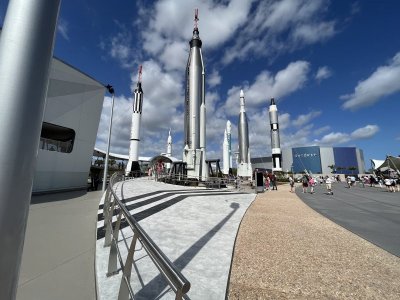
NASA rolls Artemis 2 rocket out to launch pad for trip to the moon.

WhatInThe

SF VIP
NASA has rolled out the Artemis 2 rocket to the launch pad at Cape Canaveral Florida for the first manned trip to the moon in decades. They won't actually go into moon orbit but go around/sling shot back to earth. They don't want to deal with the possibility of getting stuck in lunar orbit.

Dry run on Feb 2 and launch date set for Feb 6

NASA rolls Artemis 2 rocket to the pad ahead of historic moon launch
 
Cool! We're finally getting back to the moon! Let's just hope they don't screw it up. Here are the manufacturers of the rocket...

Key Manufacturers of the Artemis II Rocket
The SLS is a "mega-rocket" built by a coalition of major aerospace contractors for NASA:
  • Boeing: Built the 212-foot-tall Core Stage, which is the orange backbone of the rocket.
  • Northrop Grumman: Manufactured the twin Solid Rocket Boosters that provide 75% of the thrust during liftoff.
  • Aerojet Rocketdyne: Provided the four RS-25 engines at the base of the core stage.
  • United Launch Alliance (ULA): Built the Interim Cryogenic Propulsion Stage (ICPS), which provides the final push to the Moon.
 
I'm really looking forward to watching it from my yard. In December, I came across a NASA website that you could register to have your name on a disc that will be going on the flight. I signed up my two great-granddaughters and they were very excited, especially the 6-year-old who really, really, really wants to be an astronaut. I could print up the "boarding passes" and all the info on the astronauts and presented them to them for Christmas.

What a great idea to get people interested in the launches.
 
What I find incredible is that NASA’s Space Launch System (SLS) produces 8.8 million pounds of thrust. I would imagine that with this much thrust the ground would shake miles away. Compare that with a Boeing 747 that produces just over 200,000 pounds of thrust total from its 4 engines.

Kudos to all of our Propulsion Engineers.
 
What I find incredible is that NASA’s Space Launch System (SLS) produces 8.8 million pounds of thrust. I would imagine that with this much thrust the ground would shake miles away. Compare that with a Boeing 747 that produces just over 200,000 pounds of thrust total from its 4 engines.

Kudos to all of our Propulsion Engineers.
Starship’s first stage produces nearly 17 million pounds of thrust.
 
I have been fortunate enough to fly well past Cape Canaveral on occasions to be able to watch rockets on their climb out as they prepare to reach outer space. It’s a beautiful sight.

1768859520072.jpeg
 
This beckons memories of the grade school days when we got our Weekly Reader in class and read about John Glenn, about things learned as we ventured into space, and the drama of that first man to set foot on the moon. It is even interesting to listen to the ranting of the non-believers who say it was all a hoax. Such is life.
 
NASA's Universal Waste Management System (UWMS), a high-tech, titanium space toilet developed for deep-space missions like Artemis II. It is one of the most expensive commodes ever built, second only to the system on the 1992 Space Shuttle Endeavour, which cost roughly $30 million.

Key Features and Purpose
  • Microgravity Operation: Because nothing "just flushes" in space, the system uses a 3D-printed titanium dual fan separator to create powerful airflow and suction to pull waste away from the body.
  • Inclusive Design: It was specifically designed with input from female astronauts to be more ergonomic and to allow the simultaneous use of both liquid and solid waste collection.
  • Compact and Efficient: It is approximately 65% smaller and 40% lighter than the previous toilets used on the International Space Station (ISS).
  • Water Recycling: It is designed to recycle urine into drinkable water, a critical capability for long-duration missions to the Moon and eventually Mars.
The $23 million Universal Waste Management System (UWMS) was manufactured by Collins Aerospace, a subsidiary of RTX (formerly Raytheon Technologies).

For the 2025 fiscal year, RTX Chairman and CEO Christopher T. Calio received a base salary of $1.53 million. His total compensation for the year was approximately $24.85 million, reflecting a 38% increase from 2024.
 
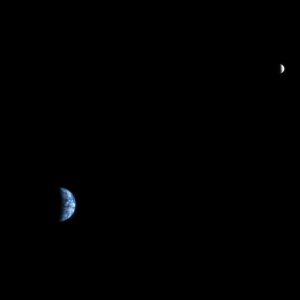
Earth and Moon from Mars

The HiRISE instrument would make a great backyard telescope for viewing Mars, and we can also use it at Mars to view other planets, such as Jupiter. This is an image of Earth and the Moon, acquired at 5:20 a.m. MST on 3 October 2007, at a range of 142 million kilometers, which gives the HiRISE image a scale of 142 km/pixel and an Earth diameter of about 90 pixels and a Moon diameter of 24 pixels. The phase angle is 98 degrees, which means that less than half of the disks of the Earth and Moon have direct illumination. We could image Earth/Moon at full disk illumination only when they are on the opposite side of the sun from Mars, but then the range would be much greater and the image would show less detail.

On the day this image was taken, the Japanese Kayuga (Selene) spacecraft was en route from the Earth to the Moon, and has since returned spectacular images and movies. On the Earth image we can make out the west coast outline of South America at lower right, although the clouds are the dominant features. These clouds are so bright, compared with the Moon, that they are saturated in the HiRISE images. In fact, the RED-filter image was almost completely saturated, the blue-green image had significant saturation, and the brightest clouds were saturated in the IR image. This color image required a fair amount of processing to make a nice-looking release. The Moon image is unsaturated but brightened relative to Earth for this composite. The lunar images are useful for calibration of the camera.

Image: NASA/JPL/University of Arizona [high-resolution]

Caption:
Alfred McEwen and Eric Eliason
Picture1.jpg
 
Back
Top