
David777
Well-known Member
- Location
- Silicon Valley
As the COVID-19 pandemic wanes, there are now many current news reports on the rise of head colds, RSV, and influenza. And the latter has been killing many of we seniors for decades, often causing rise to lethal bacterial pneumonias. Understanding the relationship of temperature of one's upper respiratory tract in below two news articles can lead to becoming less susceptible to coming down with these viral diseases. Something I've been very successful at as an adult over decades despite during winters working in large labs and open offices with dozens to hundreds of other workers, many that go to work despite being sick, sneezing and coughing virus into room air.
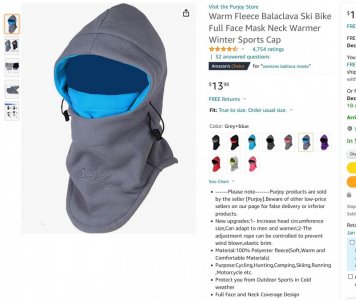
What we have all learned during the COVID-19 pandemic is a good N95 mask that fits well can protect a person in such environments, not only from COVID but also other respiratory viruses. That is why this person is now wearing an N95 mask to supermarkets. The other is that it is important to keep one's head warm overnight after days where one has been in rooms where others are so sick. It is that incubation period when one cannot easily tell a virus may be growing that such can actually be knocked out by keeping one's head and throat warm with head gear like a warm balaclava. For years, I've actually owned a down balaclava for that very purpose.
Why Upper Respiratory Infections Are More Common in Colder Temperatures
https://hms.harvard.edu/news/why-upper-respiratory-infections-are-more-common-colder-temperatures
They found that each virus triggered an EV swarm response from nasal cells, albeit using a signaling pathway different from the one used to fight off bacteria. The researchers also discovered a mechanism at play in the response against the viruses. Upon their release, the EVs acted as decoys, carrying receptors that the virus would bind to instead of nasal cells.
“The more decoys, the more the EVs can mop up the viruses in the mucus before the viruses have a chance to bind to the nasal cells, which suppresses the infection,” said Huang, who is also a research fellow at Northeastern.
The researchers then tested how colder temperatures affected this response, which is especially relevant in nasal immunity given that the internal temperature of the nose is highly dependent on the temperature of the outside air that is inhaled through it. They took healthy volunteers from a room temperature environment (about 74 F) and exposed them to 39.9 F temperatures for 15 minutes and found that the temperature inside the nose fell by about 9 F. They then applied this reduction in temperature to the nasal tissue samples and observed a blunted immune response. The quantity of EVs secreted by the nasal cells decreased by nearly 42 percent and the antiviral proteins in the EVs were also impaired.
From 2016:
https://www.medicaldaily.com/body-heat-kill-viral-infections-common-cold-391713
The researchers from Yale infected airway cells with a rhinovirus in their lab, and kept some at a normal body temperature (98 degrees Fahrenheit) and others just below it (91.4 degrees). Whether it’s cold or hot, infected cells tend to make little interferons, Tech Times reported — but in the two temperature groups, the virus persisted. In fact, the cells in below-average temps replicated immediately, while the cells in the normal temps died off much quicker and were not able to replicate as quickly.
That’s not all. Researchers used mathematical modeling and genetic approaches to better understand the underlying ways in which a virus grows. The found that not only does the warm temperature kill the infection off faster, but it maximizes the effect of an enzyme, called RNAseL, in the double-stranded RNA. The enzyme is part of the interferon response, and eventually helps to eliminate it. Taken altogether, these findings show that even in the absence of interferons, warm temperatures have profound effects on the body’s antiviral response and the outcomes of the common cold, the researchers wrote.
What we have all learned during the COVID-19 pandemic is a good N95 mask that fits well can protect a person in such environments, not only from COVID but also other respiratory viruses. That is why this person is now wearing an N95 mask to supermarkets. The other is that it is important to keep one's head warm overnight after days where one has been in rooms where others are so sick. It is that incubation period when one cannot easily tell a virus may be growing that such can actually be knocked out by keeping one's head and throat warm with head gear like a warm balaclava. For years, I've actually owned a down balaclava for that very purpose.
Why Upper Respiratory Infections Are More Common in Colder Temperatures
https://hms.harvard.edu/news/why-upper-respiratory-infections-are-more-common-colder-temperatures
They found that each virus triggered an EV swarm response from nasal cells, albeit using a signaling pathway different from the one used to fight off bacteria. The researchers also discovered a mechanism at play in the response against the viruses. Upon their release, the EVs acted as decoys, carrying receptors that the virus would bind to instead of nasal cells.
“The more decoys, the more the EVs can mop up the viruses in the mucus before the viruses have a chance to bind to the nasal cells, which suppresses the infection,” said Huang, who is also a research fellow at Northeastern.
The researchers then tested how colder temperatures affected this response, which is especially relevant in nasal immunity given that the internal temperature of the nose is highly dependent on the temperature of the outside air that is inhaled through it. They took healthy volunteers from a room temperature environment (about 74 F) and exposed them to 39.9 F temperatures for 15 minutes and found that the temperature inside the nose fell by about 9 F. They then applied this reduction in temperature to the nasal tissue samples and observed a blunted immune response. The quantity of EVs secreted by the nasal cells decreased by nearly 42 percent and the antiviral proteins in the EVs were also impaired.
From 2016:
https://www.medicaldaily.com/body-heat-kill-viral-infections-common-cold-391713
The researchers from Yale infected airway cells with a rhinovirus in their lab, and kept some at a normal body temperature (98 degrees Fahrenheit) and others just below it (91.4 degrees). Whether it’s cold or hot, infected cells tend to make little interferons, Tech Times reported — but in the two temperature groups, the virus persisted. In fact, the cells in below-average temps replicated immediately, while the cells in the normal temps died off much quicker and were not able to replicate as quickly.
That’s not all. Researchers used mathematical modeling and genetic approaches to better understand the underlying ways in which a virus grows. The found that not only does the warm temperature kill the infection off faster, but it maximizes the effect of an enzyme, called RNAseL, in the double-stranded RNA. The enzyme is part of the interferon response, and eventually helps to eliminate it. Taken altogether, these findings show that even in the absence of interferons, warm temperatures have profound effects on the body’s antiviral response and the outcomes of the common cold, the researchers wrote.