The cost of retirement keeps climbing

bobcat

Well-known Member
Location
Northern Calif
According to a recent survey by Clever Real Estate involving 1000 retirees, they claim a new retiree needs, on average, $823,800 in savings and investments to retire comfortably in 2026. That’s a significant increase from the $580,310 figure they estimated for last year. That's almost a $250,000 jump from the previous year. That's crazy. I can see some inflation and fallout from tariffs, but this can't be the new normal. Many retirees would be lucky to have a quarter of that.

I don't know what a comfortable retirement looks like with this picture, but it's quite a stretch from what I imagined. I really think it depends on what one's expectations and habits are, and where they live. Maybe I'm being naive.
 
We all have different needs, different resources, different support networks, and different numbers.

Some people lucky enough to have a traditional pension and a social security don’t need a dime to live comfortably.

Some people have only social security but qualify for a variety of supplemental programs.

None of us need to worry about anything other than our own personal retirement situation, the rest is just noise.

“Do what you can, with what you have, where you are.” - Theodore Roosevelt
 
According to a recent survey by Clever Real Estate involving 1000 retirees, they claim a new retiree needs, on average, $823,800 in savings and investments to retire comfortably in 2026. That’s a significant increase from the $580,310 figure they estimated for last year. That's almost a $250,000 jump from the previous year. That's crazy. I can see some inflation and fallout from tariffs, but this can't be the new normal. Many retirees would be lucky to have a quarter of that.

I don't know what a comfortable retirement looks like with this picture, but it's quite a stretch from what I imagined. I really think it depends on what one's expectations and habits are, and where they live. Maybe I'm being naive.
800.000 / 30.000 = 27 years if you get nothing else.
'Comfortable', that word irritates me.
 
According to a recent survey by Clever Real Estate involving 1000 retirees, they claim a new retiree needs, on average, $823,800 in savings and investments to retire comfortably in 2026. That’s a significant increase from the $580,310 figure they estimated for last year. That's almost a $250,000 jump from the previous year. That's crazy. I can see some inflation and fallout from tariffs, but this can't be the new normal. Many retirees would be lucky to have a quarter of that.

I don't know what a comfortable retirement looks like with this picture, but it's quite a stretch from what I imagined. I really think it depends on what one's expectations and habits are, and where they live. Maybe I'm being naive.
there's no way in hell i'll ever have that kind of money even with my 401k. so i'll hafta work til i can't anymore.
 
there's no way in hell i'll ever have that kind of money even with my 401k. so i'll hafta work til i can't anymore.
Well, personally I think there are at least three major variables (Perhaps more) that can really skew the numbers. One is whether you have a significant mortgage amount on your home, another is lifestyle, and the third might be medical expenses.

Anyway, I guess I was mostly shocked by the increase in one year. There must be some fuzzy math or logic at work. IDK
 
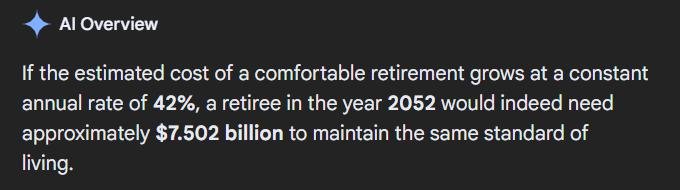
The increase in the amount needed to retire comfortably for the one year period referenced in the OP is 42%.

If you assume that the same increase of 42% annually continued for the next 27 years, below you can see how much will be needed to retire "comfortably" in the year 2052.

27years.jpg
 
The increase in the amount needed to retire comfortably for the one year period referenced in the OP is 42%.

If you assume that the same increase of 42% annually continued for the next 27 years, below you can see how much will be needed to retire "comfortably" in the year 2052.

View attachment 496004
Oh, no problem. I'll get right on it.
 
The increase in the amount needed to retire comfortably for the one year period referenced in the OP is 42%.

If you assume that the same increase of 42% annually continued for the next 27 years, below you can see how much will be needed to retire "comfortably" in the year 2052.

View attachment 496004
Ha ha ..... that would be something. I actually think the figure was more of a reassessment than a growth rate. I think it was re-estimating how much a retiree today would need for the next 30 years or so. It's about $27,000 a year, but still, it seems a bit much to me. IDK
 
Truth is, married couples living on dual SS incomes should consider what their finances will be in the very likely event that one spouse predeceases the other. The lesser SS check will be immediately gone. Even worse, there'll be a government clawback of the previous month's SS payment because SS is issued in advance, not arrears.

I don't ever look to DH & my financial future as including both of our SS checks. Only DH's (the larger of the two).
I learned a long time ago to hope for the best but plan for the worst.
 
Truth is, married couples living on dual SS incomes should consider what their finances will be in the very likely event that one spouse predeceases the other.
And that's exactly what happens to us. We did the best we could to plan for that possibility in advance so that either could make it without the other.

I was listening to a TV financial program just yesterday and the speaker said when a couple retires, if one dies, there is a 50% chance that the surviving spouse will live to age 92.

On top of that is the grim prospect of what will happen to SS benefits in 8 years (from right now).
 
I was reading an article about this and other retirement issues yesterday. Part of it was about the housing market being so tight partially because too many seniors are not downsizing out of their big homes into something smaller. But like the article pointed out, the reason is not always stubbornness--although in my Huzz's case it is--but even though they sell the house for a considerable amount of money, there's not always anywhere suitable to move to. Smaller houses or condos or apartments that they can afford are too far away from the services they need and want.

Also they might be moving away from neighbors and sometimes family. And unless they live in a mansion, no matter how much they sell their large family home for, it's still not enough to afford most fancy senior communities for very long.

It's become a real issue, I think.
 
Everyone missed the boat on this. The increase in the amount "BELIEVED" was needed......The OP did not accurately quote.
Yes, just to clarify. There isn't any actual amount that holds true for every retiree, since everyone's situation is rather unique. These numbers were just what those surveyed believed would be needed to sustain an approximate 30 year lifespan in retirement. I guess the shocking thing to me was the spike in the re-assessment. What would have changed in a year to warrant that much of a difference?

This isn't the original article I read (Although I could find it, I think), but it is another one with a separate survey, and in this one the amount believed would be needed is even higher, but the re-assessment increase is pretty close to the same. Again, they are just ballpark estimates.

MSN
 
I was reading an article about this and other retirement issues yesterday. Part of it was about the housing market being so tight partially because too many seniors are not downsizing out of their big homes into something smaller. But like the article pointed out, the reason is not always stubbornness--although in my Huzz's case it is--but even though they sell the house for a considerable amount of money, there's not always anywhere suitable to move to. Smaller houses or condos or apartments that they can afford are too far away from the services they need and want.

Also they might be moving away from neighbors and sometimes family. And unless they live in a mansion, no matter how much they sell their large family home for, it's still not enough to afford most fancy senior communities for very long.

It's become a real issue, I think.
Same here. They want to downsize, but there is nothing else. So as a solution they split up their house and give half to their kid(s).

Carien en Teun delen hun huis in Lent

Carien and Teun share their house in Lent

Suddenly a home suitable for all stages of life, without us having thought of it
Twenty years ago, Carien (63) and Teun (60) moved into their corner house in Lent, together with their two daughters. The children have since left home, but the house remained the same: spacious, in a nice location…

And, to be honest, quite large for two people. ‘We talked about it often: our house is actually very suitable for sharing. But we were thinking more about later. When we are really old. But now we suddenly knew: this is the moment.’

From family home to house to share

The real trigger came when youngest daughter Cris (25) had to leave her home. Her temporary rental contract was not renewed, and she was suddenly out on the street. Moreover, she was paying a considerable amount for a room with a shared kitchen, shower, and toilet. ‘That wouldn't get any better in this hopeless housing market,’ says Carien. ‘Then we thought: why doesn't she just come and live upstairs with us?’ They did not want to return to the family structure of the past.

‘That was immediately clear to all of us; we value our own lives and really wanted to create two independent living units.’ And so they got to work: they created a living room in the attic and an extra kitchenette in the landing next to it, and installed a connecting door in the hall downstairs to split the house.

Daughter number two follows
As if it were meant to be, their eldest daughter Margot (29) also indicated that she would like to live in Lent again. She lives in a small studio in Utrecht, with rent that swallows up more than half of her income, and she sees no chance of finding something better anytime soon. Renting or buying a nice home is unfeasible. And above all, unaffordable.

So soon both daughters will be living in the ‘upstairs house’. Carien and Teun live downstairs – with their own entrance via the garden. Officially, it has simply remained one address. ‘We have a corner house, so we have space all around,’ says Teun. ‘Fortunately, we had already converted our garage into a multifunctional space with a shower and toilet.’ Carien had her studio there – and the space was also suitable for one of our parents, should that ever be necessary.’

Practical and future-oriented

‘My studio is now at the back of the garden and we sleep in the former garage,’ says Carien. ‘That does mean, however, that we no longer have a workspace in the house, or a space to retreat to for a while. That is why we have applied for a permit for an extension, where we plan to create our bedroom. And then our house will suddenly be suitable for all stages of life – without us having planned it that way beforehand.’

 
Last edited:
Well, I may as well dig out my grave, put a tent over it and save what I pay in housing to pay for bare
minimums and save on the cost of burial.
Joking aside:
Reports like this just suck the life out of people who live by numbers and can't achieve that number goal they quote.
Just do the best you can, even though costs do rise, I can't remember a year they decreased, I find I can live on less
than I needed 10 years ago. I also find I don't miss the things I thought I needed back then.
 
Well, I may as well dig out my grave, put a tent over it and save what I pay in housing to pay for bare
minimums and save on the cost of burial.
Joking aside:
Reports like this just suck the life out of people who live by numbers and can't achieve that number goal they quote.
Just do the best you can, even though costs do rise, I can't remember a year they decreased, I find I can live on less
than I needed 10 years ago. I also find I don't miss the things I thought I needed back then.
Yes, I think you are correct. A person who enjoys the simple life and is moderately frugal can live on a fraction of what is quoted. I think some of these averages are possibly figuring in going out to dinner twice a week, and doing some traveling, etc.... Granted, for a homeowner, some major expenses do come along (New roof, repairs, new AC unit, or newer vehicle), but I still think that one can come in far below what is imagined.
 
Everyone missed the boat on this. The increase in the amount "BELIEVED" was needed......The OP did not accurately quote.
I had no opinion on how much is needed. I just took the OP at face value and had AI calculate the amount needed if the base starting figure in 2025 is $580,310 and it increased year over year by 42%.
 
I Googled the discussed article yesterday and read it fully.
2026 Retirement Statistics: Average Savings Fall $500,000 Short of What Retirees Say They Need | Clever Real Estate

I agree the $823K retirement savings figure is likely more than what most Americans will need if they don't live in high cost of living areas. What caught my interest was the underlying pessimism in the survey responses.

It seems many who were surveyed are already being caught financially short:
14% have avoided medical appointments or treatments, or skipped meals to preserve their savings.
Half aren't confident they'll be able to sustain their current quality of life for the rest of their lives and struggle to pay some of their current expenses. Almost a quarter aren't confident about it for the next year. o_O

The surveyed group had retired an average of 11 years earlier, presumably secure in the belief that they'd adequately prepared financially.

The responses showed high levels of eroded confidence in Social Security's future disbursements, the economy's stability, and their own ability to manage with the funds that will be available to them.

I did a little additional research and saw that the typical US household in the 65-74 age range has about $200K in savngs. Seems most financial planners recommend retiring with 10 ten times your annual income.

US median household income in 2024 was $83,730, thus $837,300 in recommended retirement assets.
The 'magic number' for a comfortable retirement just got bigger
 
The notion of 10x gross annual salary in savings is a great goal but it only tells part of the story.

The amount is meaningless unless you are able to balance your expenses against the earnings of your nest egg while still maintaining a surplus that helps keep you in step with cost increases due to inflation.

It seems like there is all sorts of conventional wisdom and solid advice to help the average person during the accumulation phase but little information and guidance about actually turning those savings and investments into a sustainable retirement income that takes inflation over a thirty year period into account.
 
Well, personally I think there are at least three major variables (Perhaps more) that can really skew the numbers. One is whether you have a significant mortgage amount on your home, another is lifestyle, and the third might be medical expenses.

Anyway, I guess I was mostly shocked by the increase in one year. There must be some fuzzy math or logic at work. IDK
I don't have a mortgage and I don't have the money to have a lifestyle. I never had enough income to save for retirement. The only jobs I'm qualified for is low paying ones. I will likely end up a ward of the state when I can no longer work. In my lifetime if I had saved up for retirement I never would've come close to having this kind of money.
 
I Googled the discussed article yesterday and read it fully.
2026 Retirement Statistics: Average Savings Fall $500,000 Short of What Retirees Say They Need | Clever Real Estate

I agree the $823K retirement savings figure is likely more than what most Americans will need if they don't live in high cost of living areas. What caught my interest was the underlying pessimism in the survey responses.

It seems many who were surveyed are already being caught financially short:
14% have avoided medical appointments or treatments, or skipped meals to preserve their savings.
Half aren't confident they'll be able to sustain their current quality of life for the rest of their lives and struggle to pay some of their current expenses. Almost a quarter aren't confident about it for the next year. o_O

The surveyed group had retired an average of 11 years earlier, presumably secure in the belief that they'd adequately prepared financially.

The responses showed high levels of eroded confidence in Social Security's future disbursements, the economy's stability, and their own ability to manage with the funds that will be available to them.

I did a little additional research and saw that the typical US household in the 65-74 age range has about $200K in savngs. Seems most financial planners recommend retiring with 10 ten times your annual income.

US median household income in 2024 was $83,730, thus $837,300 in recommended retirement assets.
The 'magic number' for a comfortable retirement just got bigger
Well, here is another twist. According to Elon Musk, once robots and AI are making everything 24/7, the cost of everything will plummet and money will become irrelevant (According to him). Now if the cost of retirement is rapidly escalating, that tells me these two camps aren't talking to each other or there is a lot of miscalculation going on. Robotics companies are betting hundreds of billions on the future, so it can't be all just BS.
 
Back
Top