


AnnieA
Well-known Member
- Location
- Down South
A Gulfport Covid-19 unit nurse died this week.  She was hospitalized for 72 days and died in the unit in which she had previously worked.
She didn't go to the hospital until she got short of breath at which point her O2 sats were 63%. By that point she had significant lung damage from silent hypoxia.
WHY isn't there a massive public health campaign educating people to purchase a less than $20.00 pulse oximeter to monitor oxygen saturation if they are positive or presumed positive? I can see no downside at all in advising people to do this.
Doctors have known of the dangers of Covid's unique asymptomatic "silent hypoxia" since the spring and more and more data is coming in showing the dangers. Usually, as O2 sats drop, people feel short of breath. With Covid, this is often not happening and "silent hypoxia" is masking lung damage that's occurring before symptoms. When people finally do feel short of breath, lung damage has already occurred to the extent that it's often too late in the long run.
https://www.sunherald.com/news/coronavirus/article247129151.html
Excerpt: "A week after she first got sick, McRae was having trouble breathing. A monitor showed her oxygen saturation at only 63%."
A preprint study from the UK last week shows that:
https://www.medrxiv.org/content/10.1101/2020.11.06.20225938v1.full
"Initial oxygen saturation measurements (on air) for confirmed COVID-19 patients conveyed by ambulance correlated with short-term (30-day) patient mortality or ICU admission... We found that even small deflections in oxygen saturations of 1-2% below 96% confer an increased mortality risk in those with confirmed COVID."
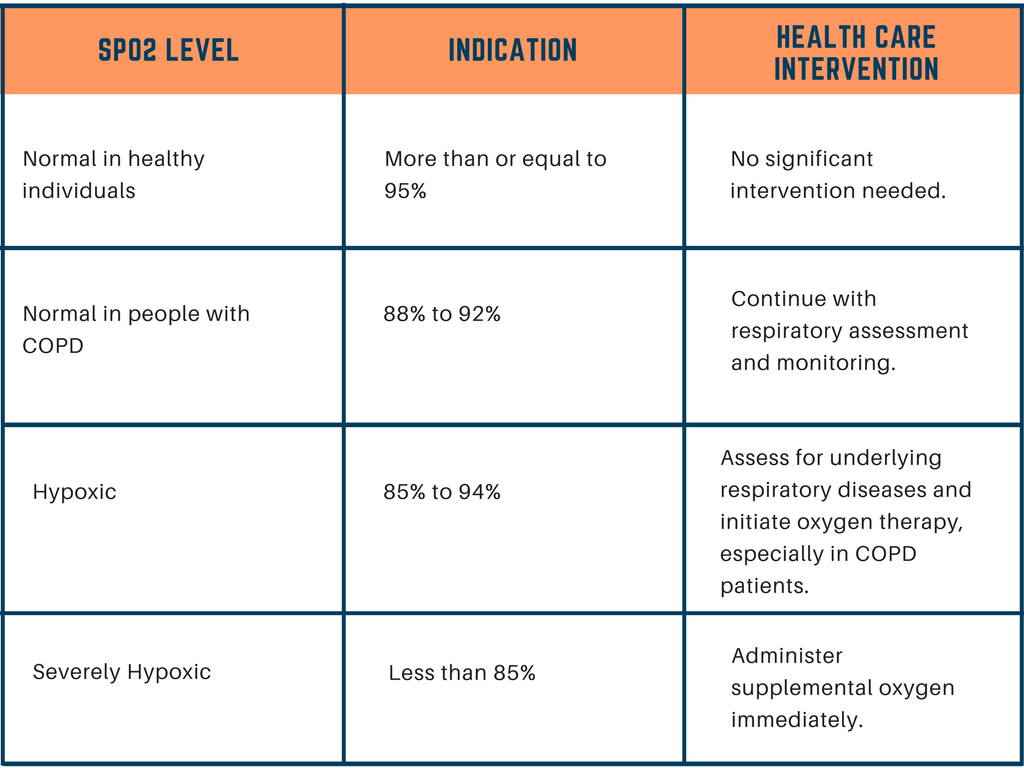
Here's an O2 sat chart:
She was hospitalized for 72 days and died in the unit in which she had previously worked.She didn't go to the hospital until she got short of breath at which point her O2 sats were 63%. By that point she had significant lung damage from silent hypoxia.
WHY isn't there a massive public health campaign educating people to purchase a less than $20.00 pulse oximeter to monitor oxygen saturation if they are positive or presumed positive? I can see no downside at all in advising people to do this.
Doctors have known of the dangers of Covid's unique asymptomatic "silent hypoxia" since the spring and more and more data is coming in showing the dangers. Usually, as O2 sats drop, people feel short of breath. With Covid, this is often not happening and "silent hypoxia" is masking lung damage that's occurring before symptoms. When people finally do feel short of breath, lung damage has already occurred to the extent that it's often too late in the long run.
https://www.sunherald.com/news/coronavirus/article247129151.html
Excerpt: "A week after she first got sick, McRae was having trouble breathing. A monitor showed her oxygen saturation at only 63%."
A preprint study from the UK last week shows that:
https://www.medrxiv.org/content/10.1101/2020.11.06.20225938v1.full
"Initial oxygen saturation measurements (on air) for confirmed COVID-19 patients conveyed by ambulance correlated with short-term (30-day) patient mortality or ICU admission... We found that even small deflections in oxygen saturations of 1-2% below 96% confer an increased mortality risk in those with confirmed COVID."
Here's an O2 sat chart:
Last edited:


