Historical perspective on attitudes concerning death and dying.

Mr. Ed

Be what you is not what you what you ain’t
Location
Central NY
I am fascinated about all aspects of the human condition, including death. Questions like why people behave the way they do? Views on death and/or the afterlife? What is the purpose of religion? What is sin? Is immorality a sin? Why?

After death, do we go to the place we conceive as the afterlife? Christians go to their understanding of heaven,

Atheism​

Atheist views on life after death vary depending on individual beliefs. Some Atheists don’t believe in any sort of life after death, but others believe in the existence of spirits, afterlife, or reincarnation.


Buddhism​

Buddhists believe in reincarnation, the cycle of death and rebirth. Since Buddhists don’t believe in the existence of souls, reincarnation means taking on another body in their next life. Bardo, the intermediate state, is the time between death and rebirth where Buddhists experience different phenomena.
However, being in this reincarnation cycle is considered a suffering experience, and the goal is to escape this cycle by reaching Nirvana. Nirvana is seen as an end to suffering and to some as a heavenly paradise.

Christianity​

Christian belief in the afterlife depends on what denomination they’re a part of, but most believe in the resurrection of Jesus, the existence of the afterlife, and that moral choices you make on Earth affect whether you end up in Heaven or Hell. Catholic Christians believe in Purgatory, a place where the dead destined for Heaven must first go if they need purification for their sins.


Hinduism​

Hindus believe in reincarnation after death and that the atman, or soul, receives a new body and life depending on Karma, or good and bad actions taken in their previous life. They believe you can be reincarnated as not only humans, but also animals, insects, and plants.
The goal is to be released from the reincarnation cycle and achieve Moksha, liberation from the cycle. After being freed of the cycle, it’s believed they return to be with Brahman.

Judaism​

Jewish afterlife beliefs depend on the individual’s beliefs. Jews focus more on their life on Earth, but most Jews believe there is an afterlife, but it can come in many forms. Some Jews believe in a reincarnation cycle, while others believe in the World to Come, a heaven-like paradise.


Islam​

Muslims believe that death is the end of physical life on Earth, but the soul lives on. The soul goes to the Angel of Death to wait for Judgment Day. On Judgment Day, their actions during their time on Earth will be judged to determine whether they go to Jannat, paradise, or Jahannam, Hell.

Spiritualism​

Spiritualists believe that the afterlife, or spirit world, is a realm where spirits continue to evolve. They believe souls live on and take their consciousness with them. They believe souls can interact with those living on Earth through mediums in the spirit world and physical world.
 

Attachments

  • Historical Perspectives on Attitudes concerning Death and Dying.pdf
    241 KB · Views: 0
You know, as I have gotten older I try to not think about it too much. When I was younger I used to dwell on the topic a lot and leaned towards a Spiritualism type of attitude but now I just live each day knowing that eventually I will find out (or not).
 
Because no one knows and if they did, their description would be their perspective, which may or may not be accurate for another person, so ultimately there is no way knowing until it's our turn to die.

Western society associates death with pain and agony, using the media as its source of information. Nowadays, according to movie themes, violence and sex are the king and queen of moviegoers interests. No wonder death is unsettling when views about death and dying are limited to graphic movie images of pain and agony.

There is truth in we are what we eat. An overwhelming interest in violence will predictably emit violent behavior.
 
Interesting topic Mr. Ed, thank you.

Here's what came to mind when I read the title - Do people as a whole have a different attitude on death when their country is being overrun during a war or when the atrocity of genocide takes place. Did people's mindset change during the time of major plagues, like the black death.
On an individual basis, how often does a person's mindset change when dealing with a long illness for which there is no cure.
 
Last edited:
I think the ideal of purgatory has fallen by the wayside especially for American Catholics. At least it has for me, I never really believed in it. I have no ideal which afterlife is correct or if there is a combination of the beliefs that is true.

I do know that if there is an afterlife, if there is, I want to be there for my children, as I have always been there for my children. If we “come back”, I want to be a man. To be totally honest, this life has pretty much been hell for me, I am ready for whatever life after death is or is not.
 
I'm interested in how mankind came to have any sort of religious belief. Why did they think some superior being existed and had control over their lives?
Archaeologists know that ancient man buried their dead with great reverence and included personal possessions in the grave. They seemed to think the dead person lived on in another world and would need food and drink on their journey to this after-life. Where did those ideas come from?
 
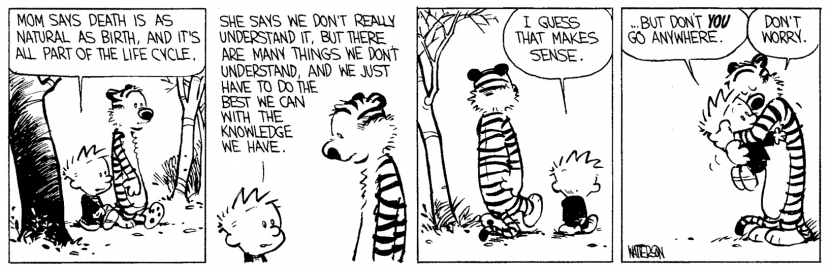
calvin-hobbes-death-meaning-830x271.png
 
In India, cows are considered "sacred" by the Hindu's....I doubt those people eat much beef. On the flip side, when I was in Thailand, dogs were considered a "reincarnation" of those who had been A$$holes in their previous life, and a good Thai considered it his "duty" to kick any dogs they came across.
There are some really strange "religious" beliefs among the various religions. My guess is that 98% of the "devout" will be quite surprised when they pass.
 
I think realizing that death is an unescapable fact, for billions no matter the religion there is comfort in believing there is something more once we die. No proof either way so debating what happens is of no use other than an exercize for the brain.

I don't fear death since I've lived a good life and understand there is an expiration coming. My only regret is marrying a woman younger than me since the acturial tables place me dying well ahead of my wife. Death has a period of grief & feeling of loss when a loved one dies. I would rather me experience that than my wife.
 
...in Thailand, dogs were considered a "reincarnation" of those who had been A$$holes in their previous life, and a good Thai considered it his "duty" to kick any dogs they came across.
My view is just the opposite, and consider Thais to be reincarnation" of those who had been A$$holes in their previous life, and a good Dogs considers it his "duty" to bite any Thais they came across. 😆
 
I won't answer here but I wrote and had published a book called "Angels explain Death and Prayer" available on Amazon, Barnes and Noble, Google play, Apple Tunes, etc. Half of the book are truths about death and after death FROM THE HOLY ANGELS!
 
I am fascinated about all aspects of the human condition, including death. Questions like why people behave the way they do? Views on death and/or the afterlife? What is the purpose of religion? What is sin? Is immorality a sin? Why?

After death, do we go to the place we conceive as the afterlife?

Fascinating subject, of course goes right straight to the heart of mankind's concerns.

My religion:
Christian. I believe Taoism and true Christian philosophy(the teachings of Jesus) have many parallels.

The purpose of religion:
To guide people in their conduct with each other, a "how to" reference manual on proper conduct, very practical- has support from modern non-theological sources such as the field of psychology.

Sin:
Yes, there is sin(my opinion). God created us with free will, of course knows our nature, knows we will falter, since we are not programmed robots. God expects humans to "try" to abide by non-harmful conduct.

Afterlife:
That's the million dollar question in the back of everyone's mind. It's not magic or rocket science, certainly feasible. In Christianity Jesus the Christ tells us that if we accept Him as our savior, then we can be accepted into Heaven.

I wonder if the Christian heaven is the same place, or different than the afterlife that other religions refer to.
 
God sent Jesus to save mankind, Jesus was without sin, what if a different person was born without sin would they be Devine?
 
What? Where does it specifically say Jesus was born without sin?
So I looked up the explanation for this, apparently Jesus was born without original sin, as explained by Saint Augustine, in the Bible. I can “buy into” the no original sin concept. However, did Jesus commit any sins as he journeyed onward to the end of his life? Did he break any of the Ten Commandments as set forth by God the father?

What I read says he had no sin whatsoever. I would disagree. Is it possible that another person would/could be born without sin and become another child of God. Idk. You will have to ask God. Let us know HIS answer is. 🤣
 
Questions like why people behave the way they do?
An interesting topic.
I used to believe the stories I grew up with and was quite religious. And I remember the thrills/chills of listening to personal stories people would tell, such as out-of-body experiences. It was so disappointing when science kept explaining things that had been mysterious, like how stimulating a part of the brain could cause an out-of-body experience, low blood pressure seeing a light, conditions that could cause hearing and seeing things, that people can 'remember' things that didn't happen,etc etc. At first the idea of just not existing anymore after death took a bit of emotional adjustment, but now I'm ok with it and kind of embarrassed at my past self, and feel a lack of connection when other people are publicly embracing their stories.
I can certainly imagine how religions happened, the desire to understand the world, and to control/predict outcomes, wanting to tell a dying child that they will be okay, etc.
 
An interesting topic.
I used to believe the stories I grew up with and was quite religious. And I remember the thrills/chills of listening to personal stories people would tell, such as out-of-body experiences. It was so disappointing when science kept explaining things that had been mysterious, like how stimulating a part of the brain could cause an out-of-body experience, low blood pressure seeing a light, conditions that could cause hearing and seeing things, that people can 'remember' things that didn't happen,etc etc. At first the idea of just not existing anymore after death took a bit of emotional adjustment, but now I'm ok with it and kind of embarrassed at my past self, and feel a lack of connection when other people are publicly embracing their stories.
I can certainly imagine how religions happened, the desire to understand the world, and to control/predict outcomes, wanting to tell a dying child that they will be okay, etc.
Welcome to the forum HoneyNut. Could you please cite some reference material for the science you mention in your post.
 
So I looked up the explanation for this, apparently Jesus was born without original sin, as explained by Saint Augustine, in the Bible. I can “buy into” the no original sin concept. However, did Jesus commit any sins as he journeyed onward to the end of his life? Did he break any of the Ten Commandments as set forth by God the father?

What I read says he had no sin whatsoever. I would disagree. Is it possible that another person would/could be born without sin and become another child of God. Idk. You will have to ask God. Let us know HIS answer is. 🤣
I'll ask tonight, but I may not get back to you.
 
Last edited:
Could you please cite some reference material for the science you mention in your post.
I'm sorry it would have been various articles and lectures and shows over several decades and I was not studying it, just encountering info during general science reading and learning. I did google tonight to see what I could find, and I found a reference on a neuro science journal site to an abstract from a study in 2005 about causing out-of-body experiences from stimulating a particular brain section, but the price of access to the actual research article was over $40 and even aside from the money I don't relish reading research publications - one class I had in college required us to read stuff like that and it was not fun (wasn't about our topic here, the class was just teaching us how to slog through that style of information).
 
God sent Jesus to save mankind, Jesus was without sin, what if a different person was born without sin would they be Devine?
Isn't everyone born without sin? Wouldn't sin as we understand sin to be, begin sometime later ?
 
I think realizing that death is an unescapable fact, for billions no matter the religion there is comfort in believing there is something more once we die. No proof either way so debating what happens is of no use other than an exercize for the brain.

I don't fear death since I've lived a good life and understand there is an expiration coming. My only regret is marrying a woman younger than me since the acturial tables place me dying well ahead of my wife. Death has a period of grief & feeling of loss when a loved one dies. I would rather me experience that than my wife.
Now that's a sign of true love.
 
Isn't everyone born without sin? Wouldn't sin as we understand sin to be, begin sometime later ?
We are all born with original sin according to christian religion. I don’t know if the sin changes with the religion though. 😂


Back
Top