Excavation and Restoration: Stonehenge in the 1950s and 60s

Meanderer

Supreme Member
Location
PA
Excavation and Restoration: Stonehenge in the 1950s and 60s
atkinson-team-1954.jpg

Richard Atkinson (in the trench, second from right) and team excavating the bluestone circle in 1954.

"It’s 100 years since Cecil and Mary Chubb gave Stonehenge to the nation, and we’re marking the anniversary with a series of blog posts tracing the care and conservation of Stonehenge since 1918. Here we look at the years between 1950 and 1964, which saw an explosion of research and conservation activity at the monument."

"Not surprisingly, little happened at Stonehenge for an extended period during and after the Second World War. But in 1950, the Society of Antiquaries asked a team of three experienced archaeologists – Richard Atkinson, Stuart Piggott and J F S Stone – to write up a ‘full and definitive’ volume on the archaeology of Stonehenge."

p50213.jpg

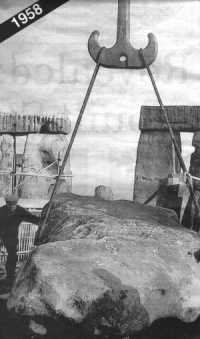
A lintel of the outer circle is lifted into place in 1958

READ MORE

restavraciya-0013.jpg


restavraciya-0050.jpg
restavraciya-0095.jpg


restavraciya-0054.jpg
restavraciya-0077.jpg


restavraciya-0095-1.jpg
 
Last edited:

How They Rebuilt Stonehenge 50 years ago​

"For decades the official Stonehenge guidebooks have been full of fascinating facts and figures and theories surrounding the world's greatest prehistoric monument. What the glossy brochures do not mention, however, is the systematic rebuilding of the 4,000 year old stone circle throughout the 20th Century".

"This is one of the dark secrets of history archaeologists don't talk about: The day they had the builders in at Stonehenge to recreate the most famous ancient monument in Britain as they thought it ought to look".
"

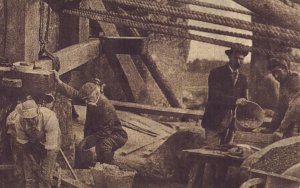
This picture shows workers on the site in 1901 in a restoration which caused outrage at the time but which is rarely referred to in official guidebooks. For it means that Stonehenge, jewel in the crown of Britain's heritage industry, is not all it seems. Much of what the ancient site's millions of visitors see in fact dates back less than 50 years.

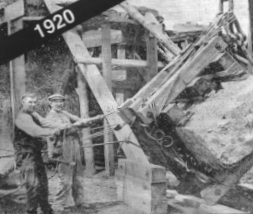
"From 1901 to 1964, the majority of the stone circle was restored in a series of makeovers which have left it, in the words of one archaeologist, as 'a product of the 20th century heritage industry'. But the information is markedly absent from the guidebooks and info-phones used by tourists at the site. Coming in the wake of the news that the nearby Avebury stone circle was almost totally rebuilt in the 1920s, the revelation about Stonehenge has caused embarrassment among archaelogists. English Heritage, the guardian of the monument, is to rewrite the official guide, which dismisses the Henge's recent history in a few words. Dave Batchelor, English Heritage's senior archaeologist said he would personally rewrite the official guide. 'The detail was dropped in the Sixties', he admitted. 'But times have changed and we now believe this is an important piece of the Stonehenge story and must be told'.
330624.jpg
330627.gif
330628.gif

"Cambridge University archeological archivist and leading Stonehenge author Christopher Chippindale admitted: 'Not much of what we see at Stonehenge hasn't been touched in some way'. And historical research student Brian Edwards, who recently revealed that the nearby Avebury Monument had been totally rebuilt, has found rare pictures of Stonehenge being restored. He said: 'It has been as if Stonehenge had been historically cleansed'. 'For too long people have been kept in the dark over the Stonehenge restoration work. I am astonished by how few people know about it. It is wonderful the guide book is going to tell the full story in the future.' (Read More)
 
I had been to London 8 times but never saw Stonehenge. Finally saw it around 2015. It was OK but I wouldn't go back. It's a bit of a tourist trap! Can't understand why some strange people dress up in crazy customs and go out there on June 21. I rather see with the least number of people there. Anyway, saw it once but don't need to see it again.
 
It's just a big 'ole Pi

The number π is a mathematical constant. It is defined as the ratio of a circle's circumference to its diameter, and it also has various equivalent definitions. It appears in many formulas in all areas of mathematics and physics.Wiki
:ROFLMAO:
 
Maybe Stonehenge was created as a giant's board game......get your ladder out!

Swing for victory in Stonehenge and the Sun — Fun & Board Games​

 
Last edited:
Re the OP: Well it was there when Thomas Hardy wrote "Tess of the D'Urbervilles." in 1891 He lived in the area and described it as standing up well in the book.

It was there when I saw it in1992. Was it demolished and rebuilt in between? I doubt it and I'm not going to be convinced otherwise by that "Indiewiki" site and its "alternative media activists."

I'm just guessing those pictures were men making a movie set.
 
Back
Top