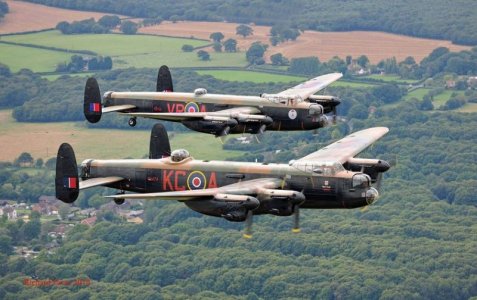
Rare WW II Lancaster bomber returns to Winnipeg, 'very emotional experience' for some

@Cinderella
I'm sure that you would know of the memorial register at Lincoln Cathedral. In 1980 I visited my uncle in Collingham, Notts and we visited the cathedral. We were talking to a docent there and they decided to open up the glass case and turn the page for the day. By coincidence another uncle's name was on that page! He was a Lancaster pilot who died with his crew in 1943.
It's my understanding that there are only two flight worthy Lancaster's at present.
 
The Lancaster that is currently on tour out west is housed in the Canadian Warplane Museum in Hamilton, Ontario.
In a typical year it makes 50 pleasure flights between June 1 - Nov. 11. In addition to the flight crew it can carry up to a max. of 4 other people (tourists). The flight path is from Hamilton Ont. east over Niagara Falls then circling back west then north over the western end of Lake Ontario to Toronto then back southwest to it's home in Hamilton.

The actual flight time is 1 hour and the cost per person is $3,500.00. Despite the high cost, seats are booked a year or more in advance.

I see it often when I'm out working in my back yard as it flys over my house on it's way back from Niagara Falls toward Toronto as it approaches the western end of Lake Ontario. You can actually hear it coming long before you see it in the sky.

Even though I've seen it dozens of times, I always stop what I'm doing and look up to the sky when I hear those thunderous engines approaching 👂Even just standing there looking up at it as it flies overhead gives one pause to think about what it must have been like seeing & hearing dozens of those planes flying overhead on a bombing run during WWII 🤔

Lancaster.jpg
 
Merlin engines a glorious sound, you recognise instantly. Brings a lump to the throat, with a crew of 7 the losses were very high.
You've got that right! I always know immediately when I hear those engines. There's no mistaking it for any other plane
 
I think over 7,000 were built and around half were lost in action.

Most were built in Great Britain I believe but a total of 430 Lancasters were built in Canada: 422 bombers and 8 long-distance transport planes. The latter carried mail to service members in Europe and key wartime personnel. On arrival in Britain, the Mk. X bombers were assigned to Royal Canadian Air Force (RCAF) squadrons.

Although there are a handful of Lancasters still in exsistance around the globe there are only 2 that are still airworthy. One at the Canadian Warplane Museum in Hamilton, Ontario Canada and the other is located at an operational RAF airfield at RAF Coningsby in Great Britain.
 
Most were built in Great Britain I believe but a total of 430 Lancasters were built in Canada: 422 bombers and 8 long-distance transport planes. The latter carried mail to service members in Europe and key wartime personnel. On arrival in Britain, the Mk. X bombers were assigned to Royal Canadian Air Force (RCAF) squadrons.

Although there are a handful of Lancasters still in exsistance around the globe there are only 2 that are still airworthy. One at the Canadian Warplane Museum in Hamilton, Ontario Canada and the other is located at an operational RAF airfield at RAF Coningsby in Great Britain.

Based on your post, I've just found this. Canadian Lancaster, Vera, meets up with British Lancaster, Thumper:

 
You've got that right! I always know immediately when I hear those engines. There's no mistaking it for any other plane
The RCNVR in WW2 operated motor torpedo and motor gun boats in the English channel that were powered by 4 V12 Rolls Royce merlin marine engines, burning 100 octane aviation gas. Thats about 4000 horsepower in a 110 foot long wooden speed boat, armed with 2 torpedoes, and a number of 6 pounder quick firing guns, plus twin 50 caliber machine guns and Vickers heavy machine guns. Top speed of around 35 miles an hour. Their mission was to go out at sunset, cross to the French coast, and lay in wait for a German coastal convoy to come into range. Floating in the dark with their engines shut down the 4 boats in the squadron were just about invisible. The German S boats were their adversaries.

The Canadian officers had been power boat owners pre war, but now they were facing the nightly dangers of attacking much bigger ships in the dark at ranges of less than 300 yards. Target sighted, green 20, all boats, engage! Crash start of 16 V12's, and then bringing the guns to bear and running in so close that the Germans couldn't depress their deck guns enough to hit the fast boats. Red and green tracers, star shells to illuminate the convoy, blowing through all guns blazing, then reverse course and come back in with torpedoes launched, then gone in a minute.

Later in the war the Canadians were sent to support the invasion of Italy in August of 1943. They navigated from the south coast of the UK down the coasts of France and Spain and into The Med and to Sicily. Remember these boats were only 110 feet long, and they were navigating using coastal charts and astral navigation for a 2500 mile voyage. In the last year of the war, the Canadian motor torpedo boats found them selves in the Adriatic Sea along the cost of Yugoslavia, assisting the partizans with their fighting against the Germans that were occupying their country. Along way from home in Canada.

 
We mustn't forget what these planes were used for, though. One example is the bombing of Nuremberg by around 800 Lancasters in a single raid. Another example is the bombing of Dresden, where around 1,000 Lancasters were used over two days. Lancasters dropped over 600,000 tons of bombs during WWII, the equivalent of about 41 Hiroshima bombs.

Then there was the famous Dambuster Raids, where Lancasters used bouncing bombs to bounce over torpedo nets and target German dams. (1955 movie):

 
Back
Top