U.S. pump prices and projections

Part of the reason Spirit Airlines has shut down is because of high fuel prices. As a result, some 17,000 employees and contractors are now out of work and will soon be collecting unemployment benefits, which will cost taxpayers millions.

This is becoming a huge issue in the UK and across Europe. Flights are beginning to get cancelled. Lufthansa have cancelled 20,000 short haul flights planned for the summer, for example. It's going to get tougher, and more expensive, to find the sun, it seems.

 
Part of the reason Spirit Airlines has shut down is because of high fuel prices. As a result, some 17,000 employees and contractors are now out of work and will soon be collecting unemployment benefits, which will cost taxpayers millions.

And what is the government doing? They're building an ugly, tasteless, giant arch for the National Mall and a tacky giant ballroom as part of a new White House east wing. Taxpayers will foot the bill for all this garbage, which will cost billions!
For one thing the government filed a lawsuit in 2022 to block the takeover of a financially strapped and mismanaged Spirit by Jetblue. Spirit then filed for Chapter 11 in 2024 and then again last fall. An attempt to bail out Spirit by the government was rejected by Spirits creditors... which resulted in its closing.
 
Don't believe the headlines, imo. I'm referring to the ones claiming oil prices are falling, due to potential peace deal.

While a part of that might be true, the real reason is demand destruction in Asia... which is starting to bite. No one wants to get caught if/when supply outstrips demand. It will happen, but no one really knows when.
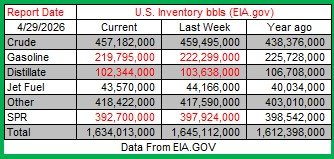
Energy Inventory.jpg
Distillate inventories are at the lowest since 2003 and exports of distillates reached an all time high.
Gasoline stocks are decreasing, but not substantially... in historic norms.
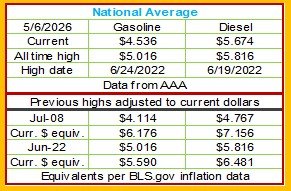
energy prices.jpg
It is conceivable that pump prices for gasoline might moderate going forward, although American drivers have been relentless in their demand... thus far. Diesel might also moderate, but that is quite iffy, imo.
 
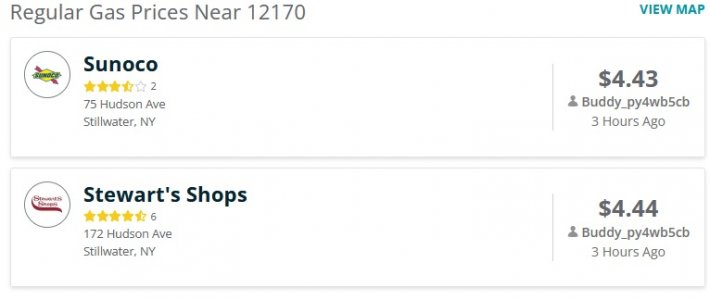
Regular unleaded at my usual station just surged another 28 cents to $4.08 since the last time I checked. It's now $1.58 a gallon mor than it was at the end of February. That's a 63% increase. I generally fill up when my guage reads about 1/4. And it usually takes about 13 gallons. So that means an extra $20 every time I fill up.

In the past we have had slighly lower than average gas prices probably due to our proximity to wells and refinerys. But it looks like that might change as more of that oil is now being exported.

U.S. crude oil exports surge to record as tankers flock to Gulf Coast during Iran war
 
I never understood why higher demand raises prices? Increasing the volume of manufacturing/producing goods reduces the price per item.

It's price gouging called something else by capitalism:(. Just because there may be a waiting period to purchase a product it shouldn't cost more. Plain greed and taking advant

Here's the problem with our oil...

The U.S. produces a massive amount of oil, but it's often the "wrong" kind for our infrastructure:
  • U.S. Production: Mostly light, sweet crude (low sulfur, low density) from shale regions like the Permian Basin.
  • U.S. Refineries: About 70% of capacity is optimized for heavy, sour crude (high sulfur, high density).
  • Historical Context: Most refineries were built in the 1970s and 80s when the world supply was shifting toward heavier oils from places like Venezuela and Mexico.
So even though we produce more than we use, we can't refine enough of it, so we need to import oil that's compatible with our refineries.
Don't forget that there has been a concerted effort to suppress US production of the low sulfur oil. The industry built its refineries to deal with the heavier oil being imported. At the same time there has been an argument that fossil fuels in general were pumping sulfur and carbon into the atmosphere. It seems we once again created a solution requiring a problem. Kind of like shooting yourself in the foot to justify an argument against guns. Maybe I have my hat on backwards again, but I'm a bit tired of snow job causing a heat wave.
 
I feel the need to express some opinions... more than I have thus far.

The notion that U.S. refiners cannot refine shale oil or light sweet such as WTI, is false. The issue being twofold.
  1. Heavy sour runs at a steep discount from light sweet. $20, $30, $40 per barrel, depending on which light sweet and heavy sour.
  2. Heavy sour has a larger refinery gain than light sweet. Depending on which crudes, can be 2 gallons more per barrel in refinery gain. (edited from 2 barrels to 2 gallons)
Refineries spent billions on additional cracking units, cokers, etc. to take economic advantage of those factors (mostly in the US, along the gulf coast). However, switching to light sweet would decrease production, via less refinery gain, as well as jacking up the price of light sweet, all of which would result in much higher prices at the pump.

The sulfur question. Some shale oil does have high sulfur, but not all. Heavy sour, by definition... has high sulfur content. Billions of dollars were spent by U.S. refiners to build hydrodesulfurization plants, as well as the pipeline infrastructure to deliver hydrogen to those plants. The U.S. is not alone this system, as it is worldwide.
 
Last edited:
Don't forget that there has been a concerted effort to suppress US production of the low sulfur oil.
Don't you mean "the production of high sulfur oil?" High sulfur oil caused the problem with acid rain. Low sulfur oil helped solve that problem and its production was mandated -- not "suppressed."
 
But it looks like that might change as more of that oil is now being exported.


That's the problem with a commodity traded worldwide, you have to pay what the going price is.

Australia has ordered emergency fuel reserves from the United States for the first time in decades as the nation remains exposed by the global oil crisis and usual suppliers fall short.

Australia has turned to the US as the crisis has meant the Asian nations which usually supply refined fuels are coming up short.

It comes as six oil cargo ships heading to Australia from Malaysia, Singapore and South Korea were cancelled earlier this week.
Prime Minister Anthony Albanese and Energy Minister Chris Bowen said China will replace the six tankers alongside “alternative sources”.
 
What everyone is omitting or ignoring is this is about oil prices. As in oil is also used in car engines and needs changing. Some shops around here have significantly increased their oil change prices and no long offer coupons, sales, discounts etc. Throw in supply chain which is literally driven by fuel and fuel prices other stuff already starting to show transportation costs.
 
What everyone is omitting or ignoring is this is about oil prices. As in oil is also used in car engines and needs changing. Some shops around here have significantly increased their oil change prices and no long offer coupons, sales, discounts etc. Throw in supply chain which is literally driven by fuel and fuel prices other stuff already starting to show transportation costs.
Motor oil, yeah that's the key to the entire price structure of oil prices.
 
It's an admission of poor planning and being completely ignorant off, or completely ignoring the history of the Strait of Hormuz among other things.
I't's not a war between 2 nation states who think similarly or have more common interests. Here the combatants think differently, have different goals and priorities. This isn't about territory or politics. That's one of the reasons 'a' deal cannot be reached. This 'war' or action should've been war gamed better.
 
Last edited:
Back
Top