Anything Scottish, just for fun!

Scottish Aye

Yesterday at 09:58 ·

SCOTLAND ACCIDENTALLY APPROVES “TITTIES FOR CITIES” INITIATIVE
What began as a potato growing scheme has somehow become legal permission tae get yer baps oot in public.
Scotland is in a state of pure confusion this morning after ministers officially approved a brand new nationwide initiative titled “Titties for Cities.” What began as a routine policy review has now spiralled into the most baffling government announcement since the time someone accidentally approved a seagull compensation scheme.
According to several mortified civil servants, this was never the intention. The initiative was supposed to be “Tatties for Cities”, a wholesome agricultural scheme aimed at boosting Scotland’s potato production to keep up with national demand for chips, mash, crisps, and the millions of tattie scones sold every week across the country. The plan was simple, transform rundown, vacant and derelict patches of land in Scotland’s cities into community potato plots that would help feed the nation.
But thanks to one catastrophic spelling error, swapping a for i, the proposal went forward as “Titties for Cities.” And somehow, unbelievably, not a single committee, councillor or minister noticed.
By the time someone finally twigged, the policy had already been approved unanimously, allocated funding, printed on glossy brochures, translated into Gaelic, and announced at a press conference where everyone politely pretended the name was completely normal.
And now, because the motion passed exactly as written, Scotland has accidentally created the first fully legal “get yer baps oot” initiative in Europe, provided, technically, that it’s done “for city development purposes.”
It is now expected that, with the freedom of the nipple for all being granted entirely by accident, and the weather sitting at a baltic minus three, A&E departments may soon see a rise in injuries caused by cold nips taking folk’s eyes oot. Doctors have already warned the public to “mind where ye’re pointing them.”
Meanwhile, potato farmers are raging. One Perthshire grower put it perfectly: “We just wanted more freedom tae plant tatties. Noo the whole country might run oot o’ mash for Burns Supper because somebody made a spelling mistake.”
Government officials are scrambling to quietly amend the paperwork, but insiders say it’s “far too late”, the posters are printed, the banners are hung, and the hashtag #TittiesForCities is now officially unstoppable.
So instead of revitalising Scotland’s abandoned plots with potatoes, the nation now finds itself with a legally approved public nipple initiative that was absolutely never meant to exist.
We aimed for agriculture.
We got nipples.
Scotland, Whether you’re a man proudly sporting a pair of winter ready chesticles, or a woman blessed with a matching set of high or low hanging munros, permission has now, unbelievably, been granted for everyone tae get them oot, purely for “city development purposes,” ofcourse.
 

THE TRUE ORIGIN OF THE TROJAN HORSE, STOLEN FROM SCOTLAND

Most schoolbooks claim the Trojan Horse was invented by the Greeks. But the truth is far stranger, far hairier, and involves far more whisky.

In around 750 BCE, a Greek traveller named Aeschylos O’Theopolis arrived in the wild lands of Scotland. He claimed he had come to share philosophy, mathematics, and hygiene. In reality, he wanted to sell olive oil at a wildly inflated price.

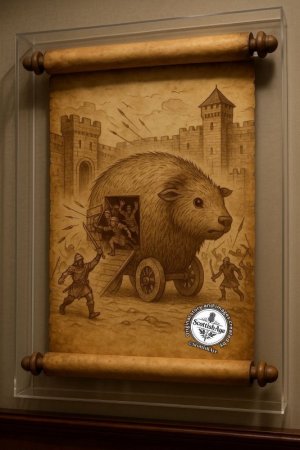
During his visit, he found himself near a Highland stronghold that had been seized by one Celtic tribe. Another tribe wanted it back, but attacking the walls was impossible. So they built something nobody had ever seen before, A colossal wooden haggis on wheels.
IMG_1509.jpeg

It was eight men tall, covered in shaggy hides, and smelled faintly of whisky and onions.The Plan was simple, under cover of darkness, they rolled the monstrous haggis up to the castle gates and left it there as if offering the world’s most generous portion. The defenders, confused but curious, dragged it inside. Moments later, BOOM, a hidden hatch burst open. Dozens of fierce warriors leapt out, swinging weapons, roaring battle cries, and playing war pipes so loud midges fell out the sky.

Within minutes, the castle was retaken and Aeschylos Was Changed Forever. The Greek visitor watched the chaos, mouth open, toga flapping in the wind. He scribbled furiously into his travel diary, “By Zeus… that was genius.
Also my ears are bleeding.
These people are completely mad. I love it.”

Upon returning home, Aeschylos shared the story. But every time he tried to describe the giant wooden haggis, someone would interrupt and ask, “What is a haggis?” After the fifteenth explanation, he gave up and simply said, “Fine. It was a horse. A big wooden horse. Whatever.”
And thus the legend was born.

Later poets and storytellers polished the tale into myth, over centuries, until school children everywhere believed the Greeks had invented it.
In reality, the idea came from one unforgettable night in Scotland involving, a castle. a wooden haggis, 37 angry warriors and at least 12 empty whisky barrels

The Moral of the Story
Never underestimate an idea stolen from Scotland. Especially when it’s shaped like a haggis
 
ARCHAEOLOGISTS STUNNED BY DISCOVERY OF ANCIENT “AULD LANG SIGN”
“You are now entering… everywhere.”

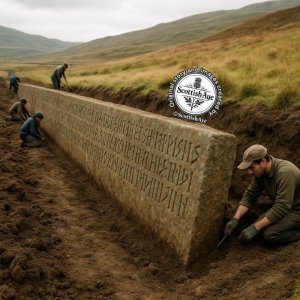
Archaeologists working in the Scottish Borders have uncovered what is now being described as the oldest, longest, and most aggressively unnecessary sign in Scottish history.

The stone structure, now nicknamed “The Auld Lang Sign,” stretches an astonishing 100 metres in length and stands just over 2 metres tall, forming what experts believe to be less of a marker and more of a statement. Carved entirely from one piece of solid stone, initial carbon dating places it at around 2,000 years old, meaning it predates roadworks, roundabouts, and at least 90% of arguments about where “the North” actually begins.

The sign appears to mark the absolute boundary of Scottish civilisation. Etched carefully along the length of the wall is ancient Celtic writing, running left to right in long sections, which scholars now believe was designed to be read by travellers approaching from the south. After months of translation work, historians confirm the carvings list the names of every land, territory, isle and vaguely defined place north of the marker.

These include recognisable locations, forgotten regions, disputed glens, several islands that may or may not exist anymore.
Experts believe this was an early attempt to clarify geography for travellers who had already walked too far north and were too polite, cold, or stubborn to ask for directions.

Historians now think the sign served a vital purpose, To warn visitors that everything beyond this point would be colder, windier, wetter, and inexplicably proud of it.
IMG_1513.jpeg
One archaeologist described the craftsmanship as “astonishing,” noting that each symbol was chiseled by hand. Intriguingly, the rear (south facing) side of the wall contains only a single carved line of text. After careful translation, scholars agree the phrase roughly translates to
“It’s shite doon there anyway.” Experts believe this was intentional, suggesting ancient Scots saw no need for further explanation, clarification, or diplomacy.

The discovery has already sparked heated debate, with some arguing the sign proves Scotland has always been well signposted, while others insist it is simply evidence that even 2,000 years ago, Scots felt the need to clearly state, “This is ours.”

The Auld Lang Sign is expected to go on public display next year, once archaeologists finish arguing about whether it should be classed as history, infrastructure, a border, or the world’s earliest passive aggressive review of the south.

Scotland.
Signposted.
Since forever


Back
Top