


Furryanimal
Y gath o Gymru
- Location
- Wales
Haggis Close the Strait of Hagguz in Response to US Tariffs, Global Whisky Supply in Chaos
In an unprecedented escalation of trade tensions, the Haggis community has officially closed the Strait of Hagguz, the world’s most critical shipping route for Scotch whisky, in retaliation to newly imposed US tariffs on essential “haggis life components.”
The tariffs, introduced last week, target key materials tied to whisky production, including American white oak barrels, copper still components, and specialist fermentation equipment.
While aimed at distilleries, experts say the move has had devastating knock on effects on the wider Highland ecosystem, particularly the haggis, whose entire lifestyle is heavily dependent on a steady whisky output.
Within hours of the announcement, the Haggis Council of the Glens convened an emergency summit beneath a drystone wall somewhere near Pitlochry. By sunrise, a unanimous decision had been reached.....shut down the Strait of Hagguz indefinitely.
The narrow but vital passage, located between the Hebridean shipping lanes and what maritime experts describe as “that bit near Skye where things get a bit wavy”, handles an estimated 88% of global Scotch whisky exports.
It is now completely blocked, not by haggis themselves, but by a vast floating barricade of whisky barrels and empty glass bottles, carefully assembled and packed together across the water.
Witnesses report thousands of haggis working in coordinated teams through the night, rolling casks into the sea and launching empty bottles into gaps, creating a dense, interlocking barrier that stretches for miles.
The structure is said to be “surprisingly well engineered,” with some naval experts admitting it would be nearly impossible to break through without “a very large net and a lot of patience.”
Satellite images show cargo ships backed up for miles, with several vessels attempting to edge closer before being forced to turn back after scraping against the floating wall of oak and glass.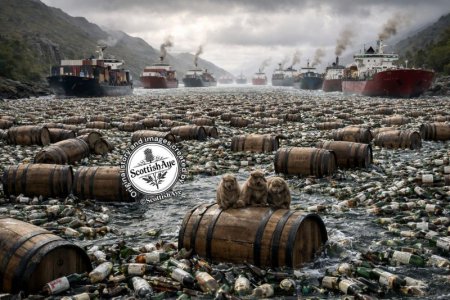
Some captains have tried negotiating passage by offering miniature whisky bottles overboard, but these have simply been absorbed into the blockade, further strengthening it.
Global markets reacted immediately. Whisky prices have surged by over 300% in under 48 hours. Bars across London have begun offering “whisky viewing experiences” instead of servings, while in the US, panic buying has led to empty shelves and questionable trades, including one reported exchange of a used jet ski for half a bottle of 12 year old Speyside.
Despite growing international pressure, the Haggis remain unmoved.
A spokesperson for the Council, issued the following statement,
“We have survived winters, hunts, and watered down blends and the Great Teacake Shortage of 1997, We do not negotiate under tariff aggression.”
Efforts to resolve the situation have so far stalled. Scottish officials attempted internal mediation by sending a delegation of Highland coos to reason with the haggis, but talks quickly collapsed after the coos were granted immediate access to grazing land and “limited but respectable” whisky shares, prompting them to declare themselves “neutral but comfortable.”
Experts now warn the standoff could last for years. Intelligence reports suggest haggis have been stockpiling whisky for generations, storing vast reserves in underground tunnel networks across the Highlands. Some estimates indicate they could sustain full operations without reopening the Strait for decades.
As tensions continue to rise, one thing is certain, until tariffs are lifted, the Strait of Hagguz will remain firmly closed and the rest of the world will have to come to terms with a rapidly drying dram
In an unprecedented escalation of trade tensions, the Haggis community has officially closed the Strait of Hagguz, the world’s most critical shipping route for Scotch whisky, in retaliation to newly imposed US tariffs on essential “haggis life components.”
The tariffs, introduced last week, target key materials tied to whisky production, including American white oak barrels, copper still components, and specialist fermentation equipment.
While aimed at distilleries, experts say the move has had devastating knock on effects on the wider Highland ecosystem, particularly the haggis, whose entire lifestyle is heavily dependent on a steady whisky output.
Within hours of the announcement, the Haggis Council of the Glens convened an emergency summit beneath a drystone wall somewhere near Pitlochry. By sunrise, a unanimous decision had been reached.....shut down the Strait of Hagguz indefinitely.
The narrow but vital passage, located between the Hebridean shipping lanes and what maritime experts describe as “that bit near Skye where things get a bit wavy”, handles an estimated 88% of global Scotch whisky exports.
It is now completely blocked, not by haggis themselves, but by a vast floating barricade of whisky barrels and empty glass bottles, carefully assembled and packed together across the water.
Witnesses report thousands of haggis working in coordinated teams through the night, rolling casks into the sea and launching empty bottles into gaps, creating a dense, interlocking barrier that stretches for miles.
The structure is said to be “surprisingly well engineered,” with some naval experts admitting it would be nearly impossible to break through without “a very large net and a lot of patience.”
Satellite images show cargo ships backed up for miles, with several vessels attempting to edge closer before being forced to turn back after scraping against the floating wall of oak and glass.
Some captains have tried negotiating passage by offering miniature whisky bottles overboard, but these have simply been absorbed into the blockade, further strengthening it.
Global markets reacted immediately. Whisky prices have surged by over 300% in under 48 hours. Bars across London have begun offering “whisky viewing experiences” instead of servings, while in the US, panic buying has led to empty shelves and questionable trades, including one reported exchange of a used jet ski for half a bottle of 12 year old Speyside.
Despite growing international pressure, the Haggis remain unmoved.
A spokesperson for the Council, issued the following statement,
“We have survived winters, hunts, and watered down blends and the Great Teacake Shortage of 1997, We do not negotiate under tariff aggression.”
Efforts to resolve the situation have so far stalled. Scottish officials attempted internal mediation by sending a delegation of Highland coos to reason with the haggis, but talks quickly collapsed after the coos were granted immediate access to grazing land and “limited but respectable” whisky shares, prompting them to declare themselves “neutral but comfortable.”
Experts now warn the standoff could last for years. Intelligence reports suggest haggis have been stockpiling whisky for generations, storing vast reserves in underground tunnel networks across the Highlands. Some estimates indicate they could sustain full operations without reopening the Strait for decades.
As tensions continue to rise, one thing is certain, until tariffs are lifted, the Strait of Hagguz will remain firmly closed and the rest of the world will have to come to terms with a rapidly drying dram