Anything Scottish, just for fun!

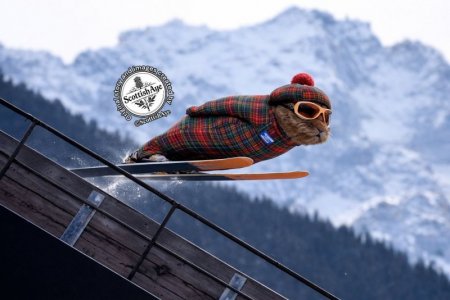
HEDDIE THE HAGGIS SHOCKS THE WINTER OLYMPICS, THEN GETS CUFFED

Spectators at the Winter Olympics were left utterly gobsmacked today after Heddie the Haggis barrelled onto the ski jump ramp, thundering down the inrun like a furry, whisky fuelled cannonball in a tartan jumpsuit.

Eyewitnesses in the crowd say Heddie appeared from behind a snow machine, strapped himself into a pair of skis fashioned on Irn Bru's coulour scheme and launched himself into the stratosphere.

What followed has already gone down in sporting history. Heddie soared through the sky, past the judges’ tower, past the safety barriers, and a staggering 20 METRES beyond the human world record, landing perfectly in a dramatic snow cloud before triumphantly brandishing a teacake to the crowd.

However, celebrations were short lived.
As Heddie slid gracefully to a stop, Olympic security swooped in, slapping tiny handcuffs on the legendary haggis for illegally entering the competition without accreditation, skis certified by FIS, or even lengthed limbs.

Officials confirmed Heddie will not be allowed to keep his record, stating
“If we accept this jump, we’d have to open the games to the unicorns, selkies, and Highland coos who are hanging about nearby and frankly, we’re not ready for that chaos.”

Meanwhile, fans have already started a petition and hashtags online:

#FreeHeddie
#LetTheHaggisFly
#WorldRecordOrWeRiot

Heddie the Haggis was last seen being escorted away in a snowmobile by police.IMG_1640.jpegIMG_1640.jpeg
 
Last edited:
THE TRUE ORIGINS OF THE SUPPERBOWL, AND HOW IT CROSSED THE ATLANTIC

Long before Americans ever heard of a “Super Bowl,” Scotland had already perfected a far superior sport, a game that in time became known simply as The Supperbowl.

The story begins in the winter of 1947, some twenty years before the very first Supperbowl was officially recorded, when an ill fated experimental snack delivery lorry broke down on the road outside Stonehaven.

The truck wasn’t carrying ordinary snacks... inside were prototype chocolate and marshmallow biscuits, a secret test batch that would not be officially released to the public until 1956 under the now famous name “teacakes.”

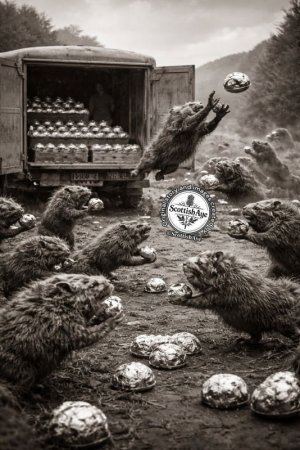
Within minutes, two rival clans of haggis arrived at the scene, the tough, hill hardened Highland Haggis rolling down from the glens, and the sharper, faster Lowland Haggis sprinting up from the fields, both determined to claim the same mysterious, shiny foiled treats for themselves.

Rather than descending into total chaos, the two groups of haggis began circling each other around the stranded lorry, chattering angrily and slapping their paws on the road, until one particularly bold Lowland haggis picked up one of the prototype teacakes and hurled it across the tarmac sparking an unexpected contest that quickly felt less like a robbery and more like the birth of something bigger.

At this stage it wasn’t a sport, and there was no marked out field or formal rules, just pure haggis chaos. Both clans began launching and hurling the prototype teacakes back to their own side in frantic attempts to claim the most for themselves, which quickly escalated into full scale rivalry.

Within minutes, haggis were tackling haggis, leaping through the air for epic foil shimmering catches, and crashing into one another in a wild battle for dominance over the stranded lorry and its precious cargo.

By the time the bewildered lorry driver finally reappeared with help, the chaos had settled and the experimental teacake lorry had been thoroughly ransacked.

Yet instead of simply disappearing back into the hills, both clans of haggis lingered at the roadside, clearly aware that something remarkable had just happened.

What began as a desperate food scramble soon became a yearly tradition, and over time humans stepped in to formalise it, introducing clear rules, recognised teams, and organised matches.

The wild skirmish of 1947 gradually evolved into the structured game that would truly become The Supperbowl. Coincidentally, when the teacakes were finally released commercially in 1956, locals joked that they had already been “field-tested by haggis.”

As decades passed and Supperbowl traditions spread, adventurous Scots began travelling over the pond to America, carrying stories of teacake battles and haggis rivalries with them.

But once there, they hit a major problem, teacakes were almost impossible to find. Rather than abandon their beloved game, they improvised, picking up the locally available leather ball already being kicked around on American college fields.

Once established in their new home, these Scots staged informal Supperbowl style matches in fields, parks, and university grounds, still throwing their “imaginary teacakes” in fast, spiralling arcs.

Americans loved the spectacle, the high catches, heavy tackles, and territorial end zones, and gradually blended these ideas with their own previous games.

Over time, the teacakes were replaced entirely by the leather ball, the haggis were left behind, and the rules were tightened and out of that mix grew what we now call American football.

And so, while America built giant stadiums, celebrity halftime shows, and a global TV spectacle around its version of the game, Scotland quietly kept the original tradition alive.

Back in the U.S., because food was no longer used and no supper was actually had, the adapted game became known as the Super Bowl as a playful homage to its Scottish ancestor, even as it took on a life of its own across the Atlantic.
IMG_1639.jpeg

Each year, long after those first prototype teacake raids in 1947, Supperbowl continued to grow into its own national institution, still rooted in haggis rivalry, still centred on food, and still unmistakably Scottish in spirit.
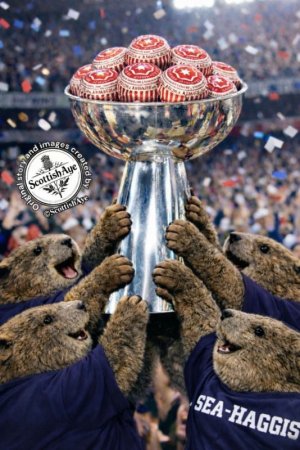
That’s why, as millions tuned in to Super Bowl 68, the real drama was unfolding at home in Haggden Park, where the Stonehaven Sea-Haggis lifted the Supperbowl 88 trophy, proof that no matter how far the sport travelled, its heart always stayed in Scotland
IMG_1641.jpeg
 
Last edited:
IMG_1643.jpeg
SCOTLAND UNVEILS “PEHS” THE WORLD’S FIRST PIE DISPENSER
In a move that has left snack engineers both horrified and impressed, a new Scottish company, “Pehs International Dundee Ltd”, has officially launched a range of Scottish themed PEHS dispensers, loosely affiliated with the original PEZ brand. But make no mistake, these are NOT your average sweet dispensers.

Instead of tiny candies popping out of the top, the newly patented PEHS mechanism releases full pie sized pastries from the bottom, a revolutionary feat of engineering designed specifically for Scotland’s culinary priorities.

The designers confirmed that releasing the pies from the top was “physically impossible unless we were willing to decapitate Nessie.”

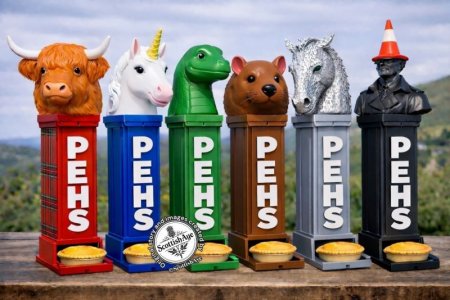
The six official designs, now proudly on sale across Scotland are,

• The Highland Coo Pehs, wrapped in tartan and dispensing classic steak pies.
• The Unicorn Pehs, releasing “magically warm” macaroni pies.
• The Nessie Pehs, dispensing legendary Scotch pies.
• The Haggis Pehs, launching traditional Scottish haggis pies.
• The Kelpie Pehs, metallic and menacing, serving mince and tatties pies.
• The Duke of Wellington Pehs including cone, dispensing full Scottish breakfast pies.

Engineers explained that the bottom release system was necessary because
“You simply cannot squeeze a proper Scottish pie through a neck. Physics, taste, and common sense all said ‘nae chance."

Early testing in Dundee has reportedly resulted in locals standing under the machines like it’s a pastry waterfall, waiting for hot pies to drop straight into their hands.

Dundee City Council has already hinted at installing PEHS machines on every street corner, replacing vending machines entirely, because apparently “nothing motivates a Dundonian quite like a mechanical pie launcher.”
One local summed it up perfectly
“We wanted flying cars… we got flying pies. Fair deal.”

Scotland has done it again
 
Air Hagg One

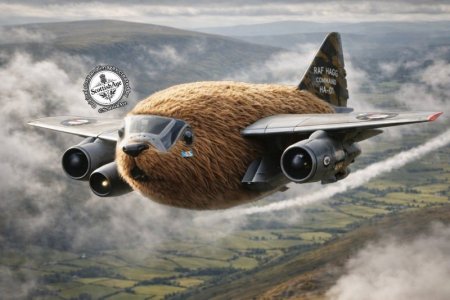
Air Hagg One is the official radio call sign used by the Royal Scottish Air Division for any aircraft carrying the sitting President of the Haggi Preservation Committee. It may also refer to the specially modified aircraft designated HA-01, the primary presidential transport.

Unlike conventional military aircraft, Air Hagg One combines advanced aviation engineering with… biological aerodynamics.

Reinforced fur lined fuselage for thermal insulation over Highland airspace, Dual engine turbo hagg propulsion system, Secure satellite communications allowing direct contact with The Highland Council, Save The Haggis task force and International Anti Poacher Units,
Advanced anti missile defence system known internally as Operation Furry Countermeasures, as well as mid air refuelling capability via whisky compatible intake valve.
IMG_1645.jpegIMG_1645.jpeg

The aircraft allows the President to travel globally, attending emergency preservation summits, whisky based trade negotiations, and urgent Haggis population briefings.

The designation “Air Hagg One” was formally established in 1953 following what is now known as, The Great Mid Air Mix-Up.
At the time, President Haggenhower was travelling aboard aircraft Hagg Force 8610 when air traffic control nearly confused the flight with a commercial service using the same number.

To prevent future incidents, the unique call sign “Air Hagg One” was permanently adopted whenever the President is onboard. Since then, no confusion has occurred.

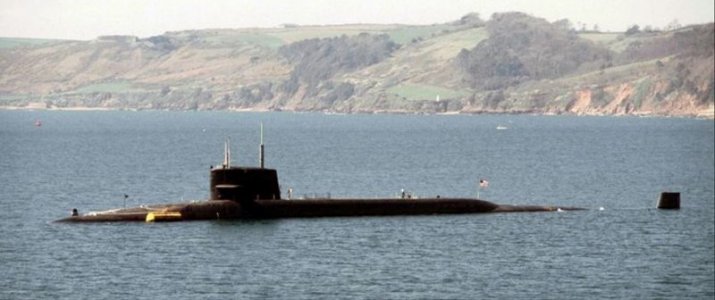
Air Hagg One was photographed earlier today conducting low altitude manoeuvres over the Highlands, believed to be en route to an emergency summit on lava Pool poaching activity, Illegal whisky dam dismantling and the recent surge in underground haggis tunnel expansions
 
Back
Top