1915 – The Gallipoli campaign begins.
The landing at Anzac Cove on Sunday, 25 April 1915 was part of the amphibious invasion of the Gallipoli Peninsula by the forces of the British Empire, which began the land phase of the Gallipoli Campaign of the First World War.
The assault troops, mostly from the Australian and New Zealand Army Corps (ANZAC), landed at night on the western or Aegean Sea side of the peninsula. They were put ashore one mile north of their intended landing beach. In the darkness, the assault formations became mixed up, but the troops gradually made their way inland, under increasing opposition from the Ottoman Turkish defenders.
For the vast majority of the 16,000 Australians and New Zealanders who landed on that first day, this was their first experience of combat. By that evening, 2000 of them had been killed or wounded together with at least a similar number of Turkish casualties. The exact number of the day's casualties is not known.
Since 1916 the anniversary of the landings on 25 April has been commemorated as Anzac Day.
Landing at Gallipoli. Sapper Fred Reynolds was the first to fall at Gallipoli. In the picture below of the Gallipoli landing, taken at 8.00am on 25 April 1915, Fred is the lone body lying on the beach.

Part of the Australian 4th Battalion and the mules for the 26th (Jacob's) Indian Mountain Battery landing at 8 am. In the foreground is the staff of Colonel Henry Normand MacLaurin, 1st Infantry Brigade, of Sydney, who was killed in action on 27 April 1915. The officer with the rolled greatcoat over his shoulder is Major Francis Duncan Irvine, later Major Brigade Major, of Sydney, who was also killed on 27 April 1915. Nearer the water's edge, centre, is Captain Dennis Malcolm King, DSO, MC, Orderly Officer, later Major. The officer on the left, with his chinstrap down, is Lieutenant R G Hamilton, the Brigade Signal Officer. At the water's edge lies an Australian engineer, Sapper R Reynolds, the first to fall during the war. Transports can be seen in the background and two of the warships' steamboats are in the middle distance. The photograph was taken by Lance Corporal Arthur Robert Henry Joyner of 1st Division Signal Company, of Paddington NSW, who was later killed in action at Bazentin, France on 4 December, 1916. AWM A01090.
Gallipoli cost the Allies 141,000 casualties, of whom more than 44,150 died. Of the dead, 8709 were Australians, 2779 were New Zealanders, Great Britain and Ireland lost 21,255, France 10,000, India 1358 and the dead from Newfoundland numbered 49. The Turks suffered over 251,000 casualties, of whom 86,692 lost their lives.
The Gallipoli campaign ended with an evacuation of allied troops beginning in December 1915. The next year Australian forces fought campaigns on the Western Front and in the Middle East. Throughout 1916 and 1917 losses on the Western Front were heavy and gains were small.
Villers-Bretonneux Military Cemetery, France with the Villers–Bretonneux Australian National Memorial, the main memorial to Australian military personnel killed on the Western Front during World War I, at the far end. More.
There are now more than 2,100 Commonwealth servicemen of the First World War buried or commemorated in this cemetery.
The fighting around Villers-Bretonneux in April resulted in: Australia 2473 casualties, Britain 9529 and France 3500. German losses were 8,000–10,400 men.
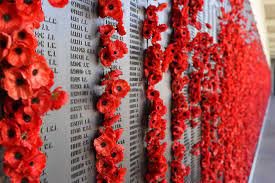
The number of deaths as a result of service with Australian units since 1860 is 102,888 as derived from the Roll of Honour at the Australian War Memorial, including:
• Boer War, South Africa 588
• First World War 61,571
• Second World War 39,653
• Korean War 340
• Vietnam War 521
• Afghanistan 43
Lest we forget.