

Luckily, I have an 02 concentrator at home my husband had when he was alive. We bought it and the company wouldn't buy it back from us because it was over 3 years old.i do better with the oxygen but it costs me a little over $200 a month for the machine

You are using an out of date browser. It may not display this or other websites correctly.
You should upgrade or use an alternative browser.
You should upgrade or use an alternative browser.
Has Anyone Participated In A Sleep Study (Or Know Someone Who Has)?
- Thread starter OneEyedDiva
- Start date
againstthegrain
Well-known Member
- Location
- Sun Valley, ID
Hopefully you'll be one of the blessed that feels immediate improvements so you'll have incentive to minimize the irritations of the equipment and live w being tethered while sleeping.I asked the technician if I lost weight if there's a chance, I would not need the machine. He was ambivalent about it and said maybe. I'm not sure mine is weight related, however I am overweight. Years ago, a roommate of mine came home. She said she stared at me sleeping for a couple of minutes and I barely took breaths. She thought I was dead, I was breathing so shallow. That was 50 years ago and I'm still here. I will be open minded and try the machine but if I know me, I won't be able to adapt to it. The thought of having something on my face while sleeping makes uncomfortable thinking about it.
As an aside Medicare covers zepbound for sleep apnea and obesity

MACKTEXAS
Well-known Member
I wouldn't think so. There has to be some reason to be tested. The observation I posted was that everyone I know who did get a test was prescribed a machine. It's not for me to say if they needed it or not.They usually don't send everyone for sleep tests.
14 per night? I'm no doctor, but Cleveland Clinic says "a normal apnea-hypopnea index [pause in breathing] for adults is fewer than five apnea and hypopneaevents per hour" -> in this report.In my case I stopped breathing 14 times an hour each night.
Yes, I feel sure that machines have been improved upon since my wife had one. I certainly hope so, because she did not have a good experience at all. I'm glad yours has worked out well for you.
I'm not familiar with Zepbound, I'll have to look into it. My drawback is I don't like taking medication. I'm better off changing my eating habits. I'm not as active as I used to be and in recent years, food has been comfort food for me.Hopefully you'll be one of the blessed that feels immediate improvements so you'll have incentive to minimize the irritations of the equipment and live w being tethered while sleeping.
As an aside Medicare covers zepbound for sleep apnea and obesity
I'm mot saying they're duping people, but I'm like you. Everyone I know that's had a sleep study, has been put on sleep apnea machines. I know of no one who passed it.I've never had one. Everyone I know who has, got a sleep apnea diagnosis, which tells me all I need to know. My wife had a sleep study early on in to her final illness (ALS) and of course was prescribed a machine (not a CPAP in her case, but similar). It was very frustrating to her because of dry mouth (then teeth issues) and being constantly awakened by noises from the machine, and discomfort from the mask. She finally ditched it all and slept upright in her recliner.

ProTruckDriver
🔶 Cancer Warrior 🔶 USN Retired 1969-1992
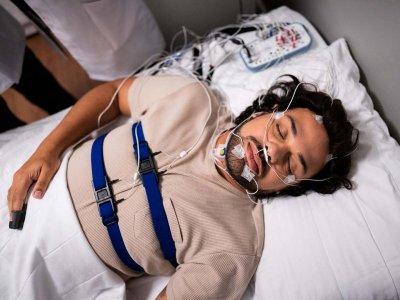
I had my Sleep Study February 2008. It was done the old fashion way, in a sleep study building. It was scheduled for 2 nights. Both nights they would wire you up with sensors on your legs, stomach, chest, face, ears, neck, fingers, arms. Then they would give you a sleeping pill. It felt like you were wired for sound. 
The first night they would take readings throughout the night. The second night they would put the wires back on and add wearing a Full Face Mask hooked up to a machine. My study was only 1 night. After I fell asleep they woke me up within 2 hours and put the mask on me. My apnea was so bad, I would stop breathing 40 to 45+ times in that hour. The next day I had my BiPAP Machine. I can't use a CPAP.
CPAP: One continues pressure during inhalation and exhalation.
BiPAP: Two distinct pressure levels. Higher for inhalation and Lower for exhalation that adjusts automatically breath by breath.
Before wearing the BiPAP the upper portion of my heart was enlarged. After about 1 or 2 years of the BiPAP my heart returned to normal.
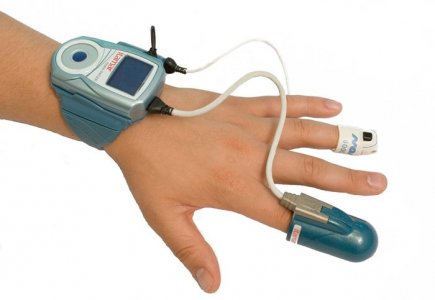
Sleep Studies are very easy to do now-a-days. They give you a monitor and a few wires and sensors to hook up and you sleep in your own bed.
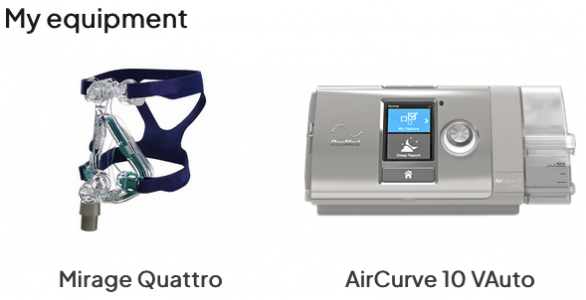
The first year or two I tried many masks. It was frustrating at first, but when I found the right mask it felt good. I've worn the Resmed Full Face Quattro for about 16 years now. My BiPAP Machine is the Resmed Aircurve 10 Auto. BiPAP Pressures are 17 cm H2O / 12 cm H2O.
I sleep like a baby using the BiPAP.

The first night they would take readings throughout the night. The second night they would put the wires back on and add wearing a Full Face Mask hooked up to a machine. My study was only 1 night. After I fell asleep they woke me up within 2 hours and put the mask on me. My apnea was so bad, I would stop breathing 40 to 45+ times in that hour. The next day I had my BiPAP Machine. I can't use a CPAP.
CPAP: One continues pressure during inhalation and exhalation.
BiPAP: Two distinct pressure levels. Higher for inhalation and Lower for exhalation that adjusts automatically breath by breath.
Before wearing the BiPAP the upper portion of my heart was enlarged. After about 1 or 2 years of the BiPAP my heart returned to normal.
Sleep Studies are very easy to do now-a-days. They give you a monitor and a few wires and sensors to hook up and you sleep in your own bed.
The first year or two I tried many masks. It was frustrating at first, but when I found the right mask it felt good. I've worn the Resmed Full Face Quattro for about 16 years now. My BiPAP Machine is the Resmed Aircurve 10 Auto. BiPAP Pressures are 17 cm H2O / 12 cm H2O.
I sleep like a baby using the BiPAP.

I just read several reports on it from various Hospitals and research groups. Talk about conflicting results. When you asked the tech if losing weight may help and he was ambivalent in the answer. Well, this is his job for one, and he is not a MD. In your shoes I would do it, give it a tryI'm mot saying they're duping people, but I'm like you. Everyone I know that's had a sleep study, has been put on sleep apnea machines. I know of no one who passed it.
and also, lose some weight if possible to see if that makes a difference. If not then to me that would really prove if you have the medical
condition that causes it. Some thin people have it because it truly is a medical condition. Mainly, that is what I would want to know.
Being overweight as you said, could be the problem or not, if not it probably is not making it better. Whichever way you choose, do your best
to help get an accurate diagnosis.

Lara
Friend of the Arts
- Location
- Atlantic Coast
I took my teenaged son in for a sleep study because he was breathing erratically at night. I opted to stay in the room with him so I would be sure he understood he had to fall asleep and not be goofing off. We were in there for the full 20 mins, lights low, and he hadn't talked nor moved at all when out of nowhere, with his eyes still closed he yells "Hey Mom, can we stop at McDonalds on the way home?!" Grrr. What a joke.

Harry Le Hermit
Member
It's been a couple of decades, but yes... and actually a couple at 5 year intervals as well. I was originally sent for study, due to heart damage and the potential of it being caused by lack of oxygen. As an aside, I would get up 2~3 times nightly and had what I would describe as lingering jet lag, from where I traveled so much.
I was always given ambien (I think) for the study. They settled on a Bi-Pap at 21/16, which was quite breathtaking at first. It was quite a chore to get any mask to fit, without leakage. It seems the technicians are not familiar with airflow physics. At any rate, the straps were/are very tight, resulting in my adoption of cushioning pads to spread the pressure over more area of my head.
The frequent nighttime bathroom visits ceased almost immediately. That lingering jet lag feeling was loss of cognitive function, which mostly recovered in about 6 months. The heart damage has remained stable.
It clearly worked for me, but we are all different... so you will have to make your own judgement.
I was always given ambien (I think) for the study. They settled on a Bi-Pap at 21/16, which was quite breathtaking at first. It was quite a chore to get any mask to fit, without leakage. It seems the technicians are not familiar with airflow physics. At any rate, the straps were/are very tight, resulting in my adoption of cushioning pads to spread the pressure over more area of my head.
The frequent nighttime bathroom visits ceased almost immediately. That lingering jet lag feeling was loss of cognitive function, which mostly recovered in about 6 months. The heart damage has remained stable.
It clearly worked for me, but we are all different... so you will have to make your own judgement.

Gardenlover
Well-known Member
Give it time, it makes a differance.I just completed an at home sleep study this past Monday. The process is (at least where I live) is to do an at home study and if it's inconclusive, they have you come in for an overnight study.
I got my results yesterday and according to them, I have severe sleep apnea. I have to go in June to spend the night. They will titrate a machine to where it needs to be so that I get the necessary breaths I need to take in order to sleep without having future medical issues. They will then order a machine for me. (A pulmonologist ordered the test because I have a slightly enlarged pulmonary artery). I will do as they say, but I'm not sure if I will comply with using a sleep apnea machine, but I will give it my best shot.

MarciKS
Dust Bunny Whisperer
not 14 per night...it was per hour. so that's like 112 times a night.I wouldn't think so. There has to be some reason to be tested. The observation I posted was that everyone I know who did get a test was prescribed a machine. It's not for me to say if they needed it or not.
14 per night? I'm no doctor, but Cleveland Clinic says "a normal apnea-hypopnea index [pause in breathing] for adults is fewer than five apnea and hypopneaevents per hour" -> in this report.
Yes, I feel sure that machines have been improved upon since my wife had one. I certainly hope so, because she did not have a good experience at all. I'm glad yours has worked out well for you.
MACKTEXAS
Well-known Member
I'm sorry that I misread what your earlier post said.not 14 per night...it was per hour. so that's like 112 times a night.

I sleep in a recliner due to my back problems. It’s very comfortable. Like you, I can’t sleep on my back. If I wake up on my back, I know getting out of bed will be painful.A couple of my doctors mentioned me participating in a sleep study for possible sleep apnea detection. The latest...my cardiologist (this week). At first I declined, but now I'm thinking maybe I should. Too bad it won't be like the one in NYC that was paying $5,000 several years ago. Honorary Son #3 said his late aunt did one and he thinks it could be a good thing.
My main problem, other than trying to sleep in a strange location being monitored by strangers, would be that I can't sleep in beds anymore. I wake up feeling like somebody beat me up on the side I laid on. Also, I can't sleep on my back either. For at least 10 years, I've been sleeping comfortably in my recliner.
If you've done a sleep study or know someone who has, please let me know what the experience was like. Was it concluded that you (or the other person) has sleep apnea?
Around my area, sleep studies are done at home. The patient has a monitor he/she wears and after they awaken, they send the monitor back for reading. My wife had it done. The doctor told her that she needs to get a regimented bed time, instead of changing times of going to bed and also no napping during the daytime.

PeppermintPatty
🐢. 🐳. 🐢
- Location
- Canada
My dad took part in a sleep study. He had sleep apnea. He had to wear a mask and had so many wires hooked up to him that he couldn’t sleep properly. He finally gave up in the study but it was confirmed that he did indeed have sleep apnea.
jimintoronto
Well-known Member
I have the exact same mask and Resmed machine that you have. The difference is that because I live in Canada, my machine and mask cost me nothing. Zip, zilch, nada. The Ontario Provincial Ministry of Health provided them at no cost to me. I have a sleep study done every 5 years, at no cost to me. Mine is a CPAP system. I do pay for the replacement filters that fit into the machine, and the nose piece of the mask. JIMB>I had my Sleep Study February 2008. It was done the old fashion way, in a sleep study building. It was scheduled for 2 nights. Both nights they would wire you up with sensors on your legs, stomach, chest, face, ears, neck, fingers, arms. Then they would give you a sleeping pill. It felt like you were wired for sound.
The first night they would take readings throughout the night. The second night they would put the wires back on and add wearing a Full Face Mask hooked up to a machine. My study was only 1 night. After I fell asleep they woke me up within 2 hours and put the mask on me. My apnea was so bad, I would stop breathing 40 to 45+ times in that hour. The next day I had my BiPAP Machine. I can't use a CPAP.
CPAP: One continues pressure during inhalation and exhalation.
BiPAP: Two distinct pressure levels. Higher for inhalation and Lower for exhalation that adjusts automatically breath by breath.
Before wearing the BiPAP the upper portion of my heart was enlarged. After about 1 or 2 years of the BiPAP my heart returned to normal.
Sleep Studies are very easy to do now-a-days. They give you a monitor and a few wires and sensors to hook up and you sleep in your own bed.
The first year or two I tried many masks. It was frustrating at first, but when I found the right mask it felt good. I've worn the Resmed Full Face Quattro for about 16 years now. My BiPAP Machine is the Resmed Aircurve 10 Auto. BiPAP Pressures are 17 cm H2O / 12 cm H2O.
I sleep like a baby using the BiPAP.
View attachment 499974

jujube
SF VIP
On the in-facility test I did last month, I was averaging 33 stops per hour.
jujube
SF VIP
For my home test, I also had a thing that stuck to my upper chest and connected to the wristwatch with a long cord, as well as the finger-thingy. I couldn't get more than 20 feet from my phone that was recording the results.

jimintoronto
Well-known Member
Think about what may happen, during one of your "I stopped breathing for a minute episodes". You may not restart breathing. Happens to people all the time, It's called " sudden death ".I read that people who sleep on their side, or even worse on their stomach, have the hardest time adapting to a CPAP. I do both and thinking about having something strapped on my face makes me claustrophobic.
againstthegrain
Well-known Member
- Location
- Sun Valley, ID
It's far easier to take the medication and learn how to eat differently in the process. You will forget those old excuses for weight management when you have some proper assistance in the effort.I'm not familiar with Zepbound, I'll have to look into it. My drawback is I don't like taking medication. I'm better off changing my eating habits. I'm not as active as I used to be and in recent years, food has been comfort food for me.
Last edited:

againstthegrain
Well-known Member
- Location
- Sun Valley, ID
yeah, but eventually you fall asleep and get a good night's rest for once. You might feel miraculously improved from day 1 or may struggle for weeks or months to get the right equipment and mind set to finally accept that your longevity, mood, and daily productivity could be greatly elevated by overcoming this relatively small nuisance compared to the results you'll feelI read that people who sleep on their side, or even worse on their stomach, have the hardest time adapting to a CPAP. I do both and thinking about having something strapped on my face makes me claustrophobic.
Last edited:
ProTruckDriver
🔶 Cancer Warrior 🔶 USN Retired 1969-1992
My insurance pays for my machine and supplies also. I pay nothing.I have the exact same mask and Resmed machine that you have. The difference is that because I live in Canada, my machine and mask cost me nothing. Zip, zilch, nada. The Ontario Provincial Ministry of Health provided them at no cost to me. I have a sleep study done every 5 years, at no cost to me. Mine is a CPAP system. I do pay for the replacement filters that fit into the machine, and the nose piece of the mask. JIMB>
I've been hearing for the last few years Resmed wants to stop making the Mirage Quattro. They say it's a legacy. Their alternative is the Resmed AirFit F20 or the AirTouch F20. I'm not going to worry about it because I have enough Mirage Quattro masks and supplies to last me another 2 or 3 years. My supplies come in every 3 months:
Every 3 months: 1 Heated Tubing, 3 Cushions, 9 Filters, 1 Mask Frame.
Every 6 months these are added: 1 Head Gear and 1 Humidifier.
againstthegrain
Well-known Member
- Location
- Sun Valley, ID
Can you compare and contrast the results from the 2 different tests, please?For my home test, I also had a thing that stuck to my upper chest and connected to the wristwatch with a long cord, as well as the finger-thingy. I couldn't get more than 20 feet from my phone that was recording the results.