.
.
Memory loss occurs when a person loses the ability to remember events and information they would normally be able to recall.
This could be something that happened only seconds or minutes ago, or a memorable event that happened in the past.
Memory loss can be distressing, for the person affected as well as for their family.
Dementia usually occurs in people over the age of 65.
Someone with dementia will struggle to remember immediate or recent events, but can still recall events that happened a long time ago.
Therefore, if their long-term memory is affected, it probably isn't dementia.
The memory loss doesn't happen suddenly but gets gradually worse over time.
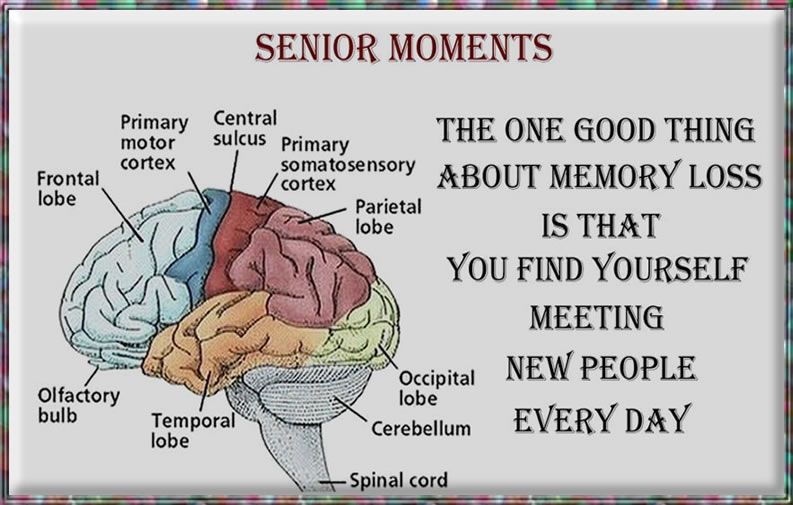
Several areas of the brain are associated with memory,
The cerebral cortex is divided into right and left hemispheres. (often referred to as gray matter)
The cortex covers the outer portion of the cerebrum and cerebellum. The portion of the cortex that covers the cerebrum is called the cerebral cortex.
It encompasses about two-thirds of the brain mass and lies over and around most of the structures of the brain.
It is the most highly developed part of the human brain and is responsible for thinking, perceiving, producing and understanding language.
It is also the most recent structure in the history of brain evolution.
Most of the actual information processing in the brain takes place in the cerebral cortex.
The cerebral cortex is divided into lobes that each have a specific function.
For example, there are specific areas involved in vision, hearing, touch, movement, and smell.
Other areas are critical for thinking and reasoning. Although many functions, such as touch, are found in both the right and left cerebral hemispheres,
some functions are found in only one cerebral hemisphere. For example, in most people, language abilities are found in the left hemisphere.
Cerebral Cortex Lobes
Parietal Lobe - involved in the reception and processing of sensory information from the body.
Frontal Lobe - involved with decision-making, problem solving, and planning.
Occipital Lobe - involved with vision.
Temporal Lobe - involved with memory, emotion, hearing, and language.
Aging may be considered a major factor in memory loss
Memory loss may also be the result of trauma, injury, disease, and lifestyle choices, such as alcoholism and drug use.
.