

The U.S. is at war with... the U.S.!!!

RambleTamble

Member
Location
U.S.
On February 26, 2026, the U.S. military mistakenly shot down a U.S. Customs and Border Protection (CBP) drone near the Texas-Mexico border. The incident, described as a major breakdown in federal coordination, occurred near Fort Hancock, about 55 miles southeast of El Paso.

Key Details of the Incident
  • Weapon Used: Military personnel used a high-energy laser (part of a counter-unmanned aircraft system) to disable the drone after misidentifying it as a threat.
  • Cause: The Pentagon reportedly was not alerted in advance by the CBP about the drone's flight, leading military operators to mistake the government aircraft for a "hostile" or "cartel" drone.
  • Airspace Closure: Following the "friendly fire" incident, the FAA expanded flight restrictions over Fort Hancock, effective through June 24, 2026. Commercial flights at El Paso International Airport were not impacted this time.
  • Joint Response: The Department of Defense, CBP, and FAA issued a joint statement late Thursday acknowledging the engagement within military airspace and pledging increased cooperation.
This was the second major drone-related mishap in the region in just two weeks:
  • February 11, 2026: CBP personnel used a military-provided laser near Fort Bliss against what they thought was a cartel drone, but it turned out to be a Mylar party balloon.
  • That earlier incident caused a brief, eight-hour shutdown of the El Paso International Airport.
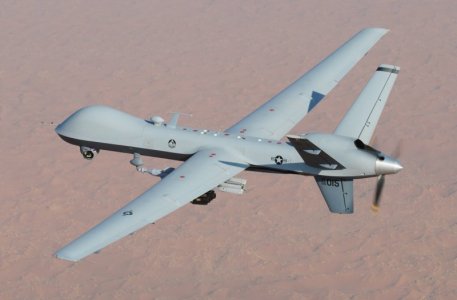
Oops.
 
The specific drone shot down on February 26, 2026, was a General Atomics MQ-9 Reaper (also known as the Predator B), a high-altitude surveillance aircraft.

Estimated Costs
  • Unit Cost: A single MQ-9 Reaper costs approximately $30 million to $34 million in current valuation.
  • Operating Cost: It costs roughly $12,255 to $13,000 per hour to keep one of these drones in the air when factoring in personnel, maintenance, and equipment overhead.
  • Total System Value: A full system—which typically includes four aircraft, a ground control station, and satellite links—can cost upwards of $57 million to $64 million.
Comparison with Other "Targets"
The recent series of incidents at the border highlights a massive cost disparity in the objects being engaged:
  • The Drone: $30M+.
  • The Balloon: On February 11, the same laser system was used to down what turned out to be a Mylar party balloon, which typically costs less than $5.
  • The Weapon: The military used the Locust laser system (manufactured by BlueHalo), which is designed to provide a low "cost-per-shot" compared to traditional missiles, though the initial acquisition of the laser technology itself is a multi-million dollar investment.
 
  • The Weapon: The military used the Locust laser system (manufactured by BlueHalo), which is designed to provide a low "cost-per-shot" compared to traditional missiles, though the initial acquisition of the laser technology itself is a multi-million dollar investment.
The silver lining is

It works.
 
No.... this is our tax dollars at work.

The most recent broad estimate from the Department of Health and Human Services (HHS/ASPE) was for 2019.
Meanwhile.... In 2021, state and local governments spent $862 billion on public welfare, or 23 percent of direct general
expenditures.
"...The largest slice of operational costs were vendor payments for medical care, which totaled $702 billion dollars in 2021, or 81 percent of all state and local public welfare spending....".
Shows you the never-ending issue of people not being able to afford healthcare.
 
The military budget is now over a trillion dollars a year! This is some interesting information about military waste...

Precise estimates of waste in the U.S. military budget vary by source, but experts and audits consistently identify hundreds of billions of dollars in inefficiencies, failed projects, and unaccounted assets.

Total Estimated Waste
  • Bureaucratic Waste: A 2015 Pentagon-commissioned study identified $125 billion in administrative waste over five years.
  • Annual Percentage: Management consulting firm McKinsey estimated that 15% to 20% of the Pentagon’s annual expenses, or $75 billion to $100 billion per year, is wasteful.
  • Improper Payments: The Department of Defense (DOD) reported approximately $11 billion in improper payments in 2020 alone—about 1.7% of its total payments.
Audit Failures & Unaccounted Assets
  • Failed Audits: The Pentagon has failed seven consecutive annual audits since 2018. In the most recent 2024 audit, it could not fully account for its $824 billion budget.
  • Missing Assets: As of late 2023, the DOD was unable to adequately account for 63% of its $3.8 trillion in assets. Much of this is untraceable property held by military contractors.
Failed and Over-Budget Projects
  • F-35 Lightning II: This program has been cited for over 800 unresolved design flaws and massive cost escalations, with maintenance alone expected to cost taxpayers billions more than initially projected.
  • Future Combat System: The Army spent $8 billion on this failed vehicle development program before canceling it with almost nothing to show for the investment.
  • Sentinel Missile Program: Reported to be 81% over budget as of 2024, triggering legal reviews for potential cancellation.
 
Back
Top