UK bans sale of cigarettes to future generations.

That's a pretty cruel, cold turkey method at a time when the young troops are already going through a really rough time.

When I quit smoking, my husband was still active duty and I was using the military pharmacy, where every single time I went in with my RX for nicotine patches, I would have to hear whining about how costly they were for the poor military. I would say, surely they aren't as expensive as a patient with lung cancer, but they didn't see it that way. The pharmacy budget being separate from the surgery budget.

I don't know what it costs now, but at that time, a carton of 10 packs of their cheapest cigarettes cost $5.00. It was as if they wanted us to smoke.

Are you old enough to remember when C rations and K rations contained packages of cigarettes ? That practice ( of giving tobacco to troops ) began in the WW1 era. JIMB>
 
Depending on the source, the US government collects $4-9 billion in tobacco taxes each year. They will have to recoup that money from somewhere, which most likely means they will increase taxes on ? others.

Would you be willing for your income tax to be increased because tobacco is banned?
 
if they're gonna ban cigarettes they should ban booze too then.

adding this:
In the United States, between 11,000 and 13,500 people die each year in crashes involving alcohol-impaired drivers. Globally, it is estimated that roughly 273,000 deaths occur annually due to drunk driving.
 
Depending on the source, the US government collects $4-9 billion in tobacco taxes each year. They will have to recoup that money from somewhere, which most likely means they will increase taxes on ? others.

Would you be willing for your income tax to be increased because tobacco is banned?
The government would save far more than what they lose in tax revenue by having fewer cancer patients and people with other health problems that they would otherwise need to support with welfare since they wouldn't be able to work due to their illnesses. The government would also save a lot on Medicaid and emergency room visits currently needed to treat those people.

And the federal government never raises taxes to offset costs. They just add it to the national debt. State governments need to be a little more responsible.
 
The government would save far more than what they lose in tax revenue by having fewer cancer patients and people with other health problems that they would otherwise need to support with welfare since they wouldn't be able to work due to their illnesses. The government would also save a lot on Medicaid and emergency room visits currently needed to treat those people.

And the federal government never raises taxes to offset costs. They just add it to the national debt. State governments need to be a little more responsible.
You are right. But the costs to treat obesity are much higher so shouldn't that be controlled also?
 
You are right. But the costs to treat obesity are much higher so shouldn't that be controlled also?
Maybe so. They could tax food based on the person's body mass index. If you're within a certain range, there is no tax, but if you go outside that range, the further out you go, the more tax you would pay.

They could also enact taxes on sugary foods the same way they do with "sin" taxes. Gluttony is one of the seven deadly sins in Christianity, so Christians shouldn't have a problem with that.

Of course, these taxes shouldn't be excessive. They should just be enough to offset the cost of obesity treatment so the rest of us wouldn't have to pay for it.

NOTE: I'm just brainstorming here. Feel free to offer your own solutions.
 
I'm for restrictive retail bans and not doing so in public locations, or promoting or advertising, for products that are known to be harmful to our bodies. If a product is costing the rest of us money due to having to support their medical issues, then those products ought be fully taxed to minimally cover all their overhead to society. The strategy should be to make it difficult to do harmful things without complete bans.

The UK ban does not penalize those doing so, where they are not bothering or impacting others. As someone with a general "Let It Be" Counterculture philosophy, I'm fine letting people doing a lot of dangerous or harmful things. For instance if someone wants base jump off remote wilderness cliffs, fine. But not off our downtown skyscrapers or bridges.

Or if someone want to center their lives around constant pornography and weird seks, fine. Just do so privately out of sight of the rest of us and don't publicly promote whatever around children. Or if someone with a boring life decides to spend their life doing heavy drugs, fine. But I don't want to see them on our city sidewalks, shooting up in public, bothering others in any way, or having the public pay for their medical issues. If government can't tax whatever to cover society's overhead, then who ever's as a group should be responsible for funding their own sicknesses or be sent off to some remote island where they can't affect the rest of us.

I feel the same way with weed. Don't smoke around others like is currently a hot subject in New York City where they got their law wrong. Don't penalize people that do so discretely. Don't ban use where other people are not about in public open air places, well away from others.
 
Last edited:
You are right. But the costs to treat obesity are much higher so shouldn't that be controlled also?
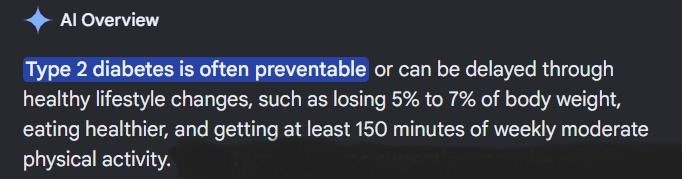
I was also thinking about the cost of diabetes specifically.

From the American Diabetes Association -> "The total annual cost of diabetes in 2022 is $412.9 billion, including $306.6 billion in direct medical costs and $106.3 billion in indirect costs. People with diagnosed diabetes now account for one of every four health care dollars spent in the U.S."

diabetes.jpg
 
What are some OTC products many people use, supposedly to improve their health? Here are a few:

Supposedly healthy snacks, like Granola, Protein Bars, and Trail Mix are often packed with added sugars, oils, and high-fructose corn syrup.

Fat-free and reduced-fat products - when fat is removed, manufacturers often add sugar, sodium, or artificial fillers to maintain flavor, which can be worse than regular products for metabolism.

Cleansing & detoxing products - these are unnecessary, even harmful. The body detoxifies itself via the liver and kidneys. Using these products can result in dangerous, rapid weight loss and nutrient loss which is harmful to long-term health.

Some people strictly cut all carbs: eliminating all carbohydrates can lead to nutrient deficiencies, heart issues, and reduced energy.

Veggie Chips & pre-packaged salads: Many veggie chips are mostly corn/potato starch and fried in oil.

The news reported that one major cereal manufacturer is (again) adding toys to boxes of cereal, an obvious ploy to attract young children to consume more sugared products, making them more susceptible to succumb to type 2 diabetes later in life, the same as the older generation now on high cost diabetes medications.

Obviously some or all of the products on the list should be banned if we are to reply on those in charge to look out for our best interests.
 
And you know this?

Senator Dick Durbin reintroduced the "Dietary Supplement Listing Act of 2026" (S. 3677) in January 2026, requirng manufacturers to register all products, ingredients, and labels with the FDA. Opponents argue it acts as a "Trojan Horse" to eventually allow the FDA to target and remove products such as dietary supplements.

I shouldn't have said nobody - there is always an exception.

But even the exception you name isnt aiming for a ban, it is aiming for regulation and transperency of ingredients etc - which doesn't seem a bad idea to me
Opponents will use the slippery slope argument - like posters here are doing about cigarette ban to younger people - but it seems nobody was actually calling for a ban on dietary supplements
 
if they're gonna ban cigarettes they should ban booze too then.

adding this:
In the United States, between 11,000 and 13,500 people die each year in crashes involving alcohol-impaired drivers. Globally, it is estimated that roughly 273,000 deaths occur annually due to drunk driving.


No - because alcohol in moderation is not a health hazard nor do most people drink it to addictive levels

Obviously drink driving is illegal and there are limits on alcohol sales - the obvious one being to underage people. and the are heavy taxes on alcohol products.
It is also easy to make your own - so banning just leads to black market and moonshine production

and nobody is going to ban cigarettes anyway - what UK is doing is incrementally increasing the age at which one can buy them. Selling to underage people is already illegal
 
I shouldn't have said nobody - there is always an exception.

But even the exception you name isnt aiming for a ban, it is aiming for regulation and transperency of ingredients etc - which doesn't seem a bad idea to me
Opponents will use the slippery slope argument - like posters here are doing about cigarette ban to younger people - but it seems nobody was actually calling for a ban on dietary supplements
The bill is about regulation, yes, but when using the word "aim," or "aiming," it suggests a goal, or plan to accomplish a desired outcome. Since neither of us can possibly know the intent or goal of Durbin, who introduced the bill, it would be pure conjecture to assume the bill won't lead to more control or even a ban in the long run.

The "slippery slope" regulations on tobacco products, weren't exactly slippery, since tobacco has been increasingly regulated for years, and now we see how all that eventually led to a ban in the UK. I recognize that you do not perceive it as a ban, but that is debatable, since it is a ban by matter of degree, at the very least.

I assume that you realize I'm not promoting a ban on supplements. In my posts you've replied to, and other of my posts in this thread so far, I have pointed out the discrepancies and contradictions, where the issue of tobacco products restrictions varies from other personal freedom restrictions and fail to align or remain uniform.

As I was composing this post, I see your post #187 just appeared, where you wrote:
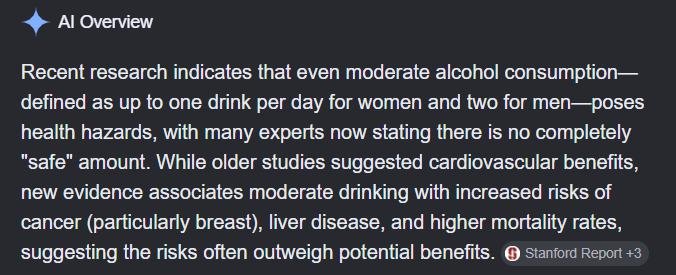
alcohol in moderation is not a health hazard

The information you have appears to be obsolete:

moderate.jpg
 
No - because alcohol in moderation is not a health hazard nor do most people drink it to addictive levels

Obviously drink driving is illegal and there are limits on alcohol sales - the obvious one being to underage people. and the are heavy taxes on alcohol products.
It is also easy to make your own - so banning just leads to black market and moonshine production

and nobody is going to ban cigarettes anyway - what UK is doing is incrementally increasing the age at which one can buy them. Selling to underage people is already illegal
Actually according to AI:
The World Health Organization (WHO) estimates that approximately 400 million people worldwide aged 15 and older lived with alcohol use disorders (AUD) as of 2024, representing about 7% of the global adult population.

Of this number, roughly 209 million people suffer from alcohol dependence.

Not sure I'd say most people.
 
Back
Top