You are using an out of date browser. It may not display this or other websites correctly.
You should upgrade or use an alternative browser.
You should upgrade or use an alternative browser.
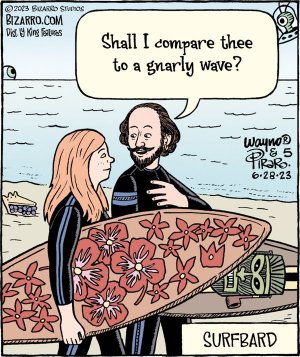
Bill Shakespeare...Alive and Well!
- Thread starter Meanderer
- Start date


Beware the Ides of March. But Why?
"It's unlikely even Shakespeare could have predicted how his famous phrase would have evolved."
"You've probably heard the soothsayer’s warning to Julius Caesar in William Shakespeare's play of the same name: “Beware the Ides of March.” Not only did Shakespeare’s words stick, they branded the phrase—and the date, March 15—with a dark and gloomy connotation. It’s likely that many people who use the phrase today don’t know its true origin. In fact, just about every pop culture reference to the Ides—save for those appearing in actual history-based books, movies or television specials—makes it seem like the day itself is cursed."
"But the Ides of March actually has a non-threatening history. Kalends, Nones and Ides were ancient markers used to reference dates in relation to lunar phases. Ides simply referred to the first new moon of a given month, which usually fell between the 13th and 15th. In fact, the Ides of March once signified the new year, which meant celebrations and rejoicing."
"It's unlikely even Shakespeare could have predicted how his famous phrase would have evolved."
"You've probably heard the soothsayer’s warning to Julius Caesar in William Shakespeare's play of the same name: “Beware the Ides of March.” Not only did Shakespeare’s words stick, they branded the phrase—and the date, March 15—with a dark and gloomy connotation. It’s likely that many people who use the phrase today don’t know its true origin. In fact, just about every pop culture reference to the Ides—save for those appearing in actual history-based books, movies or television specials—makes it seem like the day itself is cursed."
"But the Ides of March actually has a non-threatening history. Kalends, Nones and Ides were ancient markers used to reference dates in relation to lunar phases. Ides simply referred to the first new moon of a given month, which usually fell between the 13th and 15th. In fact, the Ides of March once signified the new year, which meant celebrations and rejoicing."

RadishRose
Forever in Our Hearts
- Location
- Connecticut, USA
https://www.history.com/this-day-in-history/the-ides-of-marchBeware the Ides of March. But Why?
"It's unlikely even Shakespeare could have predicted how his famous phrase would have evolved."
"You've probably heard the soothsayer’s warning to Julius Caesar in William Shakespeare's play of the same name: “Beware the Ides of March.” Not only did Shakespeare’s words stick, they branded the phrase—and the date, March 15—with a dark and gloomy connotation. It’s likely that many people who use the phrase today don’t know its true origin. In fact, just about every pop culture reference to the Ides—save for those appearing in actual history-based books, movies or television specials—makes it seem like the day itself is cursed."
"But the Ides of March actually has a non-threatening history. Kalends, Nones and Ides were ancient markers used to reference dates in relation to lunar phases. Ides simply referred to the first new moon of a given month, which usually fell between the 13th and 15th. In fact, the Ides of March once signified the new year, which meant celebrations and rejoicing."

Gaer
"Angel whisperer"
- Location
- New Mexico U.S.A.
I am so glad I read that! This now makes sense! It's a time of the new Spring year with celebrations and rejoicing. It's a renewal, not a time of the year to be feared. All my life I'd heard, "Beware the Ides of March", said with a dire expression of warning.Beware the Ides of March. But Why?
"It's unlikely even Shakespeare could have predicted how his famous phrase would have evolved."
"You've probably heard the soothsayer’s warning to Julius Caesar in William Shakespeare's play of the same name: “Beware the Ides of March.” Not only did Shakespeare’s words stick, they branded the phrase—and the date, March 15—with a dark and gloomy connotation. It’s likely that many people who use the phrase today don’t know its true origin. In fact, just about every pop culture reference to the Ides—save for those appearing in actual history-based books, movies or television specials—makes it seem like the day itself is cursed."
"But the Ides of March actually has a non-threatening history. Kalends, Nones and Ides were ancient markers used to reference dates in relation to lunar phases. Ides simply referred to the first new moon of a given month, which usually fell between the 13th and 15th. In fact, the Ides of March once signified the new year, which meant celebrations and rejoicing."
Thanks for setting me straight!


Warrigal
SF VIP
- Location
- Sydney, Australia
Julius Caesar was the Shakespearean play that I studied in my final year at High School. We were required to memorise passages to quote when sitting for the Leaving Certificate English exam.
In the play Caesar is warned by a soothsayer to be careful, because the signs are ominous, by crying out "Beware the ides of March". Caesar refuses to listen and we get the famous words -
"A coward dies a thousand times before his death, but the valiant taste of death but once. It seems to me most strange that men should fear, seeing that death, a necessary end, will come when it will come."
Later, Caesar sees the soothsayer again and says to him, "The ides of March are come", to which the sooth sayer replies, "Aye Caesar, but not gone." That day, Caesar is assassinated by the conspirators including his friend Brutus.
This play has stuck in my mind since I was a teen and I love the example of courage depicted in the play.
I did not plan it, but I was married on March 15, the ides of March, in 1963.
In the play Caesar is warned by a soothsayer to be careful, because the signs are ominous, by crying out "Beware the ides of March". Caesar refuses to listen and we get the famous words -
"A coward dies a thousand times before his death, but the valiant taste of death but once. It seems to me most strange that men should fear, seeing that death, a necessary end, will come when it will come."
Later, Caesar sees the soothsayer again and says to him, "The ides of March are come", to which the sooth sayer replies, "Aye Caesar, but not gone." That day, Caesar is assassinated by the conspirators including his friend Brutus.
This play has stuck in my mind since I was a teen and I love the example of courage depicted in the play.
I did not plan it, but I was married on March 15, the ides of March, in 1963.

RadishRose
Forever in Our Hearts
- Location
- Connecticut, USA

A day in the life of William Shakespeare

A man of many interests
"William Shakespeare is revered around the world as the greatest playwright to have ever lived. But Shakespeare was much more than just a man of the theatre. He was also a celebrated poet, a family man and a hugely successful businessman."
"As well as writing new plays, Shakespeare juggled other interests from his home in Stratford-upon-Avon, New Place. Based on what we know about him, and the history of this period, we have imagined what a typical day in his life was like in 1604."
"Tax records reveal that New Place had 10 fireplaces, which means it may have had as many as 30 rooms. Stratford, not London, was Shakespeare's base from 1597 onwards. Shakespeare was a literary commuter, travelling south when professional commitments required him to be there, but enjoying his fine Warwickshire home whenever he had the chance. When in the capital he rented. He did buy a house in London in 1613, but it is likely that he made the purchase purely as an investment."
"In 1604 he wrote a new piece set in the far-off land of Cyprus for his theatre company, The King's Men. The play was called Othello after its main character, a general in the Venetian army. Shakespeare took his inspiration from a book called Gli Hecatommithi by Geraldi Cinthio, which also told the story of a Moorish military officer. Much of Shakespeare's work was based on other stories, meaning he would have needed a study with a large number of books to refer to when writing."
(READ MORE)
A man of many interests
"William Shakespeare is revered around the world as the greatest playwright to have ever lived. But Shakespeare was much more than just a man of the theatre. He was also a celebrated poet, a family man and a hugely successful businessman."
"As well as writing new plays, Shakespeare juggled other interests from his home in Stratford-upon-Avon, New Place. Based on what we know about him, and the history of this period, we have imagined what a typical day in his life was like in 1604."
04.45
Shakespeare awakes
"Shakespeare wakes up in one of the most impressive houses in Stratford-upon-Avon.""Tax records reveal that New Place had 10 fireplaces, which means it may have had as many as 30 rooms. Stratford, not London, was Shakespeare's base from 1597 onwards. Shakespeare was a literary commuter, travelling south when professional commitments required him to be there, but enjoying his fine Warwickshire home whenever he had the chance. When in the capital he rented. He did buy a house in London in 1613, but it is likely that he made the purchase purely as an investment."
05:00
Straight to work
"In an age before electric or gas lighting, Shakespeare rises early to take advantage of natural light.""In 1604 he wrote a new piece set in the far-off land of Cyprus for his theatre company, The King's Men. The play was called Othello after its main character, a general in the Venetian army. Shakespeare took his inspiration from a book called Gli Hecatommithi by Geraldi Cinthio, which also told the story of a Moorish military officer. Much of Shakespeare's work was based on other stories, meaning he would have needed a study with a large number of books to refer to when writing."
(READ MORE)
RadishRose
Forever in Our Hearts
- Location
- Connecticut, USA
Yikes... I read quite a bit of this. I now know more about Billy Shakes than I ever did. 


Four times Shakespeare has inspired stories about robots and AI

Commander Data plays Prospero
 Commander Data is an android on the starship USS Enterprise. United Archives GmbH/Alamy
"Star Trek is one of science fiction’s richest sources of Shakespeare allusions. In the 1994 episode Emergence, android Lieutenant Commander Data is performing the role of exiled magician Prospero from The Tempest on the holodeck. Just as he quotes Prospero’s mysterious claim that he has brought the dead to life, the Enterprise’s voyage is disrupted by an unexpected storm."
"The Tempest also begins with a ship being driven off course by a (magical) storm, and a curious connection is implied between Data’s performance and the discovery of a strange new being on the ship, an emerging artificial consciousness."
Commander Data plays Prospero
"Star Trek is one of science fiction’s richest sources of Shakespeare allusions. In the 1994 episode Emergence, android Lieutenant Commander Data is performing the role of exiled magician Prospero from The Tempest on the holodeck. Just as he quotes Prospero’s mysterious claim that he has brought the dead to life, the Enterprise’s voyage is disrupted by an unexpected storm."
"The Tempest also begins with a ship being driven off course by a (magical) storm, and a curious connection is implied between Data’s performance and the discovery of a strange new being on the ship, an emerging artificial consciousness."

Thomas Jefferson and Shakespeare
"While in England in 1786, Jefferson went on a trip with John Adams that included Shakespeare’s childhood home at Stratford-upon-Avon. Although Adams described this tourist site as “small and mean,” Jefferson simply noted the costs of going there, including entry fees to see the birthplace and the tomb. He and Adams also followed the custom of other visitors by cutting a souvenir piece of wood from a chair where Shakespeare had supposedly sat. In 2006, Jefferson’s home at Monticello exhibited this memento, along with a wry note by Jefferson: “A chip cut from an armed chair in the chimney corner in Shakespeare’s house at Stratford on Avon said to be the identical chair in which he usually sat. If true like the relics of the saints it must miraculously reproduce itself.”
"Jefferson and Adams’s diaries certainly suggest the visit was disappointing (one biographer pictures Jefferson’s “teeth obviously grating” as he jotted down the fees). Many years later, however, a very different version of these events—perhaps apocryphal—was suggested by Abigail Adams. She wrote in an 1815 letter that when Thomas Jefferson first reached Stratford, he kissed the ground." READ MORE
"While in England in 1786, Jefferson went on a trip with John Adams that included Shakespeare’s childhood home at Stratford-upon-Avon. Although Adams described this tourist site as “small and mean,” Jefferson simply noted the costs of going there, including entry fees to see the birthplace and the tomb. He and Adams also followed the custom of other visitors by cutting a souvenir piece of wood from a chair where Shakespeare had supposedly sat. In 2006, Jefferson’s home at Monticello exhibited this memento, along with a wry note by Jefferson: “A chip cut from an armed chair in the chimney corner in Shakespeare’s house at Stratford on Avon said to be the identical chair in which he usually sat. If true like the relics of the saints it must miraculously reproduce itself.”
"Jefferson and Adams’s diaries certainly suggest the visit was disappointing (one biographer pictures Jefferson’s “teeth obviously grating” as he jotted down the fees). Many years later, however, a very different version of these events—perhaps apocryphal—was suggested by Abigail Adams. She wrote in an 1815 letter that when Thomas Jefferson first reached Stratford, he kissed the ground." READ MORE


Mizmo
Well-known Member
- Location
- Ontario, Canada