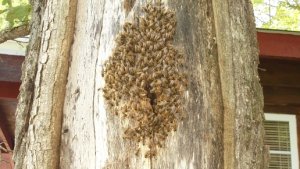
What do you think is killing off honeybees? Do you think they will all eventually disappear?

Barneyhill

New Member
20 years ago I remember during the late summer months having to spray or stomp honeybees in my back yard because a huge number of them gathered around the ripe apples pears and grapes that had fallen to ground in our yard. Looking back now I feel bad that I had to resort to extreme measures to be rid of them because for the past 5 years they have virtually vanished from our back yard during the summer fruit tree and vine harvest. I didn't see a bee this past summer didn't see any during the summer of 2018.
If I am not mistaken I think I saw about four during the summer of 2017.

There are several theories out and about their demise. what are your ideas on this? Honeybees without them humans couldn't exist without because they are our main pollinators of various fruit trees and vegetables.

https://www.thoughtco.com/why-honeybees-are-disappearing-1203584
 

I like bees. I watch them, often. They do their thing, I do mine. They interest me.

It's wasps that I can't stand. I've been stung many times, when aloft, sometimes out of nowhere. I do spray for wasps, when I find their nests under the eaves of my house. I feel not so great about that, but if it's them or me, it's gonna be them, everytime.

I opened my front door, one morning, and this wasp, who had been between my security screen door and door, stung both sides of my neck, in under five seconds. Painful as hell. I never saw where he went, but I sealed every gap in my screen door.

To this day, when I open that door, I'm on guard.
 
OK, honeybees are very beneficial and important. Honeybees are in trouble. So what to do? It isn't a difficult question......begin learning the craft of beekeeping! Given that one isn't allergic to their stings, that one can afford the cost and that one's community is amenable to and has the available flowering plants then one can prepare to go active in beekeeping next spring! Get a book like "Beekeeping for Dummies", or any of a multitude of other titles, go online and watch youtube videos of how to accomplish the multitude of skills and where to buy a package of bees then get the paraphernalia and put in your order for bees now!
The future of bees is in our hands and backyard beekeepers with one or two colonies, or five colonies like me, we are the future of the honeybee.
And BTW, once you get started you get hooked on it. On a warm summer's day the pleasure of reclining in a comfy chair near one's beehives and watching the foragers busily going to and fro, hearing the contended humming of the thousands of bees inside the hive is a joy not quite like anything else. Besides, when one has a healthy colony of bees living in their hive then one has their honey to harvest. When people learn you have honey from your own bees, they want some.....even if they don't usually eat honey. OK, I guess I've voiced my opinion.
 
OK, honeybees are very beneficial and important. Honeybees are in trouble. So what to do? It isn't a difficult question......begin learning the craft of beekeeping! Given that one isn't allergic to their stings, that one can afford the cost and that one's community is amenable to and has the available flowering plants then one can prepare to go active in beekeeping next spring! Get a book like "Beekeeping for Dummies", or any of a multitude of other titles, go online and watch youtube videos of how to accomplish the multitude of skills and where to buy a package of bees then get the paraphernalia and put in your order for bees now!
The future of bees is in our hands and backyard beekeepers with one or two colonies, or five colonies like me, we are the future of the honeybee.
And BTW, once you get started you get hooked on it. On a warm summer's day the pleasure of reclining in a comfy chair near one's beehives and watching the foragers busily going to and fro, hearing the contended humming of the thousands of bees inside the hive is a joy not quite like anything else. Besides, when one has a healthy colony of bees living in their hive then one has their honey to harvest. When people learn you have honey from your own bees, they want some.....even if they don't usually eat honey. OK, I guess I've voiced my opinion.
What a great post. Yes. Everyone can become a bee keeper. We bought one for our backyard. It’s still new but we are excited about it. I’ve always liked bees 🐝 and have no problems with wasps or Hornets. I leave them alone and they leave me alone. It’s all good.
 
Last edited:
I know nothing about beekeeping but if you keep stealing their food to make honey, naturally there are going to be repercussions.

The main problem is invasion by mites.

Areas that don't have the mites have plentiful bees.
 
field sprays - are a killer to everything ' iam quite sure we could live quite happly without the deadly stuff (n)(n)
 
Not having a degree in honeybee-ology, I understand that farmers are concerned about the drastic decrease in bee population., and their ability to pollinate crops. Insecticide use is a short term solution with unknown long term consequences. I suppose we'll kill off most of the bees, and the price of crops will skyrocket, out of reach for most of us, causing us to find a real solution, rather than short term fixes.
 
I like bees. I watch them, often. They do their thing, I do mine. They interest me.

It's wasps that I can't stand. I've been stung many times, when aloft, sometimes out of nowhere. I do spray for wasps, when I find their nests under the eaves of my house. I feel not so great about that, but if it's them or me, it's gonna be them, everytime.

I opened my front door, one morning, and this wasp, who had been between my security screen door and door, stung both sides of my neck, in under five seconds. Painful as hell. I never saw where he went, but I sealed every gap in my screen door.

To this day, when I open that door, I'm on guard.
Sorry the wasps stung you. Glad you didn't suffer a reaction from the stings.
 
Not having a degree in honeybee-ology, I understand that farmers are concerned about the drastic decrease in bee population., and their ability to pollinate crops. Insecticide use is a short term solution with unknown long term consequences. I suppose we'll kill off most of the bees, and the price of crops will skyrocket, out of reach for most of us, causing us to find a real solution, rather than short term fixes.
I read earlier this year we all could help in some way in helping to keep a healthy population of bees by planting flowers


https://www.motherearthliving.com/gardening/gardening-tips/plants-to-save-the-bees-ze0z1710zhee
 
Honey bees are not native to North America. Settlers introduced them. The job of pollinating fell to other insects and other types of native bees before the advent of honey bees here. If the honey bee disappeared, it would be concerning, but the native flora would still survive.


Native Bees of North America
Native bees are an unappreciated treasure, with 4,000 species from tiny Perdita to large carpenter bees, they can be found anywhere in North America where flowers bloom. Most people don’t realize that there were no honey bees in America until the white settlers brought hives from Europe. These resourceful insects promptly managed to escape domestication, forming swarms and setting up housekeeping in hollow trees, other cavities or even exposed to the elements just as they had been doing in their native lands. Native pollinators, in particular bees, had been doing all the pollination in this continent before the arrival of that import from the Old World. They continue to do a great deal of it, especially when it comes to native plants.


Non-native honey bee, Apis mellifera: 1. Queen surrounded by attendants. 2. Swarm. 3. Combs of a feral colony

The honey bee, remarkable as it is, doesn’t know how to pollinate a tomato or an eggplant flower, while some native bees are masters at this. The same thing happens with a number of native plants, such as pumpkins and squash, blueberries and cranberries, which are more efficiently pollinated by native bees than by honey bees
 

Back
Top