What will happen as far as our fuel?

Thus my opinion is: If there is a shortage, it is created by the oil companies to drive up prices.
Google seems to agree with you:

Asian economies are most dependent on oil passing through the Strait of Hormuz, with China (37.7% of flows), India (14.7%), South Korea (12.0%), and Japan (10.9%) being the largest importers. Roughly 89% of these shipments are destined for Asia. Conversely, the United States is largely independent, receiving only ~2.5% of its imports through this chokepoint.

Most Dependent Countries (Importing via Strait)
China: The largest recipient, taking 37.7% of the flows in 2026.
India: The second-largest, receiving ~14.7% of the shipments.
South Korea & Japan: Extremely high dependency, with roughly 70–80% of their total oil imports passing through this point.
Other Asian Nations: Combined, other Asian countries account for an additional 13.9% of flows.

Dependent Exporting Countries (Shipping out of Strait)
The Persian Gulf countries are highly reliant on this route to export their production:
Saudi Arabia: ~37% of exports via the strait.
Iraq: ~23% of exports.
UAE: ~13% of exports.
Iran & Kuwait: Also rely on this route for the majority of their exports.

Independent or Low-Dependency Countries
United States: Low dependency (2.5% of imports) due to high domestic production (e.g., in shale oil fields) and diverse supply sources.
Russia: A major exporter that does not rely on Middle Eastern oil supplies.
Canada & Mexico: Low reliance on this specific maritime route for their crude supply.

While physical dependence is low for some, any disruption in the Strait—through which ~21% of global petroleum liquids flow—would cause global oil prices to rise, affecting all countries regardless of their direct import reliance.
 
I get frustrated seeing a thread like this—where the vast majority of the responses are courteous, respectful and informative—get disrupted by a few either blatant or thinly veiled references to politics—which, as @Matrix has repeatedly made clear, and is noted several times on this site, is off-limits.

There are many forums and discussion boards where political discussions are allowed, and even encouraged, so the flouting of this rule, which luckily doesn't happen often, frustrates me.
 
Do you think that there will be a fuel shortage and maybe long lines at gas stations again like in the mid seventies because of the Straight of Hormuz problems?
In our area there wasn’t a real shortage in the 70s just panic that caused long lines.
we've already had it this month...long queues for fuel.. garages running out completely , prices through the roof.

it;s stabilised now.. not queues at the moment, everywhere seems to have fuel again, but the prices have not come down.. in some garages they're charging almost £2.00 per LITRE...

When I drove up to my daughter at the weekend...I passed many garages on and off the motorway .. the prices varied from £1.55 which is HUGE... up to £2.00 per LITRE... there's 4.5 Litres in a UK gallon...
 

Europe could run out of jet fuel in 6 weeks, IEA chief tells AP​

Source: CNBC

Published Thu, Apr 16 2026 7:22 AM EDT Updated 5 Min Ago


The International Energy Agency’s head warned Thursday that Europe maybe has six weeks left of jet fuel as the airline industry continues to grapple with headwinds due to the Middle East crisis.

IEA Executive Director Fatih Birol said the Strait of Hormuz blockade will result in “the largest energy crisis we have ever faced,” in an interview with the Associated Press on Thursday.

“In the past there was a group called ‘Dire Straits.’ It’s a dire strait now, and it is going to have major implications for the global economy. And the longer it goes, the worse it will be for the economic growth and inflation around the world,” he said.

He added that the broader economic impact includes “higher petrol (gasoline) prices, higher gas prices, high electricity prices,” with some parts of the world “hit worse than the others.”

Read more: Europe could run out of jet fuel in 6 weeks, IEA chief tells AP
Yes I saw in the News that KLM says they have fuel for 6 weeks and they skip a lot of flights to European cities. Just take the train.
 
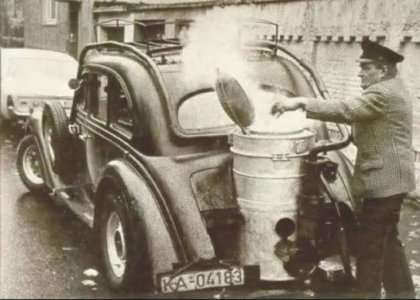
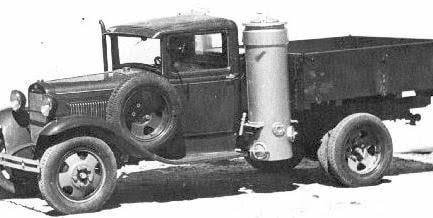
During WW II petrol driven cars in Australia were converted to run on "water gas" that was produced by passing steam over red-hot coke (carbon) at high temperatures, typically around 1000°C (1832°F). The main chemical reaction is:

C + H₂O → CO + H₂

Somehow this reaction, probably as the result of increased pressure, drove the pistons that caused the motion of the car. It is possible that in the future we might have to reexamine some of these earlier substitutes for fossil fuels.
https://www.sciencedirect.com/topics/engineering/water-gas-reaction
I’ve read about those gasogene powered vehicles. It would probably be possible to make something smaller and much more efficient today.

1776358389378.jpeg
1776358570558.jpeg
 
AND lets remember WHERE 90 percent of the fertilizer that American farmers use, comes from ? Canada, that is where it comes from. Canada has the largest number of potash mines in the world. Now imagine what would happen to US farmers if Canada stopped selling to you, and instead sold it to the rest of the world at higher prices ?

The second largest supplier is Russia, who only produce enough potash to meet their own domestic requirements. Be careful what you do, it all ways has international repercussions. JIMB>
 
Back
Top