

You are using an out of date browser. It may not display this or other websites correctly.
You should upgrade or use an alternative browser.
You should upgrade or use an alternative browser.
Who Knew? Some Fun Facts
- Thread starter RadishRose
- Start date





MrPants
Senior Member
The Alimentarium food museum in Vevey, Switzerland, is where you’ll find the world’s oldest slice of cake!
The cake was discovered in an ancient Egyptian tomb in 1913, the cake consists of two slices of wheat flatbread with a milk and honey filling. Estimated to date back to the reign of Pepi II (2251 to 2157 BCE). The cake’s two copper molds that served as a vacuum, resulting in its preservation.
The cake was discovered in an ancient Egyptian tomb in 1913, the cake consists of two slices of wheat flatbread with a milk and honey filling. Estimated to date back to the reign of Pepi II (2251 to 2157 BCE). The cake’s two copper molds that served as a vacuum, resulting in its preservation.

Lewkat
Senior Member
- Location
- New Jersey, USA


When I observed my first autopsy, the Medical Examiner told us, “The only bone not connected to another bone is the hyoid. It sits in back of the throat and is supported by thyroid cartilage and is attached to the roof of the tongue.
The autopsy was done on a 22 y/o senior college student that was raped and murdered 8 days prior to her graduation. The cause of death was strangulation, which usually breaks the hyoid bone. We were able to nab the suspect in less than 48 hours. He was sentenced to
life w/o parole. He stills sits in one of our fine prisons here in Pennsylvania.
The autopsy was done on a 22 y/o senior college student that was raped and murdered 8 days prior to her graduation. The cause of death was strangulation, which usually breaks the hyoid bone. We were able to nab the suspect in less than 48 hours. He was sentenced to
life w/o parole. He stills sits in one of our fine prisons here in Pennsylvania.
Last edited:
Lewkat
Senior Member
- Location
- New Jersey, USA





OldFeller
Well-known Member
- Location
- Pennsylvania, USA
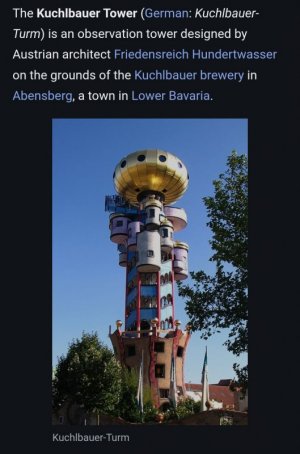
Brewery Tour or Art Museum? Kuchlbauer: Art and Beer in Germany!
Last edited:

Lewkat
Senior Member
- Location
- New Jersey, USA


debodun
SF VIP
- Location
- way upstate in New York, USA
In the English system, three of the 7 days of the week are obviously named after astronomical bodies - Sunday=Sun, Monday = Moon, Saturday = Saturn. The other five are named after Norse mythological beings:
Tuesday - Tiw (or Tiu), the Old English form of the sky and war god Týr.
Wednesday - Woden(or Odin), the chief deity in Norse mythology.
Thursday - named after Thor, the Norse god of thunder.
Friday - Frigg (or Frigga). Is the Norse goddess of love, marriage, and wisdom.
If you look at the French words for these days, their planetary origins are more apparent:
Tuesday is Mardi, or Mars Day.
Wednesday is Mercredi, or Mercury's day.
Thursday is Jeudi, or Jupiter's day.
Friday is Vendredi, or Venus' day.
Tuesday - Tiw (or Tiu), the Old English form of the sky and war god Týr.
Wednesday - Woden(or Odin), the chief deity in Norse mythology.
Thursday - named after Thor, the Norse god of thunder.
Friday - Frigg (or Frigga). Is the Norse goddess of love, marriage, and wisdom.
If you look at the French words for these days, their planetary origins are more apparent:
Tuesday is Mardi, or Mars Day.
Wednesday is Mercredi, or Mercury's day.
Thursday is Jeudi, or Jupiter's day.
Friday is Vendredi, or Venus' day.
Last edited:
OldFeller
Well-known Member
- Location
- Pennsylvania, USA
In the English system, three of the 7 days of the week are obviously named after astronomical bodies - Sunday=Sun, Monday = Moon, Saturday = Saturn. The other five are named after Norse mythological beings:
Tuesday - Tiw (or Tiu), the Old English form of the sky and war god Týr.
Wednesday - Woden(or Odin), the chief deity in Norse mythology.
Thursday - named after Thor, the Norse god of thunder.
Friday - Frigg (or Frigga). Is the Norse goddess of love, marriage, and wisdom.
If you look at the French words for these days, their planetary origins are more apparent:
Tuesday is Mardi, or Mars Day.
Wednesday is Mercredi, or Mercury's day.
Thursday is Jeudi, or Jupiter's day.
Friday is Vendredi, or Venus' day.
OldFeller
Well-known Member
- Location
- Pennsylvania, USA
This guy built his own replica of the Monkee Mobile.
OldFeller
Well-known Member
- Location
- Pennsylvania, USA
What’s at the End of Zzyzx Road?


OldFeller
Well-known Member
- Location
- Pennsylvania, USA
How Radio Waves Were Discovered
radio /rā′dē-ō/
noun
- Electromagnetic radiation with lower frequencies and longer wavelengths than those of microwaves, having frequencies lower than 300 megahertz and wavelengths longer than 1 meter.
- The transmission and reception of electromagnetic waves within this range, especially when convertible to audible sounds.
"the use of radio in warfare." - A device, such as a walkie-talkie, that transmits or receives such signals.
- The system or industry that broadcasts programs of audio content to the public or subscribers by means of radio waves.
"She was famous during the early days of radio." - Audio content, especially short programs or sets of songs, created for or distributed through such a system.
"listening to radio." - An electronic device for listening to radio programming, consisting of a tuner and speakers.
Last edited:

StarSong
Awkward is my Superpower
- Location
- Sunny Southern California ♥
You lost me after "noun."How Radio Waves Were Discovered
radio /rā′dē-ō/
noun
- Electromagnetic radiation with lower frequencies and longer wavelengths than those of microwaves, having frequencies lower than 300 megahertz and wavelengths longer than 1 meter.
- The transmission and reception of electromagnetic waves within this range, especially when convertible to audible sounds.
"the use of radio in warfare."- A device, such as a walkie-talkie, that transmits or receives such signals.
- The system or industry that broadcasts programs of audio content to the public or subscribers by means of radio waves.
"She was famous during the early days of radio."- Audio content, especially short programs or sets of songs, created for or distributed through such a system.
"listening to radio."- An electronic device for listening to radio programming, consisting of a tuner and speakers.
When my kids were growing up and asked how TVs,radios, CDs, electricity, etc., worked, I always gave them the same answer. "It's magic." Which it is to me.