Science Fiction Inspirations...

Fyrefox

Well-known Member
Science fiction can provide many things, from horrifying looks at a dystopian future to things or expressions that have stayed with you. What are some memorable things or quotes from science fiction to you?

63D7D0D0-666B-45D9-A566-6F2DF6D8415F.jpeg
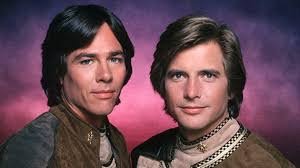
“Intelligence is the glory of the universe. Never be afraid of self-discovery.” - - from Battlestar Galactica, the original 1978 series
 

Read a great deal of SciFi in teens and 20s. Long list of favorites including the classics: Asimov, Bradbury, Clarke, but also Heinlein, Simak, LeGuin (Left Hand of Darkness and The Word for World is Forest particularly), Orwell and Huxley as well as Wells and Verne.

i went thru anthologies of short stories (and short, short ones) as if they were a snack food for the brain. Harlan Ellison's Dangerous Visions. While on Ellison, his story 'Mephisto in Onyx' perhaps my favorite of his own writings.

Also watched a lot of SciFi movies, many of them the 'B' movie on Saturday matinees. But some were better than others, The Day the Earth Stood Still being a favorite. TV scifi: Twilight Zone, Outer Limits and the many incarnations of Star Trek, which my kids have watched too. We all agree Next Generation better than original but the phenomena of the fandom of original made ST:NG possible

There's so many things that have stayed with me, but mostly the concepts of 'what if'; what would a society look like if not one of humans from earth? What would Terran societies look like if some catastrophe, natural or man made, wiped out most of us? If we were invaded by 'aliens'? And some how it tied in my interest in psychology and consciousness. When making long drives my daughter and i often have in depth conversations about the what ifs.
(Sorry so long but a subject that helped shape who i am as a person; something i get passionate about.)
 
42

from Hitchhiker's Guide to the Universe
My last job, i worked in an HR office with portable 6ft high metal & cloth Cubicle walls breaking up large high ceilinged old University building room, so you could not help but overhear things. One day the head of Training Dept Supervisor was talking to my Supervisor (database maintenance of employee info). My Boss, Ned, a classic IT type had asked a question, the other guy was a creative type who took the conversation off on a sidetrack and was about to leave when Ned said 'So what's your answer?' Over his shoulder the guy says "42" and i actually laughed out loud. Poor Ned, smart man, but he'd never read or seen the source material and we had to explain why quoting it to him was particularly funny.
 
Last edited:
I remember watching Star Trek when they'd pull our their phones. I thought how would it be possible to have a phone that's not plugged into the wall...how futuristic! Now look at what we have..phones that act as much more than phones. I've always believed that science fiction becomes science fact.
Whole books have been written and i think a documentary made about the tech inspired by Star Trek.
 
"This troubled planet is a place of the most violent contrasts. Those that receive the rewards are totally separated from those who shoulder the burdens. It is not a wise leadership."
~~“The Cloud Minders” episode of Star Trek TV series, 2/28/1969, written by Margaret Armen (said by Spock played by Leonard Nimoy)

I friggin' love most science fiction.
 
Interesting to note that Jean-Luc-Picard was portrayed by Shakespearean actor Patrick Stewart.

William Shatner, who played Captain Kirk, had previously acted in several Shakespearean plays, including Julius Caesar as Mark Antony. When Shakespearean actor, Christopher Plummer, in the mid-1950's, played the title role in Henry V in Stratford, Ontario, Shatner was his understudy and successfully filled in for him one night when he was ill. According to Shatner, that was the night he knew he was an actor.

Kirk says that Shakespeare is his favourite author. The episodes "The Conscience of the King" and "Catspaw" included scenes from Shakespearean plays. In "Requiem for Methuselah" the immortal Flint possesses a First Folio and together with "Is there in truth no Beauty?", the episode borrows from The Tempest. In "Bread and Circuses" the character Claudius Marcus wears Shakespeare's coat of arms on his robe. The titles of the episodes "All Our Yesterdays,""By Any Other Name," "The Conscience of the King," and "Dagger of the Mind" are all lines from Shakespeare.

Star Trek II: The Wrath of Khan shares themes with King Lear and the play can be seen on the antagonist Khan Noonien Singh's bookshelf.

You would be surprised just how much of Shakespeare or Shakespeare inspired script there is in Star Trek. There again it's Shakespeare's play, "The Tempest," that has been used as the basis for many a science fiction work. The Culture Show's program traced this history, including a discussion of the first work of science fiction in English, The Man in the Moon, from 1638.

 
Interesting to note that Jean-Luc-Picard was portrayed by Shakespearean actor Patrick Stewart.

William Shatner, who played Captain Kirk, had previously acted in several Shakespearean plays, including Julius Caesar as Mark Antony. When Shakespearean actor, Christopher Plummer, in the mid-1950's, played the title role in Henry V in Stratford, Ontario, Shatner was his understudy and successfully filled in for him one night when he was ill. According to Shatner, that was the night he knew he was an actor.

Kirk says that Shakespeare is his favourite author. The episodes "The Conscience of the King" and "Catspaw" included scenes from Shakespearean plays. In "Requiem for Methuselah" the immortal Flint possesses a First Folio and together with "Is there in truth no Beauty?", the episode borrows from The Tempest. In "Bread and Circuses" the character Claudius Marcus wears Shakespeare's coat of arms on his robe. The titles of the episodes "All Our Yesterdays,""By Any Other Name," "The Conscience of the King," and "Dagger of the Mind" are all lines from Shakespeare.

Star Trek II: The Wrath of Khan shares themes with King Lear and the play can be seen on the antagonist Khan Noonien Singh's bookshelf.

You would be surprised just how much of Shakespeare or Shakespeare inspired script there is in Star Trek. There again it's Shakespeare's play, "The Tempest," that has been used as the basis for many a science fiction work. The Culture Show's program traced this history, including a discussion of the first work of science fiction in English, The Man in the Moon, from 1638.

One of the things I have always loved about Star Trek is the nod to great works of English literature. I think it was the second movie (The Wrath of Khan) that began with Kirk reading from Dickens - "It was the best of times; the worst of times...," The ending of the same movie contained a reference to A Tale of Two Cities when Sydney Carlton sacrifices himself and goes to the guillotine to save another. Spock sacrifices himself to save the crew with the words, "The needs of the many outweigh the needs of the few, or the one".

In another movie (First Contact) Picard is unravelling because of his obsessive hatred of the Borg. He is jolted out of it by an angry member of the crew accusing him of being Captain Ahab prepared to sacrifice everyone in pursuit of his whale.
 
One of the things I have always loved about Star Trek is the nod to great works of English literature. I think it was the second movie (The Wrath of Khan) that began with Kirk reading from Dickens - "It was the best of times; the worst of times...," The ending of the same movie contained a reference to A Tale of Two Cities when Sydney Carlton sacrifices himself and goes to the guillotine to save another. Spock sacrifices himself to save the crew with the words, "The needs of the many outweigh the needs of the few, or the one".

In another movie (First Contact) Picard is unravelling because of his obsessive hatred of the Borg. He is jolted out of it by an angry member of the crew accusing him of being Captain Ahab prepared to sacrifice everyone in pursuit of his whale.
Loved that movie! (Not that it really matters, but the woman accusing him of being Captain Ahab was a woman from post apocalypic earth who was beamed up to the Enterprise, not a crew member.)
 
The Voyage Home was a hoot wasn't it?

I liked the way the movies dealt with contemporary issues. The Undiscovered Country was based on the collapse of the Soviet Union and the problem we in the West had trying to come to terms with the realisation that the Cold War was over. Insurrection referenced ethnic cleansing in the Balkans.

In my opinion the best science fiction is always about the present but set in another time and place.
 
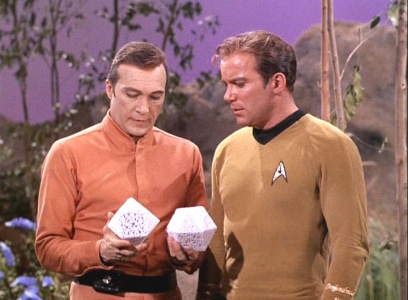
One of my favorite original Trek episodes is the one with the planet waging war via computer simulations, generating numbers of dead and the people go quietly to chambers to be 'ended'. When the Enterprise folks destroy the computers a leader of one of the sides complains because 'real war is so messy' and Shatner gives one of his best monologues ever about how war SHOULD be messy and brutal, it is incentive to making peace.
 
In "Requiem for Methuselah" the immortal Flint possesses a First Folio and together with "Is there in truth no Beauty?", the episode borrows from The Tempest.

Before the appearance of Star Trek in 1966, exactly ten years earlier (1956) a movie starring Leslie Nielsen laid the groundwork for virtually everything that followed in Gene Roddenberry's Star Trek series a decade later: interstellar travel, a "Federation", "phasers", communicators, and so forth. Roddenberry himself acknowledged the debt he owed to "Forbidden Planet" for paving the way for his show. As for "Shakespeare", it is widely known among older science fiction movie fans that "Forbidden Planet" was based on "The Tempest" - so even that connection began first with this 1956 sci-fi movie.

ufo.jpg

Only one actor from Forbidden Planet managed to turn up on Star Trek: Warren Stevens.

ZAf-A9b-C2-O0z-J.jpg
stevensrip-1.jpg
 
Before the appearance of Star Trek in 1966, exactly ten years earlier (1956) a movie starring Leslie Nielsen laid the groundwork for virtually everything that followed in Gene Roddenberry's Star Trek series a decade later: interstellar travel, a "Federation", "phasers", communicators, and so forth. Roddenberry himself acknowledged the debt he owed to "Forbidden Planet" for paving the way for his show. As for "Shakespeare", it is widely known among older science fiction movie fans that "Forbidden Planet" was based on "The Tempest" - so even that connection began first with this 1956 sci-fi movie.

ufo.jpg

Only one actor from Forbidden Planet managed to turn up on Star Trek: Warren Stevens
Remember that one well.
 
i've been thinking about it, and realized that of course 'Shakespearean' themes would show up...Shakespeare himself, dealt in the common human themes of ambition, revenge, jealousy etc. Most human stories involve our most common traits, emotions.
Few stories if any are totally 'new', but oh the pleasures in stories that unfold their themes in new and and sometimes surprising ways. Many Cold War era movies and TV shows tried to make the point of what a game changer nuclear weapons are, most often with the post war devastation. Then there's 'War Games' which has no battle scenes but the whole movie is a set up for the Computer, Joshua's line near the end. Here's that 'lesson' scene. About 3 min long, may be short ad upfront. The hacker used TicTacToe, first game Joshua learned to get thru to Joshua, who extrapolates the crucial lesson from the simple game to the war game.

 
I sometimes get reminded by life with the part in the Foundation series where some people moved to a planet that had lots of robot servants and the humans avoided contact with other humans, while other people chose to go to a planet without robots and live in crowded cities and interact with other humans all the time. I think I'd prefer the planet with robots, much better fit for an introvert.
One of my favorite sci-fi books is Prostho Plus - a novel about a dentist kidnapped by aliens and forced to provide dental care to bizarre alien species. But, don't think there were any weighty quotes from that book. :)
 
I sometimes get reminded by life with the part in the Foundation series where some people moved to a planet that had lots of robot servants and the humans avoided contact with other humans, while other people chose to go to a planet without robots and live in crowded cities and interact with other humans all the time. I think I'd prefer the planet with robots, much better fit for an introvert.
One of my favorite sci-fi books is Prostho Plus - a novel about a dentist kidnapped by aliens and forced to provide dental care to bizarre alien species. But, don't think there were any weighty quotes from that book. :)
As @Warrigal said earlier in this thread: "In my opinion the best science fiction is always about the present but set in another time and place." And how we feel about our 'present' often informs which SciFi stories 'speak' to our minds and hearts.
 
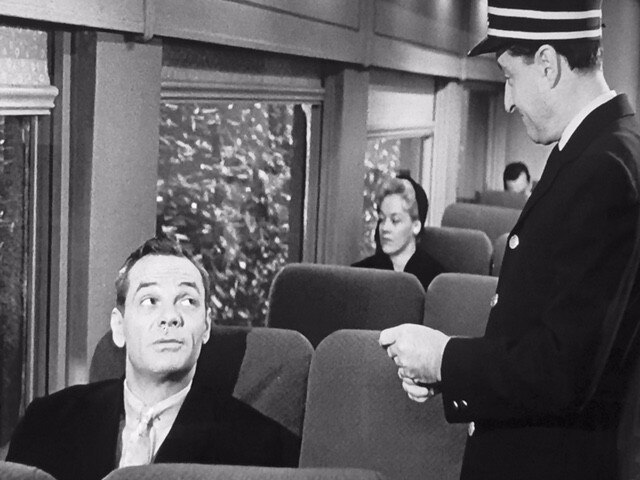
Another SF show which really addressed important issues IMO was The Twilight Zone, especially this episode, "A Stop at Willoughby":


Sorry this vid is so short; the whole episode is available on YT but it costs $1.99. Anyway, even though this was made in 1959, long before the Gordon-Gecko-greed-is-good-era, it really addressed the issues of that corporate rat race, worshipping money, etc. I also heard that it was one of series creator Rod Serling's favorite episodes.
 
Another SF show which really addressed important issues IMO was The Twilight Zone, especially this episode, "A Stop at Willoughby":


Sorry this vid is so short; the whole episode is available on YT but it costs $1.99. Anyway, even though this was made in 1959, long before the Gordon-Gecko-greed-is-good-era, it really addressed the issues of that corporate rat race, worshipping money, etc. I also heard that it was one of series creator Rod Serling's favorite episodes.
Remember that one well. Serling was amazing, it's why even some young people today will watch the marathons of TZ.
 

Back
Top