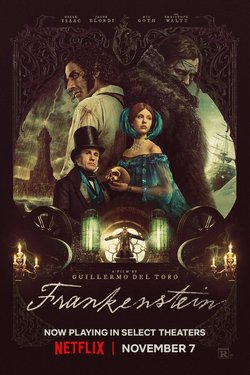
 Frankenstein
 (2025)
The film began like gang busters in a dramatic “Prelude”, which turned out to be the beginning of the ending of the famous Frankenstein saga, here written and directed by
Guillermo del Toro, which he mostly based on the original novel,
Frankenstein; or, The Modern Prometheus (1818), which she followed with a revised edition in 1823-- both by
Mary Shelley.
The thing that we soon notice is that del Toro’s screenplay differs fairly starkly from the version of the Frankenstein tale many of us are familiar with, namely from the famous 1931 film,
Frankenstein, directed by James Whale, and starring Colin Clive and Boris Karloff. Taken aback, I researched the original Shelley novel, and it turns out that del Toro did in fact fashion his screenplay much more faithfully to the original than did Whale in his looser version. Surprisingly in her novel it is never explained how Frankenstein animates his pieced-together creature; whereas in most all film versions of the story the creature is brought to life by galvanic electric shock, usually by focusing lightning.
Having seen preview trailers and photos, we anticipate the Gothic settings, scenery, castles, and moodiness, and those are featured in spades. In fact the production design and costuming are some of the chief assets of this picture.
Most of the performances, including
Oscar Isaac’s Victor Frankenstein, are over wrought, but this is tolerable, if not expected in a Gothic SciFi horror story.
Jacob Elordi as the Creature turns in a surprisingly nuanced performance, portraying Shelley’s specimen as a sapient being with feelings and longing.
Christoph Waltz does a journeyman’s job as Frankenstein’s financial backer. And
Mia Goth as Victor’s brother’s fiancee Elizabeth provides the feminine touch. The photography by
Dan Laustsen (
Nightmare Alley) is first rate, which is especially important in a Gothic film. And the music by
Alexandre Desplat is refreshingly time period accurate, sometimes a rarity in modern films.
There are detractions. The story meanders, and is a bit scattered. There are uneven uses of the creature’s superhuman strength and also his ability to heal, and he develops intellectual and emotional muance quicker than the process is shown. At times he seemed as much like T-1000 in the
Terminator film as he did a being pieced together from cadavers. Elizabeth is given too much importance in the story to its detriment. Her part was important but its use is over burdening.
I would recommend the movie for its production values, most of the acting, and for its fealty to Shelley’s original novel (which on it’s own is refreshing).
Doc’s rating: 6/10