Writing, before your first computer

I unexpectedly began having short writings published around 1980. At that time, I mailed hardcopies (sometimes with color-transparency slide photos) to the editors. At that time and for a year or so, I was hand-scribbling my initial draft, then typewriting the next draft... X-ing out misspelled or poorly chosen words. But I soon followed that method with the tidier practice of using liquid white-out, and typing-over after that had dried enough.

Cash was tight for me then. I acquired my first typewriter for $10 at a thrift store ("charity shop" as my British friends call them). It was a Smith-Corona from the late 1930s, in very decent condition, just needing a bit of cleaning of the mechanism.
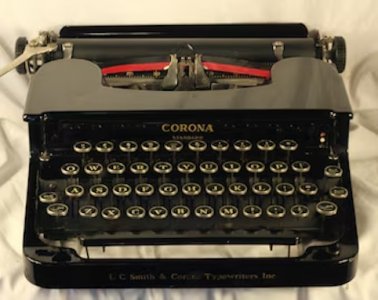
Smith-Corona '37 copy.jpg
Then, from my maternal grandmother, I inherited another S-C model, this one made in the early 1950s. It had been one my grandfather used. I really appreciated it. This typewriter had a smoother, quieter action requiring less-sharp key strokes. It served me very well for five years or so. My corrections method still remained the same.
Smith-Corona '50s.jpg
While working for a year in Vancouver in the late 80s, I modernized and bought a very affordable Olivetti electric that had options for different type-faces and a type-over mechanism (with white ink), which allowed for very neat word corrections. The model was the Olivetti Compact 60.
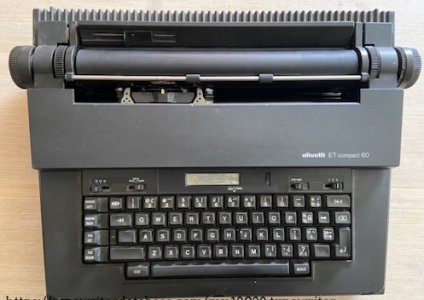
Olivetti Compact 60 .jpg
The Olivetti was a real pleasure to use. The action was extremely easy when compared with my previous typewriters.

Though a good machine, it no longer got very much use after I bought my first "tower" style computer, keyboard & monitor, a set-up then termed "a DOS machine" (and I've forgotten the brand, but it was affordable). That was in 1990, and I'd bought it because someone had contracted me for a sizable block of work that would involve several months and pay me very well. But since 1996, I've worked mainly on a laptop.

I'd be interested in what others might like to relate about your time with typewriters.:) (No requirement to include pics.)
 

Last edited:
The company where I worked in the 1980s had IBM Selectric typewriters. Those had an interchangeable type ball that moved horizontally and replaced the need for return carriages, such as those in the first two pictures you posted. Before the days of computers, I was able to buy a used Selectric for around $100 to use at home. I don't know what became of it - I probably donated it somewhere. My understanding is that today a restored Selectric is very expensive.

I write (type) a lot, but now it's all on my laptop. Seldom would I need to present anyone with a hard copy of anything I type, so I no longer replace the (expensive) ink cartridges on the printer that sits next to my laptop. I keep the printer, since it still works as a scanner. In the rare event I need anything printed, I can save it on a USB drive and go by the office supply here in town - they'll print it for me.
 
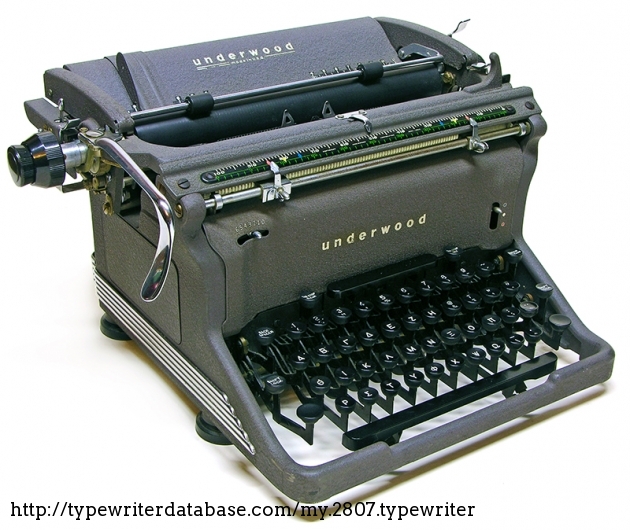
This is what I learned to type on in school..a 1950's Underwood which was already old fashioned even then in the late 60's...

gUnderwood%20_2807_1405478052.jpg
the kys were so stuiff and heavy and they had to be pressed down so far, I nearly broke my pinkie fingers trying to type.

We had Olivetti electric typewriters in class as well.. but for some reason those were only given to the slower typists

gOlivetti-Underwood+_2042_1391829644.jpg


this was the hidden fold away desk that we used in class. After every use the typerwiter had to be hidden away within the belly of the desk...


5de1b9e8b1413f34f4dbbe8698dfd73b.jpg

1-a9e1e9739bb8ee199bf644aa10120d8f.jpg
 
Last edited:
I write (type) a lot, but now it's all on my laptop. Seldom would I need to present anyone with a hard copy of anything I type, so I no longer replace the (expensive) ink cartridges on the printer that sits next to my laptop. I keep the printer, since it still works as a scanner.
Yes, that's the kind of shared Mac-based set-up we now have, but we do use it fairly frequently for hardcopies.
 
My parents bought me a mint-green Hermes 3000 portable typewriter for my 16th birthday in 1963. I was in my glory.

It had a distinctive typeface that was squarish-shaped and easy to read. The keys were easy to press. It had a snap-on hardtop cover and was fairly lightweight. I can't remember what else, but it did have some extra features. That typewriter paid for itself in college as I typed papers for the guys in the dorm. I can't remember how much I charged, but it kept me in spending money.

It was the same typewriter that Jack Kerouac and Sylvia Plath used. Ernest Hemingway had one, too. Oh, boy, I was in good company. I kept it for years until I replaced it with an electric typewriter. I sure wish I had kept it, because those old models, in good shape, are selling for a mint.
 
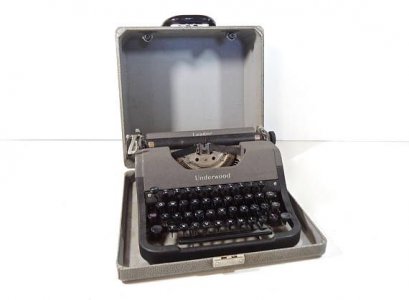
I still have a manual Underwood typewriter with the original carry case. It was given to my Dad by his boss. I was the only one in the family to use it & continued to use it when I went to college in '81.

I continued to use manual typewriters in the jail at the department in '81 until they started to computerized the book-ins in late 82-83. The only ones who had the electric IBMs were the secretaries.

The picture is very similar to the one I have & I believe it's from the late 40s.
2762981a78af0d899929c911926674ae-2428874676.jpg
 
I'm impressed. Our economics back in the day involved DIY, raising food crops, and freelance work. So for us the time wasn't ripe until a necessity was combined with a distinct financial opportunity. All a matter of self-reliance and budgeting.
I forgot the part that the eldest monk had good friends who's brother in law started a computer business in the 80's. The monk bought our first PC with the DOS operating system and a software word processor called "First Choice" to write his "manuscript". Sometimes the stuff was free, sometimes he gave us a huge discount. Sometimes we incurred a little more debt at that time, but the loan was from those good friends mentioned earlier, who were very flexible. It seemed like a natural progression of the monastery. We ran a home web page for many years and were given free internet by a local internet business. :)
 
I had an electric computer in the early 2000's. I forgot what brand. I called up a 1-800 number to inquire about ordering a part. You can imagine my surprise when the woman who answered, informed me that they didn't make typewriters anymore because of computers. Now I don't miss them anymore, since I have had a computer since 2002. Now when I see them, I think, "A typewriter! How quaint!" They now seem like something that belongs in a museum.
 
I had an electric computer in the early 2000's. I forgot what brand. I called up a 1-800 number to inquire about ordering a part. You can imagine my surprise when the woman who answered, informed me that they didn't make typewriters anymore because of computers. Now I don't miss them anymore, since I have had a computer since 2002. Now when I see them, I think, "A typewriter! How quaint!" They now seem like something that belongs in a museum.
well that's wrong, you certainly can buy new typewriters... to this day
 
Yes, 'tis true, just a couple clicks away: amazon.com/s?k=typewriter
Hi Nathan. You know, on the page that you've linked to, the black "Royal" typewriters appear to be extremely similar to the one I originally acquired for $10. I wouldn't be surprised if the mechanism is very similar, though the key action may be smoother.
 
...

I'd be interested in what others might like to relate about your time with typewriters.:) (No requirement to include pics.)
Very interesting accounting of your typewriter journey, JBR.
I started using a portable typewriter made in the late '50s when I started college in '62. I used that thing until about 1976, when I got a newer model. I think I used that until we bought a Mac 512 in around 1985, Been using computers with printers ever since.

In high school it was an elective if you wanted to learn to type. Now I wonder if that hasn't reversed, so that it's an elective if you want to learn to write or print manually...:rolleyes:
 
JBR, that Smith-Corona looks identical to one I had for years. That case made it really heavy.
 
  • Like
Reactions: JBR
JBR, that Smith-Corona looks identical to one I had for years. That case made it really heavy.
Yes, I've noticed how heavy those old-style cases are. Probably as heavy as the typewriter itself, maybe more. And oddly enough in its case the late-80s Olivetti I showed in the OP was lighter, as well as more capable. Because of the plastics in them, instead of a metal mechanism & housing for the typewriter and a case made of some sort of wood-composition, as the old portable typewriter kits were.

How times had changed. I guess one aspect being that I immediately recognized the Olivetti and its carrying case had to be treated a bit more delicately.


Back
Top