The U.S. government is insolvent

Knight

Well-known Member
The U.S. government is insolvent. That’s not hyperbole — it’s the conclusion drawn directly from the Treasury Department’s own consolidated financial statements for fiscal year 2025, released last week to near-total media silence. The numbers: $6.06 trillion in total assets against $47.78 trillion in total liabilities as of September 30, 2025.

Full article @

ttps://www.msn.com/en-us/money/markets/the-treasury-just-declared-the-us-insolvent-the-media-missed-it/ar-AA1Zebhg?ocid=msedgdhp&pc=U531&cvid=69c1a94457614f00a580f95901b03659&ei=16
 
Here is an addy form the Treasury Dept, you can look up other years there and compare them
It states the last year the US was solvent was 2001.
https://fiscaldata.treasury.gov/americas-finance-guide/national-deficit/

In the link you provided, I found what you're referring to. The early portion mentions a budget surplus in 2021 2001, in the section "Key Takeaways," but further down the page, under the heading "U.S. Deficit by Year," I found the part you're referring to, which states: "Since 2001, the federal government’s budget has run a deficit each year."

It's interesting to me how those facts correlate with personal financial affairs. Our very best years financialy were from 1993-2001. Our worst year was 2008.

Edited to correct year shown above.
 
In the link you provided, I found what you're referring to. The early portion mentions a budget surplus in 2021 2001, in the section "Key Takeaways," but further down the page, under the heading "U.S. Deficit by Year," I found the part you're referring to, which states: "Since 2001, the federal government’s budget has run a deficit each year."

It's interesting to me how those facts correlate with personal financial affairs. Our very best years financialy were from 1993-2001. Our worst year was 2008.

Edited to correct year shown above.
Figure the source was reliable and found it interesting to boot. Glad you checked it out
 
My understanding is that most countries in the world are 'insolvent'. They just keep on printing money that has no 'backing'. As long as everyone keeps printing money and no one calls in the debt, the system keeps on going. If the country 'over prints' money, then of course, hyperinflation is very possible.
I have to admit that even though I consider myself pretty knowledgeable in 'the markets', I struggle with conceptualizing money supply, currency in circulation, and what is all means.
If someone can explain how we can be solvent or insolvent with money that has no backing, please do.
 
Just thinking it over lightly this is a complicated maze isn't it?
We have all those programs the government funds that were/are being used fraudulently in every state,
whether by individuals, company's administrators or state officials.
There are National, State, County voting days to change laws or put in new ones that can pull money this way or that.
We have a Voting day here in Missouri April 7th to change were some County funds will be voted on.
I can't see this being all because of any One soul person.
This to me is just a piece of it. When we vote I am pretty sure when we cast ours, most people are viewing it as to
which way the vote is going to affect them to their benefit. Who is going to vote for higher taxes to help the country
get back in the blue?
Those are just the beginning steps into the maze. I am sure you can think of more.
 
In my view, the long-held concept of "people work - earn wages - pay taxes - fund government", is a sound strategy as long as each working part is functioning relative to the others. If jobs aren't available, or wages aren't sufficient, or taxes aren't fair, or if government spends too much, then the formula has to be fixed, or it will degenerate. We have multiple problems with this, and none are an easy fix. It's like trying to redesign a car while it's driving down the road.

Jobs are being replaced by automation, and wages are subject to pressure from cheaper imports. The top 10% of society now controls over 70% of the wealth. They do pay sufficient taxes when it is declared as personal income, but much of that wealth is undeclared through acquisitions, stock holdings, optimization, equity and assets. Their wealth grows faster than their tax burden.

Musk says 1000%, the country will go bankrupt, and full automation is the only way out. Setting aside his grasp of percentages, there is some validity to his assessment, but one has to keep in mind his agenda as well as it's uncertainties. Frankly, I think however much money government takes in, it will always spend more because those are things that get them re-elected, and cutting spending has the opposite effect.
 
Musk says 1000%, the country will go bankrupt, and full automation is the only way out. Setting aside his grasp of percentages, there is some validity to his assessment, but one has to keep in mind his agenda as well as it's uncertainties.
If we have 'full automation', the jobs go away. How does he see this as the 'only way out'? There have been many warnings, and in fact, it is happening right now, that AI and automation is taking away jobs. Having been in IT, I'm aware the alarm went out decades ago that computers would eliminate jobs --- the opposite happened. But 'full automation' is different unless I misunderstand his meaning.
 
I read the article & didn't panic. No reason to panic since I have no control over what might happen.

Do I believe America is that far in debt ? Yes.

Do I think AI will replace jobs? Yes

Do I think all will be well sometime in the future ? No.

Can I change any of what might happen? No

Alfred E. Neuman said it best "What Me Worry"
 
Respectfully disagree. I'd rather be broke in Switzerland or Norway, or Cayman Islands or Bermuda.
BonVoyageCake-FarewellCake.._2400x.jpg
 
If we have 'full automation', the jobs go away. How does he see this as the 'only way out'? There have been many warnings, and in fact, it is happening right now, that AI and automation is taking away jobs. Having been in IT, I'm aware the alarm went out decades ago that computers would eliminate jobs --- the opposite happened. But 'full automation' is different unless I misunderstand his meaning.
Well, I get that if the economy doesn’t grow faster than the debt, the math eventually breaks.
If I grasp Musk's thinking correctly, it is that with "full automation",
AI and robots would produce most goods, and since they can work mostly 24/7 without benefits or retirement, the cost of goods would be extremely low as the cost of production would be negligible.

Governments can tax automated production, so a universal basic income becomes feasible. I can follow all that, but this is where I get off the dream train. Even if you provided everyone with a UBI of $1000 a month, that might buy groceries and products that cost a fraction of what they do now, but what about mortgage payments of $3,000 a month, or insurance, or transportation, or repairs, or so many other expenses we routinely face.

If the AI/robotic future was taxed high enough to provide for all living expenses, then the cost of goods would have to go back up to pay for that, so no free lunch. Perhaps thinking outside the box, every private household could own an AI robot or two, and it would drive itself to work, and bring home the bacon. But then again, why would any company hire your robot at considerable pay when they could have their own for a fraction.

Even if AI and robotics does create more high-tech jobs, who's going to pay for college to educate those prospective workers, and who is to say that those high-tech jobs won't be done by those same androids. I don't know, there are so many variables, and a lot of predictions that could be way off. Nevertheless, it is happening, and it may be just a sink or swim scenario, so I guess we will have to adapt as the future unfolds.

 
Well, I get that if the economy doesn’t grow faster than the debt, the math eventually breaks.
If I grasp Musk's thinking correctly, it is that with "full automation",
AI and robots would produce most goods, and since they can work mostly 24/7 without benefits or retirement, the cost of goods would be extremely low as the cost of production would be negligible.

Governments can tax automated production, so a universal basic income becomes feasible. I can follow all that, but this is where I get off the dream train. Even if you provided everyone with a UBI of $1000 a month, that might buy groceries and products that cost a fraction of what they do now, but what about mortgage payments of $3,000 a month, or insurance, or transportation, or repairs, or so many other expenses we routinely face.

If the AI/robotic future was taxed high enough to provide for all living expenses, then the cost of goods would have to go back up to pay for that, so no free lunch. Perhaps thinking outside the box, every private household could own an AI robot or two, and it would drive itself to work, and bring home the bacon. But then again, why would any company hire your robot at considerable pay when they could have their own for a fraction.

Even if AI and robotics does create more high-tech jobs, who's going to pay for college to educate those prospective workers, and who is to say that those high-tech jobs won't be done by those same androids. I don't know, there are so many variables, and a lot of predictions that could be way off. Nevertheless, it is happening, and it may be just a sink or swim scenario, so I guess we will have to adapt as the future unfolds.

1774432131563.gif
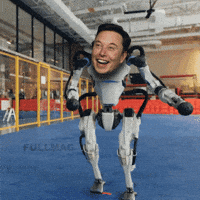
The man with the most robots wins. 😉🤭😂
 
I will chime in. While the budget had a surplus in the years being posted, the debt still increased. The reason being that revenue garnered by OASDI taxes, exceeded expenses. That was the distant past.

We focus on budget deficits, which was $1.78T for fiscal 2025. However the national debt increased $2.172T. Treasury Bills are not budgeted, with nearly $8T in total and growing rapidly.

U.S. Net International Investment Position | FRED | St. Louis Fed,
 
If we have 'full automation', the jobs go away. How does he see this as the 'only way out'? There have been many warnings, and in fact, it is happening right now, that AI and automation is taking away jobs. Having been in IT, I'm aware the alarm went out decades ago that computers would eliminate jobs --- the opposite happened. But 'full automation' is different unless I misunderstand his meaning.
if they go fully automated, what is their plan for people to have money to live on? it surely can't be legal to take away our rights to live and work and take care of ourselves? and i highly doubt they would make everything free or give us money to live on.
 
Maybe if we stopped participating in wars, and some people stopped ruining the economy by theft or whatever -- grifters in power (corporate and govt) -- we wouldn't be in such bad shape.
 
Back
Top