Well, I get that if the economy doesn’t grow faster than the debt, the math eventually breaks.
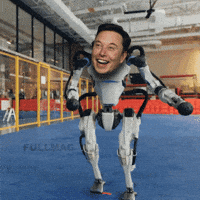
If I grasp Musk's thinking correctly, it is that with "full automation",
AI and robots would produce most goods, and since they can work mostly 24/7 without benefits or retirement, the cost of goods would be extremely low as the cost of production would be negligible.
Governments can tax automated production, so a universal basic income becomes feasible. I can follow all that, but this is where I get off the dream train. Even if you provided everyone with a UBI of $1000 a month, that might buy groceries and products that cost a fraction of what they do now, but what about mortgage payments of $3,000 a month, or insurance, or transportation, or repairs, or so many other expenses we routinely face.
If the AI/robotic future was taxed high enough to provide for all living expenses, then the cost of goods would have to go back up to pay for that, so no free lunch. Perhaps thinking outside the box, every private household could own an AI robot or two, and it would drive itself to work, and bring home the bacon. But then again, why would any company hire your robot at considerable pay when they could have their own for a fraction.
Even if AI and robotics does create more high-tech jobs, who's going to pay for college to educate those prospective workers, and who is to say that those high-tech jobs won't be done by those same androids. I don't know, there are so many variables, and a lot of predictions that could be way off. Nevertheless, it is happening, and it may be just a sink or swim scenario, so I guess we will have to adapt as the future unfolds.