I am an Atheist and always have been.

I guess it's over my head too, because I don't understand in the context of your earlier post. Don't worry, it's probably me. :D
I had to work to find the beginning of our discussion of dimensions.

you said
Actually, I believe the consensus is currently four dimensions, with the fourth dimension currently referred to as "space-time." I can sense that myself in that our dimensional reality could not exist with out space-time as it could not exist without any one of the other three. I'm not sure if there is a difference between "time" and "space-time," but theorists seem to want to label it that way.

The mistake was mine. In rereading what you said, I get a different meaning. I guess we can drop this discussion of dimensions, since it is way off-topic anyway, but I had a lot of fun playing with it, so thank you. But- time is an abstract concept, not a thing.

Modern physics and philosophy suggest that time might not exist at a fundamental level, acting instead as a "stubborn illusion" or a construct of consciousness. While our experience of time is real, theoretical work implies it is an emergent feature, not a basic component of reality. [1, 2, 3]

:ROFLMAO: My bad. At least that explanation is about consciousness, and that seems to fit in this thread. We can say "God" is like time. Both can appear to be real and useful but the world does not have agreement about that. And that plays into thoughts about words, and then we go back to Jesus being logos/the word and consciousness. How did we become aware of a god or "God" in the first place?
 
Could be? COULD be? It's totally an error to think communication can't happen without human language.

Hell, step into many countries in Europe, and your language might well not be very useful. :D
Ah, but on a boat in San Francisco Bay, there were tourists from around the world, and without sharing the same language, we still could communicate simple things. I love thinking about the Silk Road that carried ideas from one place to another and mixed people from to there. The spirit of those who traveled the road to trade one thing for another must have been a wonderful spirit of adventure and love of people. This is like the importance of many gods to developing our knowledge.

We need to exchange thoughts and information to stimulate the growth of knowledge, and that can't happen very well when people think they know God and believe that one book tells them all they need to know, and anyone who disagrees with this belief is evil. 😖 That just isn't the spirit of the Silk Road and all the exciting new things and different people.
 
I don't know if we are making opposing arguments or if we are just react emotionally in different ways.

For me, there is no argument. I just understand the process of plant "communication" as explained by science. I understand why people like to think of it magically. I understand why you can read a lab report, and then read the version the media uses to make it more interesting. Yes some trees communicate. What?? You mean like talk to each other??? OK lets go with that. The headline for the article will be "Trees Talk to Each Other". Then people will think of words and the consciousness involved in it, and it's a lovely idea to imagine. We will get rich selling a book about it.

Now that I write this, I remember a crazy episode of Northern Exposure, where this loner in the woods (Adam, I believe) with wild ideas is hired by the owner of the local paper to come up with stories that will increase readership. He milks the concept of trees talking, and residents in the town are found aimlessly milling around woods at night waiting for the trees to say something.

For me the universe is an awesome consciousness, but there is no story, until we get to humans. Chardin said, God is asleep in rocks and minerals, waking in plants and animals, to know self in man. Humans with language are the story tellers, and we can argue until we have a consensus on the best reasoning.
That's a clever way to describe what a presumed god was doing before man showed up... Sleeping. He didn't wake up until some primate evolved higher conscious to get his attention. It's fun. But even avid followers of the Bible wouldn't accept that.
 
I have an issue with the universe having consciousness, let alone a coherent communication. The universe has not thought, no feelings, and no preference. It's a process. It's a thing. But it's not sentient in any meaningful way. The universe runs by a set of rules and interactions, but they're not aware of being in any way, they just are.
 
Modern physics and philosophy suggest that time might not exist at a fundamental level, acting instead as a "stubborn illusion" or a construct of consciousness. While our experience of time is real, theoretical work implies it is an emergent feature, not a basic component of reality. [1, 2, 3]
It's hard to imagine time not existing, because it's such a big part of our lives. Well it seems to be. I've heard and thought about this time issue before. It's a hard one to wrap my mind around, as some physics concepts are. I'm still waiting for information that would do more than just make the statement time is just an illusion. If it's true. I want to know why and how anyone could know that.

It's one of those things we can't see or feel, but we still have a strong sense of it, real or illusion. That's an interesting problem, but I resist jumping to a conclusion, because I've wondered enough about it to know that I don't understand it very well, like what physically causes it?
 
I have an issue with the universe having consciousness, let alone a coherent communication. The universe has not thought, no feelings, and no preference. It's a process. It's a thing. But it's not sentient in any meaningful way. The universe runs by a set of rules and interactions, but they're not aware of being in any way, they just are.
If one worships the universe as a god, most people would probably say that to qualify as a god, something would have to be sentient. But that's only because most people expect it.
 

From Search Assist​

Sentience and Divine Nature​

  • Non-Sentient God: Some theological perspectives argue that God does not need to be sentient in a human sense. Instead, God may be seen as a force or principle that governs the universe without possessing consciousness.
  • Sentient God: Other views, particularly in certain religious traditions, may depict God as a sentient being who interacts with creation and experiences emotions like love and compassion.
 
We have a saying in my congregation as the service ends. It is "We go in God, and God in us".

It reminds us that God is not some distant deity separate from ourselves but a spirit, a force, that exists everywhere in the universe. We need no priests to have access God.

This is not a new concept. The immanence and eminence of God is hinted at in several Bible passages including Ps 139: 7-10.
 
That's a clever way to describe what a presumed god was doing before man showed up... Sleeping. He didn't wake up until some primate evolved higher conscious to get his attention. It's fun. But even avid followers of the Bible wouldn't accept that.

Neither did the Church accept his explanation. The Church would not allow him to publish his book, but after his death, his family had it published. My father, who was the top engineer for Apollo, brought the book to my attention. AI says..


The Phenomenon of Man is a seminal 1955 book by Jesuit priest and paleontologist Pierre Teilhard de Chardin that synthesizes science and spirituality, presenting evolution as a teleological process moving toward greater complexity, consciousness, and a spiritual convergence point he calls the "Omega Point". It explores human evolution as part of a grand cosmic process, bridging the material and spiritual worlds and arguing that humanity's future lies in increasing consciousness and unity, ultimately culminating in a union with the divine. The work, praised by figures like Julian Huxley but also criticized by some scientists, remains influential for its visionary attempt to reconcile Christianity with evolutionary theory.

Key Concepts
  • Evolution as a Cosmic Process:
    Teilhard views the entire universe, from matter to mind, as a single, continuous evolutionary process.

  • Hominization:
    The emergence of human consciousness (the "noosphere") is a critical step in this evolution, representing a leap in complexity and reflective thought.

  • The Omega Point:
    The ultimate goal of evolution, a point of maximum complexity and consciousness, which Teilhard identifies with the divine and the culmination of Christ's work.

  • Synthesis of Science and Faith:
    The book attempts to create a coherent worldview that integrates scientific findings (paleontology, geology) with Christian theology.
Reception and Legacy
  • Controversy:
    The book faced criticism from both scientific and religious authorities during Teilhard's lifetime, partly due to its perceived conflict with traditional doctrine and scientific materialism.

  • Enduring Influence:
    Despite controversy, it has been praised for its originality and vision, with recent papal approval and continued relevance in discussions on science and religion.
 

From Search Assist​

Sentience and Divine Nature​

  • Non-Sentient God: Some theological perspectives argue that God does not need to be sentient in a human sense. Instead, God may be seen as a force or principle that governs the universe without possessing consciousness.
  • Sentient God: Other views, particularly in certain religious traditions, may depict God as a sentient being who interacts with creation and experiences emotions like love and compassion.
I think that is humanizing God, and I am not comfortable with that. Gravity is not sentient. Nature is cyclical and not sentient. Ice ages are cyclical, and we should be in one now, but man-made carbon dioxide is preventing that. This is so not because a God makes it so. We made it so that, without knowing the consequences, it would not be good.

That sequence of cause and effect is mathematical, not something a God makes happen because He is happy or unhappy. The Bible is mythology. Stories told by humans.
 
Neither did the Church accept his explanation. The Church would not allow him to publish his book, but after his death, his family had it published. My father, who was the top engineer for Apollo, brought the book to my attention. AI says..

The Phenomenon of Man is a seminal 1955 book by Jesuit priest and paleontologist Pierre Teilhard de Chardin that synthesizes science and spirituality, presenting evolution as a teleological process moving toward greater complexity, consciousness, and a spiritual convergence point he calls the "Omega Point".
Moving toward the Omega Point was one time considered the purpose of evolution by some/many/IDK biologists, but it's no longer considered valid. Evolution does not think ahead toward an ideal goal. As understood now, it has no goal or agenda. Astonishing things still happen in evolution without an agenda of any kind, so astonishing that it looks almost as though some force designed it.

It explores human evolution as part of a grand cosmic process, bridging the material and spiritual worlds and arguing that humanity's future lies in increasing consciousness and unity, ultimately culminating in a union with the divine. The work, praised by figures like Julian Huxley but also criticized by some scientists, remains influential for its visionary attempt to reconcile Christianity with evolutionary theory.
I don't see how such a reconciliation between Christianity and evolution could happen. I wrote a term paper for my Philosophy of Religion class in college on a very similar subject and came up with clever ideas on how science and religion could meld. I got a A on it from the toughest grader I've ever had. So it's still a point of pride. But to be honest, there was a lot of nonsense and occasional leaps of logic in it.

I can respect a guy, especially a priest, just for wishing it could be so, but I don't see it as a realistic possibility.
 
I ref to Warrigal who said it best, I quote "God is not some distant deity separate from ourselves but a spirit, a force, that exists everywhere in the universe. We need no priests to have access God." End quote.
No biblical scholar can explain God.They try mightily but they miss the essential truth.
Come to me, close your eyes and call to me. Read Matthew 11:28-30.
Just, trust like a child and call to him.
Remember what it was like as a child. You knew nothing. You looked to your mother and father or those who cared for you. You knew nothing. But you believed what they told you.
Now.........do the same thing. Believe in God, call to him and wait for him to answer................and he will. Maybe not in the way you would like, but he will answer. Don't like the answer fine, but know that He answered you. What you do with it is up to you. I know all that I say is a stretch on how you get thru life but give my words some thought.
 
I ref to Warrigal who said it best, I quote "God is not some distant deity separate from ourselves but a spirit, a force, that exists everywhere in the universe. We need no priests to have access God." End quote.
No biblical scholar can explain God.They try mightily but they miss the essential truth.
Come to me, close your eyes and call to me. Read Matthew 11:28-30.
Just, trust like a child and call to him.
Remember what it was like as a child. You knew nothing. You looked to your mother and father or those who cared for you. You knew nothing. But you believed what they told you.
Now.........do the same thing. Believe in God, call to him and wait for him to answer................and he will. Maybe not in the way you would like, but he will answer. Don't like the answer fine, but know that He answered you. What you do with it is up to you. I know all that I say is a stretch on how you get thru life but give my words some thought.
What a great post.
 
Moving toward the Omega Point was one time considered the purpose of evolution by some/many/IDK biologists, but it's no longer considered valid. Evolution does not think ahead toward an ideal goal. As understood now, it has no goal or agenda. Astonishing things still happen in evolution without an agenda of any kind, so astonishing that it looks almost as though some force designed it.

The Chinese have a concept of the blending of earth and heaven.

In Chinese philosophy, "blending heaven and earth" refers to the concept of Tian Di (天地), where the dynamic, energetic forces of the cosmos (Heaven) merge with the grounding, material substance of the planet (Earth) to sustain all life, balance, and the universe itself. [1, 2, 3]
The harmonious blending of these two forces is deeply woven into Chinese culture.

I choose to remain open to this belief.

Come to me, close your eyes and call to me. Read Matthew 11:28-30.

I have mixed feelings about this one. It goes with a belief in Satan, and that belief includes being possessed by demons, and as I have explained, that is a very dangerous belief.

I went through a period of pleading to God, and my prayers remained unanswered. This goes with my fear that I was possessed. A time in my life complicated by post-traumatic stress disorder.

On the other hand, I am also familiar with feeling loved and protected. But this goes with thinking the Bible is mythology written by humans and should not be taken literally. Several of the stories were first written by the Sumerians and were discovered by Abraham in Ur. The problem being the original stories were about many gods and goddesses, so they can not be "Gods" truth if there is only one god.
 
It took me many decades to realize I was not praying in a way I could be answered.
I was interpreting his answer incorrectly and either not seeing them (in His time) or
not liking that I had to do the work and prove my faith. That's how I came to see it.

Instead of begging and pleading with worry and angst I have to reword my prayers
asking for His guidance, His path and to give me patience and understanding to know
which was Him and which was my own hopes and answers. Sometimes they have been
answered in a timely manner, such as being able to either have my youngest child in time
to go to my Grandmothers funeral or after, His timing was perfect on that one. Other times took
patience and time for things to be in place and I had to hold off just doing it myself and
messing it up.

I don't know how to explain to this to someone who does not believe in prayer. I do know
you can't approach him like a child having a hissy fit wanting things to be better or gone Now
and then call out God never answers my prayers when it is your fault.

He is not a Wizard, He is there to teach you to help yourself by the right methods, people and timing.
The rest is up to you.
 
I should add here too, I don't just pray when I am in need. I give a prayer every morning
of gratitude for another day, for the beauty of the world around me, for the simple things that
give me peace, happiness for His glory that is in each day. My health and those that love me.

I have more prayers of gratitude than of needing help over the last few decades and I think
that is a big help in being heard and shown the way and it's a commitment I made when I was
baptized right after I gave him my guilts, sins and bad feelings toward certain people in my life
and left them in that water never to look back.
 
I should add here too, I don't just pray when I am in need. I give a prayer every morning
of gratitude for another day, for the beauty of the world around me, for the simple things that
give me peace, happiness for His glory that is in each day. My health and those that love me.

I have more prayers of gratitude than of needing help over the last few decades and I think
that is a big help in being heard and shown the way and it's a commitment I made when I was
baptized right after I gave him my guilts, sins and bad feelings toward certain people in my life
and left them in that water never to look back.
You don't need "god" to show gratitude for the good things in your life. It's actually a healthy way to live.

The Buddha developed the concept of gratitude in their "loving kindness" meditation 100s of years before the advent of Christianity.
 
You don't need "god" to show gratitude for the good things in your life. It's actually a healthy way to live.

The Buddha developed the concept of gratitude in their "loving kindness" meditation 100s of years before the advent of Christianity.
Thank you for the input but I do. You can choose any manner you would like, it really does not bother me.
I am most happy as I am.
 
You don't need "god" to show gratitude for the good things in your life. It's actually a healthy way to live.
"The practice of gratitude" It's one of those things where the benefit becomes clear when you do it. I've never come across the psychological dynamics of why it works, although I'm sure there is something out there. I understand it from experience, but I've never sat down and figured out the cause/effect connection. As you say, it doesn't make any difference why or how you do it. It's still the same cat, just skinned in different ways.
 
The Chinese have a concept of the blending of earth and heaven.
In Chinese philosophy, "blending heaven and earth" refers to the concept of Tian Di (天地), where the dynamic, energetic forces of the cosmos (Heaven) merge with the grounding, material substance of the planet (Earth) to sustain all life, balance, and the universe itself. [1, 2, 3]
The harmonious blending of these two forces is deeply woven into Chinese culture.
On a purely physical level, the merging of cosmic forces and the Earth are interwoven, although not happening everywhere at the same time. But the Earth, let alone life on Earth, would not be possible without the cosmic forces to begin with. I equate "Heaven" with "The Heavens," or cosmos, but I don't give it a spiritual spin. It doesn't seem necessary.

The universe where a god resides suspiciously resembles a world where no god would be. Depending on perspectives, either one can dwarf us inconsequential beings who only share a momentary existence with the whole, while the majesty of the universe can leave us tingling with inspiration and awe.

"Science itself has a pretty good story to tell:" - As Richard Dawkins so cleverly understated when told by a theist that the Creation Story in the Bible is more interesting than science.
 
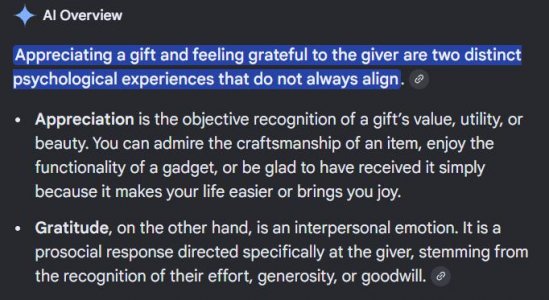
Gratitude. To one's self, or to whom? Is that truly gratitude, or just appreciating the good things happening to you right now?

Ancient self-reliant philospohers like Aristippus (founder of the Cyrenaics) argued that hedonistic, immediate, sensory pleasures are all that really matter in life.

Since the Cyrenaics were skeptics who doubted they could truly know the ultimate cause of their sensations, they saw little value in directing thanks (gratitude) especially toward abstract concepts, including evolution or the cosmos.

appreciation.jpg
 
Last edited:
This forum and it's members are also in my daily gratitude prayer. Whether you like it or not,;)
the differences we all share in so many things helps me to understand people better. To know
each of us are seeking answers in our very own way.

Only time will tell and who of us we be able to say "I was right!" In the end, does it really matter?
If we all end up in a different place or the same, or no place at all, we all got to live and believe as
we wanted. Full believer, part believer or not at all, it's wonderful to share laughs and conversations
with each of you and for now, that does matter or we wouldn't be here.
 
In the Christian religion God is the Father, Son, and the Holy Ghost. Therefore shouldn't God's pronound be "They"?
 
Back
Top