A sharp decline in Americans who are both married and homeowners by age 30 (1960-2025)

Paco Dennis

SF VIP
Location
Mid-Missouri
I wonder what this means for our grandchildren and their children. I guess they will pay rent to some private equity firm of some tricky nice comforting name like "The Living Easy Group". :mad:

2gsjgna1uruvGBHDnRaj2z6FsL6XEQR3pnqa26GnVi1Mvx9WFzNhzijpBNYXoAaBisiRKxqF8amawQARVnvzTApA26yEBw...png

Data from U.S. Census Bureau IPUMS microdata (as analyzed/reported by wealthvieu .
Visual chart created with Datawrapper


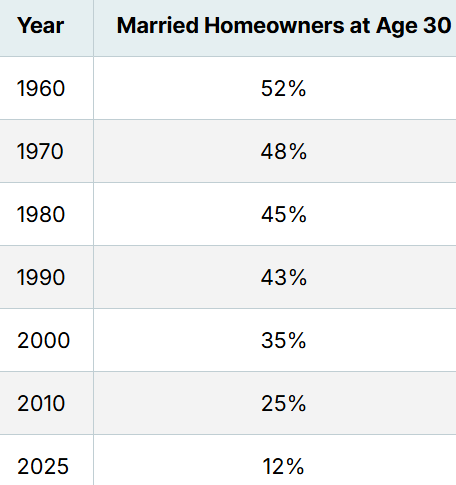
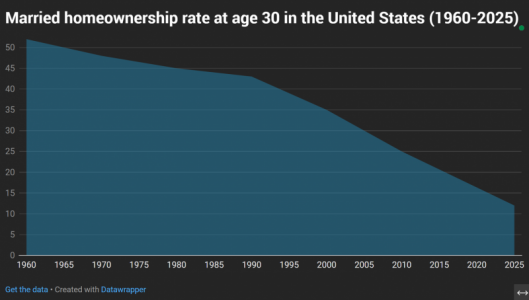
Based on U.S. Census Bureau IPUMS Census microdata, the percentage of Americans who were both married and homeowners by age 30 dropped dramatically over the past 65 years, from roughly 52% in 1960 to 12% in 2025.

During the 1960s, early marriage was common and housing was fairly affordable compared to incomes; As a result, households could often be supported with one person working full-time. By 1980, 45% of people had reached the combined goal of homeownership and being married, this number decreased to 35% by 2000, continued its downward trend to 25% by 2010 and further to just 12% by 2025.

This trend occurred due to many factors including the rapid increase in home values relative to wage growth makes it more difficult for younger people to purchase homes early in life

People now marry later and spend more time in school and initial career paths; in addition student loans; living costs in cities; and the change of social norms have all resulted in these changing marriage and home ownership patterns.

Overall, It has become increasingly unusual for people to be married and own property by 30 than it was at the middle point of the last century.

This implies a more general trend towards the increasing difficulty for younger generations of achieving fundamental life stages such as access to housing or starting a family as a result of growing economic obstacles.

Over time, this may have wider effects on social stability and economic security.

References
WeathvieuHomeownership Rate by Demographics
U.S. Census Bureau IPUMS Census microdata & American Community Survey

Related analysis on marriage and homeownership trends: https://ifstudies.org/blog/no-spouse-no-house-marriage-decl


The Sharp Decline in Americans Who Are Both Married and Homeowners by Age 30 (1960-2025) — Hive
 
I wonder what this means for our grandchildren and their children. I guess they will pay rent to some private equity firm of some tricky nice comforting name like "The Living Easy Group". :mad:
View attachment 502261


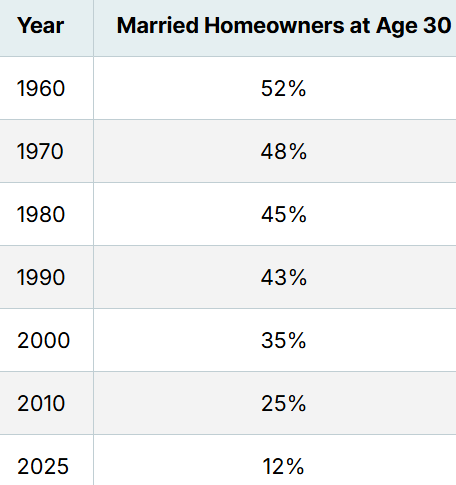
Based on U.S. Census Bureau IPUMS Census microdata, the percentage of Americans who were both married and homeowners by age 30 dropped dramatically over the past 65 years, from roughly 52% in 1960 to 12% in 2025.

During the 1960s, early marriage was common and housing was fairly affordable compared to incomes; As a result, households could often be supported with one person working full-time. By 1980, 45% of people had reached the combined goal of homeownership and being married, this number decreased to 35% by 2000, continued its downward trend to 25% by 2010 and further to just 12% by 2025.

This trend occurred due to many factors including the rapid increase in home values relative to wage growth makes it more difficult for younger people to purchase homes early in life

People now marry later and spend more time in school and initial career paths; in addition student loans; living costs in cities; and the change of social norms have all resulted in these changing marriage and home ownership patterns.

Overall, It has become increasingly unusual for people to be married and own property by 30 than it was at the middle point of the last century.

This implies a more general trend towards the increasing difficulty for younger generations of achieving fundamental life stages such as access to housing or starting a family as a result of growing economic obstacles.

Over time, this may have wider effects on social stability and economic security.

References
WeathvieuHomeownership Rate by Demographics
U.S. Census Bureau IPUMS Census microdata & American Community Survey

Related analysis on marriage and homeownership trends: https://ifstudies.org/blog/no-spouse-no-house-marriage-decl


The Sharp Decline in Americans Who Are Both Married and Homeowners by Age 30 (1960-2025) — Hive
Thank you for posting this important info!
 
I feel blessed out of the 3 grands I have at mid-20s, 3 of them bought a home at age 23-24 and one is a single lady.
Dad sort of pressured her into it when she got a settlement from an accident and compared rent to house payment
to her over a span of years. The other grands have Special needs or too young yet. Be interesting to see what happens
when the one in college is done with his degree.
 
I have a couple of thoughts on this. Maybe this is a good thing. So many divorces might mean that most people shouldn’t be married.

So many violent crimes like school shootings and mostly ‘young people crime’ may really be showing us that there don’t need to be so many unhappy young people in the world who come from abusive families, single parent families and parents who neglect their children. So less homes needed because less married people and less families.

It seems inevitable to me that prices going up on everything that sustains life, people won’t long be able to have individual homes or our world continue as it is. Only those who are elites, rich and entitled can keep paying for all of it will be able to have the houses and the money to have families.

There will still be taxes for all and so the government will still get as much money as they need.
I don’t like any of it, but I see where it all seems to be going.
 
I have a couple of thoughts on this. Maybe this is a good thing. So many divorces might mean that most people shouldn’t be married.

So many violent crimes like school shootings and mostly ‘young people crime’ may really be showing us that there don’t need to be so many unhappy young people in the world who come from abusive families, single parent families and parents who neglect their children. So less homes needed because less married people and less families.

It seems inevitable to me that prices going up on everything that sustains life, people won’t long be able to have individual homes or our world continue as it is. Only those who are elites, rich and entitled can keep paying for all of it will be able to have the houses and the money to have families.

There will still be taxes for all and so the government will still get as much money as they need.
I don’t like any of it, but I see where it all seems to be going.
I see it heading that way too Alice. I think it's the job market too. Many can't find a company they feel secure enough in
to have a job for years to come, so the thought of buying a home may be just too overwhelming. Walking away from a rental
is so much easier until you know you found security.
 
I don’t see doom and gloom in the statistics as much as different priorities and more options available, specifically for women.

The introduction of inexpensive, reliable birth control and advanced education opportunities for women along with a changing attitude in society has pretty much eliminated the old notion that two people had to get married.

I guess that I would need more information to understand the cause and effect of the statistics.

Whatever the cause, kids are resilient and will grow up just fine in a suburban home with a picket fence or an urban apartment with an elevator and a lobby.
 
Well, for one thing, today's young folk don't want to start out with a "starter" home. They want 4 bedrooms, 3 baths, a 3-car garage and a pool.

Our first home (we were 25 and 27) cost $17,500 and was most certainly a work in progress. We were just glad we had graduated from "south of the infamous Eight Mile Road" to (slightly) north of it.
I never heard the term or concept of a 'starter home' before a few years ago..
Everybody I knew considered buying a house to be a longterm investment.
Individuals in my age group and much older still live in the same homes where they raised their kids, even after some became widowed or divorced.

In contrast, the only other homeowner I know- and has been one for more than a decade and a half- is a millenial.. and has worked two solid careers at the same time to cover such expenses.
 
Well, for one thing, today's young folk don't want to start out with a "starter" home. They want 4 bedrooms, 3 baths, a 3-car garage and a pool.

Our first home (we were 25 and 27) cost $17,500 and was most certainly a work in progress. We were just glad we had graduated from "south of the infamous Eight Mile Road" to (slightly) north of it.
That's it exactly. We married late (36M)(30F) and realized living in Las Vegas in the early '90s meant we could never afford a house there. We moved back to rural VA before the next boom and got a nice little 2 br 1 ba ranch.

Then the over prime loans and I had visions if 5 br a pool, etc. Hubby said NO and 35 years later we are still in the 2 bd ranch. Fully paid for.

Hubby might be a parsimonious Scot - but in the end its not glamorous, but its paid for.
 
My Daughter is 52, my Son is 32 years old.
Neither one has ever been married.
Neither wants to be married.
They both rent.
Things are different now than they were in the past.
People are more independent than they used to be, and a lot of things go along with owning a house. They do not want to be burdened with it all.
 
Last edited:
I see it heading that way too Alice. I think it's the job market too. Many can't find a company they feel secure enough in
to have a job for years to come
, so the thought of buying a home may be just too overwhelming. Walking away from a rental
is so much easier until you know you found security.
There is another side to that. From my career experience, many young people don't stay with companies very long these days because they are entitled. They think they should move up the ladder more quickly than they deserve or they just get bored and think the grass will be greener elsewhere.

I didn't work with many Gen Zers, but the Millennials on my staff would be the first to go to Human Resources for any little thing that offended them or, when they worked from home, they would just disappear.

There's a very different work ethic than the one the Baby Boomers and GenXers had.
 
Wow...this post was all over the place...sorry.
:LOL:

Added:
I was referring to this post, my own posting...it seemed to be wobbling all over the place,
 
Last edited:
There is another side to that. From my career experience, many young people don't stay with companies very long these days because they are entitled. They think they should move up the ladder more quickly than they deserve or they just get bored and think the grass will be greener elsewhere.

I didn't work with many Gen Zers, but the Millennials on my staff would be the first to go to Human Resources for any little thing that offended them or, when they worked from home, they would just disappear.

There's a very different work ethic than the one the Baby Boomers and GenXers had.
I agree that some people do not want to work or that they do not want to put any effort onto a relationship.

My children both work, one has good friends, one has a long time relationship with someone. They just choose not to be married or own a house right now.

People who think they are entitled are one day going to get a big surprise when they wake up broke and alone.
Especially if they do not work or form meaningful relationships with other people.
 
One of my nieces-in-law put herself through college and got a bachelor's degree and now has a good job but was just barely able to afford a small, old, needing a lot of work, 2 bedroom, 1 bath house. Another niece-in-law wasn't able to attend college, manages 3 restaurants and can only afford to rent a house. Both of these NILs live in a small town where prices are about the cheapest that they are in this state; if they lived anywhere else in this state, they might be living in their cars.
 
Back
Top