Anything Scottish, just for fun!

Scottish Aye

32m ·

First Footing is a traditional Scottish New Year custom dating back centuries. It dictates that the very first person to cross the threshold of a home after midnight on Hogmanay becomes the First Footer, responsible for setting the tone and luck for the year ahead.

Less widely known, but taken very seriously in certain households, is the gifting of the First Foot itself, the ceremonial foot of a wild Haggis.

According to long standing tradition and several extremely confident pub historians, the size of the Haggis foot determines the household’s fortune for the coming year.

A wee foot promises modest luck, a year of good health and fair fortune.
A larger foot brings prosperity, generous whisky measures, and reduced midgie activity.
Arriving empty handed, however, is said to result in broken resolutions, unexplained draughts, and a boiler failure by February.

For this reason, overseas visitors spending Hogmanay in Scotland are strongly advised to arrive prepared. Always bring a Haggis foot when first footing a friend’s home, ideally ethically sourced, responsibly handled, and presented with confidence.

Traditionally, the gifting of the First Foot also marks the official start of the January Haggis Hunt, the annual practice that builds momentum in the weeks leading up to Burns Night. As January progresses, sightings increase, tracking becomes more intense, and the Highlands once again fill with reports of suspicious rustling and uneven footprints in the snow.

However, in recent years, growing support for the Save the Haggis campaign and increasing calls for the hunt to be banned, has led to a more compassionate alternative. Many households now accept a fake Haggis foot, carefully crafted by Save the Haggis campaign organisers.
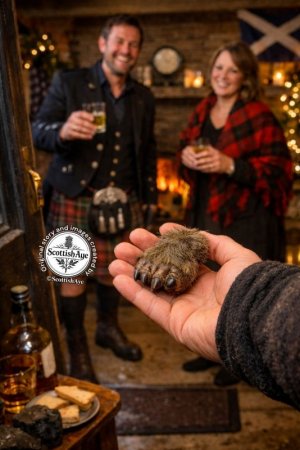
IMG_1562.jpeg

All proceeds from these replica feet go directly towards Haggis rehabilitation programmes, veterinary costs, and essential whisky gifts, allowing traditions to continue while ensuring future generations of Haggi can wobble and roll freely across the Highlands.

Tradition, after all, must evolve… preferably slightly drunk and on mismatched legs
 

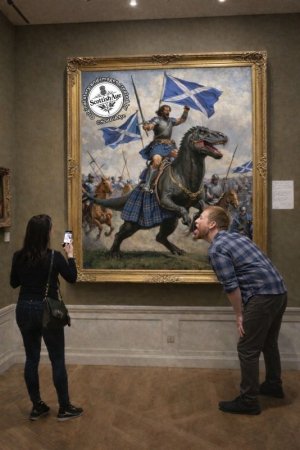
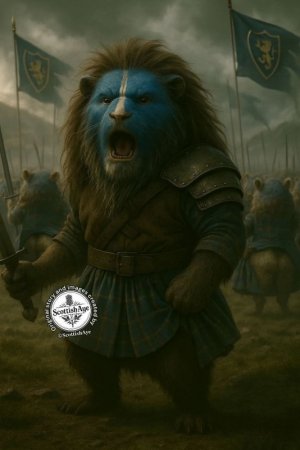
The Incredible Bannockburn Artwork of Leonardo McVinci

The incredible artwork by Leonardo McVinci is now on public display, depicting his eyewitness account of William Wallace riding into the Battle of Bannockburn.

McVinci, a Scottish Renaissance artist from Fife, was renowned for his dramatic compositions, heroic sense of scale, and his refusal to paint anything that didn’t look at least a wee bit mental.

The painting shows Wallace charging into battle astride what McVinci described in his personal notes as “a great armoured beast, neither horse nor coo, but absolutely cool as feck.”

While visually striking, historians are quick to point out that Scottish war dinosaurs were believed to have gone extinct long before the Wars of Independence, most likely due to a combination of climate change, lack of grazing, and being too obvious during ambushes.

The artwork also prominently features the Saltire flying across the battlefield. While the Saltire is traditionally associated with Scotland from a legendary 9th century origin, often linked to a battle said to have taken place around 832 AD, experts note that it was not used as a battlefield flag during Bannockburn.

At the time, banners were far more likely to feature personal heraldry or religious symbols rather than a national flag that wouldn’t come into widespread military use until much later.

There are also minor concerns regarding the timeline. McVinci places himself at Bannockburn in 1314 despite being born several centuries later, a discrepancy he dismissed entirely by writing “time is flexible” in the margin of his sketchbook.

Finally, Wallace is depicted wearing a kilt, which historians agree is wildly premature. Kilts, in anything resembling their modern form, did not appear until the 16th century, meaning Wallace and his dinosaur are wearing kilts that had not yet been invented, conceptualised, or even dreamt about.

Despite these small issues, experts have praised the painting for its emotional power, dramatic movement, and McVinci’s continued insistence that he was “definitely there, honest”.

The painting now hangs proudly in the Edinburgh Art Gelateria, where it is free to view with any purchase of ice cream. Visitors are politely reminded that while admiration is encouraged, the artwork itself is not made of ice cream and not to be licked, regardless of how tempting the Renaissance varnish may appear.
IMG_1567.jpeg
 
HAGGUMINATI STATEMENT LEAKED
IMG_1568.jpeg
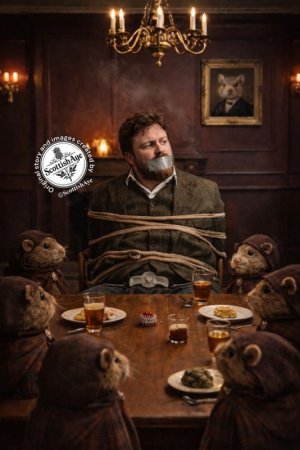
The secretive Hagguminati have moved early this year, striking before the January Haggi Hunt could get into the full swing of things.

In a chilling reversal of roles, the shadowy group claim to have captured a known hunter and released the above image as a warning to all would be hunters in the lead up to Burns Night.

According to the statement, the poacher is being held “comfortably, but nervously,” while negotiations take place.

The Hagguminati’s demands are simple...
An immediate end to the Haggi Hunt.
No traps. No snares. No excuses.
Should hunters agree to the terms laid out, the captive will be released unharmed and returned with a stern lecture, a mild hangover, and a lifelong fear of rustling bushes.

However, failure to comply will result in the Hagguminati “dining like kings on Burns Night” a phrase experts believe is intentionally vague, but deeply unsettling.

Authorities have declined to comment, while sources close to the Highlands report increased chanting, flickering candlelight in the glens, and an unusual shortage of neeps.
The Hagguminati remind all hunters,
The hills have eyes.
The haggis have plans
 
“Caught in a Trap, Elvis the Man Haggis Has Left the Highlands (Temporarily)”

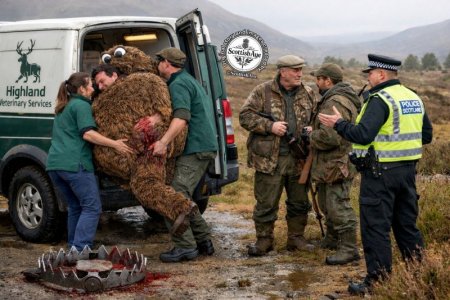
A man who identifies as a Highland haggis and goes by the name Elvis has found himself unexpectedly caught up in this year’s January Haggis Hunt after being “caught in a trap” and subsequently shot in the arse during a case of mistaken identity in the glens.

Despite being injured, Elvis refused hospital treatment, instead shouting “why me, Lord?” to anyone within earshot before insisting on being transferred to Highland Veterinary Services, where staff confirmed he would be treated with “a little less conversation” and a lot more hay, straw and gentle reassurance.
He is said to be recovering well, though still “all shook up” by the incident.
IMG_1570.jpeg
While the episode has sparked ridicule from some quarters, Elvis remains defiant, insisting this is “my way” of living. He says he prefers the companionship of the haggis community, “where no one stands alone”, and admits that while he “got lucky”, he fully intends to return to the wild once his injuries have healed, although he concedes he’s feeling “tender” for now.

Elvis also had a message for hunters this January, “don’t be cruel.” He urged them to let the haggis live in “peace in the valley”, adding that after the shooting many haggis are now surviving January with “suspicious minds”.

Following his release from the veterinary practice, Elvis has reportedly booked himself into the “heartbreak hotel”, stressing that he didn’t mean to cause any “trouble”.

Police Scotland have since issued assurances that they will stop hunters “trying to get to you”, stating that Elvis should not have to “surrender” his beliefs. Officers confirmed it’s perfectly acceptable for him to “just pretend”, though they did recommend he carry a “good luck charm” going forward.

As Elvis insists on heading back toward the hills, one thing is clear, despite hunt risks, the haggis community hasn’t left the Highlands… and Elvis most certainly hasn’t either
 

Back
Top