Artemis 2 Moon Mission to launch on April 1

RambleTamble

Senior Member
Location
U.S.
The Artemis 2 mission is the first crewed flight of NASA's Artemis program, scheduled to launch on April 1, 2026. This historic 10-day mission will send four astronauts around the Moon and back to Earth, marking the first time humans have ventured beyond low Earth orbit since the Apollo 17 mission in 1972.
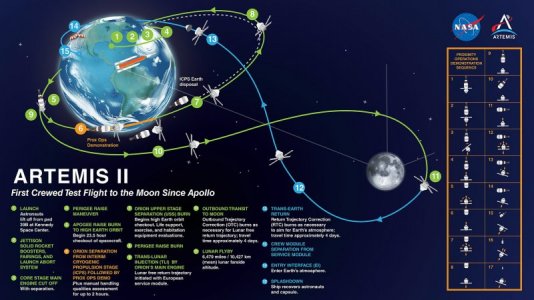
Artemis_2_map_march_2023.jpg

Principal Rocket Manufacturers
  • Boeing: Built the 65-meter (212-foot) Core Stage, which serves as the rocket's backbone and houses the flight computers and propellant tanks.
  • Northrop Grumman: Manufactured the Twin Solid Rocket Boosters, which provide over 75% of the initial thrust at liftoff. They also built the Abort Motor and Attitude Control Motor for the Orion spacecraft's Launch Abort System (LAS).
  • Aerojet Rocketdyne (an L3Harris Technologies Company): Provided the four RS-25 main engines at the base of the core stage, which were refurbished and upgraded from the Space Shuttle program.
  • United Launch Alliance (ULA): A joint venture between Boeing and Lockheed Martin that built the Interim Cryogenic Propulsion Stage (ICPS), the rocket's upper stage responsible for pushing the Orion spacecraft toward the Moon.
  • Teledyne Brown Engineering: Manufactured the Launch Vehicle Stage Adapter (LVSA), which connects the core stage to the upper stage.
 
Last edited:
Key purposes of the Artemis 2 mission include:

  • Crewed System Validation: Testing the Life Support System in deep space to ensure it can support humans for extended durations, which was not tested on the uncrewed Artemis 1 mission.
  • Testing Deep Space Navigation: Confirming that the SLS rocket and Orion spacecraft operate as designed, including human-in-the-loop manual maneuvering of the spacecraft.
  • Reaching New Distances: Testing navigation and communication systems while traveling further from Earth than any human has before.
  • Preparation for Future Landings: Preparing for future missions to the lunar surface by establishing operational procedures and testing crew performance in deep space.
  • Lunar Flyby and Return: Executing a free-return trajectory around the Moon's far side, providing critical insights for future missions like Artemis 3.
The crew, consisting of NASA astronauts Reid Wiseman, Victor Glover, Christina Koch, and Canadian Space Agency astronaut Jeremy Hansen, will orbit the Earth to adjust their trajectory before heading to the Moon
 
They had a program where you signed up to have your name included on a disk that will go along on the launch.

I signed the Littles up and they were quite excited, especially the 6-year-old who has a great interest in the space program and who plans to be an astronaut.

I could print off an impressive "boarding pass" and a packet of info about the program and bios of the crew. The 6-year-old has everything hanging on her wall.

I'll be out in the yard watching and, we're told, if the atmospheric conditions are favorable, we might be able to hear the roar of takeoff. I'm keeping my fingers crossed.
 
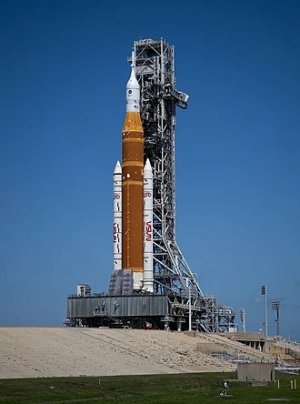
The booster rockets bolted to the sides of the orange core use solid rocket fuel.

Artemis_II_Preflight.jpg

In case any of you are interested in how solid rocket fuel works, here's an AI generated description.

How It Functions
  • Self-Sustaining Mixture: The solid propellant, often called the grain, contains both the fuel and the oxidizer. This allows it to burn without external air, which is why it works in the vacuum of space.
  • Combustion Process: An igniter at the top or bottom of the motor starts a flame front on the exposed surface of the grain. As the fuel burns, it turns into high-pressure, high-temperature gas.
  • Generating Thrust: These gases are forced through a narrow nozzle at supersonic speeds. According to Newton's Third Law, the force of the gas shooting out the back propels the rocket forward.
2. Common Ingredients
Modern high-performance solid rockets, like those used by NASA and ESA, typically use a composite mixture called APCP (Ammonium Perchlorate Composite Propellant):
  • Fuel: Usually powdered aluminum, which provides high energy density.
  • Oxidizer: Ammonium perchlorate, which provides the oxygen needed for the fuel to burn.
  • Binder: A rubbery polymer (like HTPB or PBAN) that holds the mixture together and acts as secondary fuel.
  • Catalyst: Small amounts of iron oxide are often added to speed up the burn rate.
3. Core Grain Geometries
The shape of the hole running through the center of the fuel (the "perforation") determines how the rocket's thrust changes over time. Because solid rockets cannot be throttled like a car engine, engineers "program" the thrust by shaping this hole:
  • Circular Hole: Thrust increases over time as the hole gets larger and more surface area is exposed.
  • Star Shape: Provides high initial thrust (for liftoff) that gradually decreases as the star's points burn away.
4. Key Characteristics
  • Non-Stop Burning: Once ignited, a standard solid rocket cannot be shut off or throttled; it burns until the fuel is gone.
  • Reliability & Storage: They are simpler than liquid engines because they have no pumps or valves. They can also be stored for decades and fired instantly, making them ideal for military missiles.
  • Power: They are exceptionally good at providing the massive, quick burst of power needed to lift heavy loads off the ground.
 
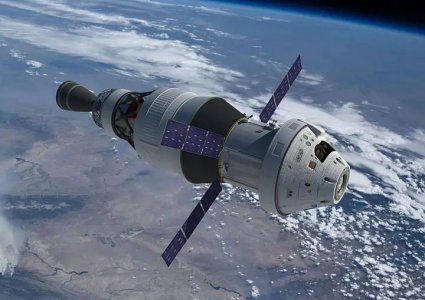
For the Artemis II mission, only the Orion spacecraft actually travels all the way to the moon.

nasa-orion.jpg

The parts that complete the journey around the moon and back are:
  • Orion Crew Module: The pressurized capsule where the four astronauts (Reid Wiseman, Victor Glover, Christina Koch, and Jeremy Hansen) live and work during the 10-day mission. This is the only part that returns to Earth and splashes down in the Pacific Ocean.
  • European Service Module (ESM): Attached to the back of the capsule, this provides the power, oxygen, water, and propulsion (using its main engine) to "slingshot" the crew around the moon. It is discarded just before the capsule re-enters Earth's atmosphere.
 
The ESM Propulsion System
The ESM contains a total of 33 liquid-fuel engines divided into three categories:
  • Main Engine: A single, refurbished Orbital Maneuvering System (OMS) engine from the Space Shuttle program. It provides about 6,000 lbs of thrust and is used for major changes in speed, like entering and leaving lunar orbit.
  • Auxiliary Engines: Eight smaller engines that act as a backup for the main engine and help with smaller orbital corrections.
  • Reaction Control System (RCS): 24 small thrusters grouped in pods around the module's exterior. These are used for "attitude control"—the precise rotations needed to point the spacecraft in the right direction.
Why Liquid fuel Instead of Solid?
Unlike solid fuel, which burns like a firework until it's gone, the ESM's liquid fuels—Monomethylhydrazine (MMH) and Mixed Oxides of Nitrogen (MON)—are hypergolic. This means they ignite instantly when they touch each other, requiring no spark plug or igniter. This makes them incredibly reliable for the hundreds of "stop-and-start" pulses needed during a 10-day trip to the Moon and back.
 
the patch on their uniforms. :cool:

il_1588xN.7530081242_n8rw.jpg
 
Yeah, we didn't have any luck seeing anything, either. Clouds between the launch and us. One little patch of blue and it didn't go anywhere near it, of course. I recorded it on TV and went back inside to watch it all.

In the early days, we used to go over for launches and landings when we could. One time, we had tickets to watch it from the Space Center. That was pretty exciting, but actually the view isn't any better than from across the lagoon.

I was lucky enough once to be spending the day at Jetty Park, a county park that is right on the channel at the port, when they towed in a rocket after it splashed down. They had it in a giant floating Quonset-hut-type thingy but it was open on both ends so you could see the rocket.
 
Live coverage can be found here -

NASA Artemis 2 Rocket Launch LIVE Update: NASA astronauts begin historic 10-day journey around moon

A sample...
Nasa Artemis 2 Rocket Launch LIVE Updates: Artemis II has successfully lifted off from Kennedy Space Center, with the Space Launch System and Orion spacecraft carrying astronauts Reid Wiseman, Victor Glover, Christina Koch, and Jeremy Hansen on a landmark journey around the Moon.

The twin solid rocket boosters and four RS-25 engines combined to generate 8.8 million pounds of thrust, powering the 5.75-million-pound rocket off the pad as umbilicals detached, marking the transition to fully autonomous flight. This roughly 10-day mission is the first crewed flight of NASA’s Artemis programme, aimed at testing systems for future lunar exploration and paving the way for eventual human missions to Mars.

With this mission, the United States is marking a significant return to lunar exploration after nearly 50 years since the Apollo missions. Nasa is also set to achieve historic milestones — sending the first woman, the first person of colour, and the first non-American astronaut on a journey around the Moon.

Apr 2, 2026 05:32 AM IST
Artemis II reaches orbit after communication link re-established
Mission Control’s communication link with the orbiting capsule cut out after switching from one tracking and data relay satellite to another. But the problem was quickly resolved by resetting ground equipment.
As reported by BBC, “The view of Australia was epic just now, it is amazing to be at this altitude,” said Reid Wiseman, the Artemis II commander.

 
Back
Top