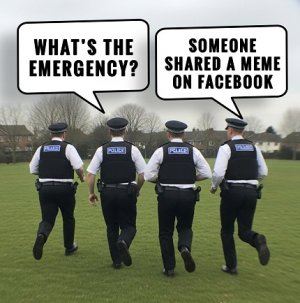
GB: No Freedom of Speech Anymore

make sure I’m standing on the same side of the tightrope as you, here is how I see your principles breaking down:

  • The Threshold of Evidence: Safety should only be a legal trigger when there is a clear, articulable, and imminent threat. Moving that needle toward "anticipation" essentially removes the leash from the state.
  • The Corruption Constant: Because power is addictive and self-preserving, the only winning move is to limit its jurisdiction. Giving it a "golden ticket" to act early is an invitation for retrospective justification—where the state finds a reason after the fact to crush dissent.
  • The Illusion of the Trade-off: You’re arguing that the "Freedom vs. Security" trade-off is a false binary. In practice, you don't actually get the security; you just get a more powerful bureaucracy and the same amount of (or more) chaos.

Where the "Red Flag" Hits the Ground​

When we look at history’s "highlight reel," as you put it, the shift toward pre-emption often uses the language of care or protection to mask the machinery of control. Whether it’s the "Suspicious Activity Reports" that go nowhere or the broader use of emergency powers, the result is often a chilling effect: people stop dancing because they’re afraid the state will misinterpret their rhythm as a riot.

It sounds like your position is one of Radical Decentralization of Risk—accepting the inherent messiness of a free society because the alternative (a "pre-emptive" state) is a guaranteed, slow-motion catastrophe.

I haven't been following this thread for a while so I've no idea if you've captured Antoli's stance on this topic. But I agree, as I've witnessed this happen in real time, as we all have since 911, with what you've said.
 

I haven't been following this thread for a while so I've no idea if you've captured Antoli's stance on this topic. But I agree, as I've witnessed this happen in real time, as we all have since 911, with what you've said.
That response was with help from Gemini AI. I tried several times to put it in italics but couldn't. @Antoli seems to be a brite mind. I am curious what he thinks of Gemini's responses. :)
 
This is what you said:

Your ancestors were still part of the European influx who took over native culture - the fact they were persecuted in their original lands doesn't change that

As I said, by the time my ancestors got here in the early 20th Century, "native culture" was long gone. There was nothing to take over, especially for Irish peasants who came to New York City to work in construction or, in my family's case, in the "funeral livery" business (hearse drivers). My ancestors emphatically were not "part of the European influx who took over native culture." I'm sorry you can't accept this basic truth.

I'm conservative, you're liberal. Let's put each other on ignore and move on.
Yes, let's put each other on ignore rather than having any discourse to understand why the other side believes the way they do. Let's just live in our own bubbles. Great strategy! :rolleyes:
 

make sure I’m standing on the same side of the tightrope as you, here is how I see your principles breaking down:

  • The Threshold of Evidence: Safety should only be a legal trigger when there is a clear, articulable, and imminent threat. Moving that needle toward "anticipation" essentially removes the leash from the state.
  • The Corruption Constant: Because power is addictive and self-preserving, the only winning move is to limit its jurisdiction. Giving it a "golden ticket" to act early is an invitation for retrospective justification—where the state finds a reason after the fact to crush dissent.
  • The Illusion of the Trade-off: You’re arguing that the "Freedom vs. Security" trade-off is a false binary. In practice, you don't actually get the security; you just get a more powerful bureaucracy and the same amount of (or more) chaos.

Where the "Red Flag" Hits the Ground​

When we look at history’s "highlight reel," as you put it, the shift toward pre-emption often uses the language of care or protection to mask the machinery of control. Whether it’s the "Suspicious Activity Reports" that go nowhere or the broader use of emergency powers, the result is often a chilling effect: people stop dancing because they’re afraid the state will misinterpret their rhythm as a riot.

It sounds like your position is one of Radical Decentralization of Risk—accepting the inherent messiness of a free society because the alternative (a "pre-emptive" state) is a guaranteed, slow-motion catastrophe.


That’s a fair summary. Once “anticipation” gets detached from actual evidence and imminent threat, the leash comes off the state. And at that point you don’t get real security, you get after-the-fact justification and people self-censoring out of fear.
 
You’re not identifying a missing principle, you’re restating the very danger I’m warning about.

“Anticipation” already exists in law, but it has strict limits such as, probable cause, reasonable suspicion, conspiracy statutes, and imminent threat standards. The state may intervene when concrete indicators exist, not when speech merely creates anxiety or when authorities anticipate that ideas might someday produce harm. The moment “anticipation” becomes detached from imminence and evidence, it turns into pre-crime, and that’s not a safeguard, it’s a blank check.

Saying “someone has to choose who controls” doesn’t solve the problem, it confirms it. If power inevitably corrupts, then the rational response is to limit power, not delegate it to whichever authority promises safety today. Free societies don’t eliminate risk by controlling speech in advance, they contain abuse by drawing bright lines around state power.

We may not change the world, but history shows that when societies abandon those lines in the name of anticipation, they don’t prevent mobs, they empower governments to punish dissent first and justify it later.
Exactly! Meanwhile there are so many house searches and confiscation of all cellphones, laptops, desktop computers and USB sticks by police task forces in Germany for criticizing politicians without even the faintest hint of criminal nature. It is only to produce fear among the people that they don't even try criticizing the government. As this often happens at 6 a.m. there is a saying "I don't have a bathrobe", if somebody doesn't like to write something that could lead to such actions at his home.

Do you Aussies like such governments? Then stay with your apology of "hate speech". Well, Australia has been an English penal colony in the beginning, thus it seems to me that you like it.
 
Yes, let's put each other on ignore rather than having any discourse to understand why the other side believes the way they do. Let's just live in our own bubbles. Great strategy! :rolleyes:
I use ignore to tune out the very few people here who don't show any interest in discourse. Repeating the same stupid platitudes isn't discourse.


Back
Top