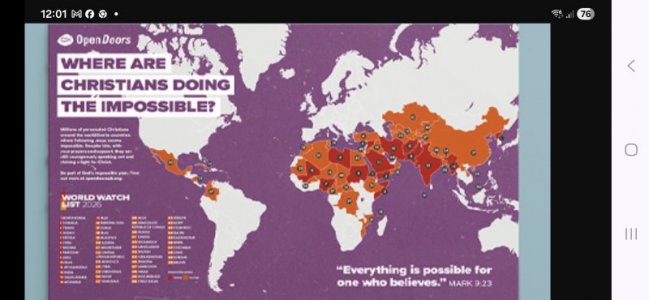
Oh, but this is the crux of it for me. If you're born in the US, then you are almost 70% more likely to be Christian. If you were born in Iran, (India?) you almost 80% more likely to be Hindu.
Meaning - we are the result of our upbringing, and our environment. This alone brings into question the veracity of our beliefs, imo. Few truly examine what part of their faith is indoctrination due to our environment. How many Christians do you know that have read the Quran? Have studied it as they have their Bible? Let alone the other religions.
Yet many are convinced they have the one true religion.
I made it my business when I was a Sunday School teacher of three very intelligent boys to learn as much as I could about Islam. When I asked them at the beginning of the calendar year what they would like to learn they said "other religions".
So, I began the year with the three Abrahamic religions of Judaism, Christianity and finally Islam.
The first topic included slavery in Egypt and the laws that covered just about every aspect of Jewish life. We visited the Great Synagogue in Sydney and listened to a speaker explaining elements of Judaism. The architecture of the Great Synagogue is derived from England, not the Middle East, and there appeared to be a very small choir loft at the front of the synagogue. One of the boys asked about the instruments that were played and was surprised to learn that there are none. Singers are unaccompanied because of strict rules about not working on the Sabbath. Playing an instrument is considered labour. They learnt about the scrolls made of silk on which the Torah is inscribed and the many laws that every Jew must do their best to remeber and follow.
For the Christianity section we studied Paul's story of his conversion on the road to Damascus and his journeys around and across the Mediterranean. To minister to Gentiles Paul needed to adapt to their ways to a degree, including eating foods that would have affronted observant Jews. This time the excursion was to a Chinese restaurant after church for yum cha. This was to drive home the point how difficult it can be to adapt to very difficult cultures, with different ideas about what is religiously acceptable or otherwise taboo. The first dish to appear was chicken feet and the boys tucked in enthusiastically, so perhaps not as difficult as we might imagine.
I also took them down to the local police station to see the lock up area. It was not a pleasant place to be confined in. It was cold, bleak and stank of urine. Paul was imprisoned more than once by the Romans but was not deterred from his missionary work. Even when given the chance to walk free after an earthquake rattled the gaol door open, he did not. He stayed, and his gaoler was so impressed (and relieved) that he became a Christian on the spot.
For Islam I looked for teaching material prepared for children in Islamic schools. I did not trust sites where Islam was interpreted by outsiders. We learnt about the life of the Prophet and his revelations that were written down by scribes, since he was illiterate. The lessons covered religious obligations such as praying 5 times a day and the ritual associated with this. As with Judaism, foods are either halal (allowed) or haram (forbidden). Cultural differences such polygamy and harsh physical punishments for stealing or blasphemy were covered briefly.
Overall, we looked for similarities more than we focussed on differences.