Interesting area of Tech re: Renewable Energy sources

"Gravity batteries". The limitation of a number of sources of renewable energy — solar, wind, tidal, some forms of biomass — is that in many instances these cannot deliver electricity continually. Storing energy during a source's high-delivery periods, for substantial contribution to the grid when most required, can obviously offer advantages.

Conventional electricity storage in lithium batteries is very familiar to us and much depended upon. Lithium batteries are obviously useful, but they wear out, there are occasional flammability issues, and refined-lithium supply chains can become precarious.

But there are several ways by which ever-present gravity can be utilized to store and deliver electricity to the grid. With some systems, the research & development has been going on for a long time. If you're a bit curious about the different approaches, maybe skim this article... if you're really interested, you might read the whole thing.

 
Last edited:
At first, I thought it was just another crazy idea, but after understanding it, the concept is simple and elegant.
Just like chemical battery storage that charges when you have sun or wind, the gravity one just raises heavy weights during the charging cycle when the power source is present, and then when it isn't, the gravity pulling on the heavy weights is used to power everything. There are no chemicals or limited lifespan as there are in batteries. It sounds like it should work fine.
 
1758469115682.jpeg
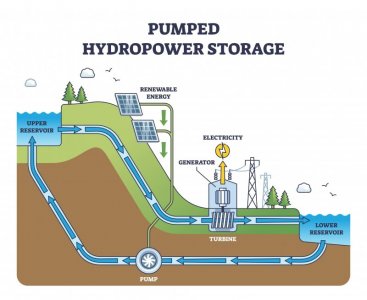
Pumped-Hydro Storage (PHS): This is the most mature and widely used form of gravity-based energy storage. It involves two reservoirs at different elevations. During times of low electricity demand, excess power is used to pump water from the lower to the upper reservoir. When power is needed, the water is released back down through turbines, generating electricity. This system has been used for over a century and accounts for the vast majority of the world's large-scale energy storage.
 
View attachment 452164
Pumped-Hydro Storage (PHS): This is the most mature and widely used form of gravity-based energy storage. It involves two reservoirs at different elevations. During times of low electricity demand, excess power is used to pump water from the lower to the upper reservoir. When power is needed, the water is released back down through turbines, generating electricity. This system has been used for over a century and accounts for the vast majority of the world's large-scale energy storage.
Looks like a good system where reservoirs are present. I would imagine that the ones designed with weights are for areas where there are no reservoirs. Just guessing.
 
  • Like
Reactions: JBR
So far as I know, this is to date the world's largest gravity battery installation & system. It uses the system developed by the Swiss company EnergyValult. It's located in Rudong, China, with construction in 2023. Grid connections and initial testing occurred in 2024. From what I can gather it is in a period of real-world evaluation.

Rudong-EVX-Sept-2023-1.jpg

There are quite a number of websites with info about the project. Here's a link to one of EnergyVault's posts about it.

100mw/hr Gravity Battery
 
Last edited:
The Chinese decision-makers must be pleased with the result with Energy Vault, pictured above. They've commissioned another one of roughly the same output from that company, to be built in another district.

Besides Energy Vault, there are other companies exploring their own designs. One of those, Gravitricity, is designing systems that don't depend on high-rise structures like the type in the picture. Theirs will instead utilize old, retired deep coal-mine shafts in which weight can be lowered and raised — hence, involving a far more compact above-ground structure. On the other hand, there are far fewer retired deep-mine shafts than available level-ground acreages.
 
Last edited:
As much as I personally would not wish to live in a nation with a communist government, I have to be impartial in thinking about China's assessment and utilization of gravity batteries. They are continuing with establishing more installations.
China is Building Gravity Batteries

History reveals an interesting pattern. The original investigators of electricity were English (or of English heritage) and German. But of course, as more knowledge about electricity and its applications developed, even nations that were rivals of (or at times at war with) England and Germany didn't hesitate to learn about and utilize electricity. Conclusion: due to benefits, science and technology have a way of spreading beyond national borders.

Energy Vault is a prominent company and although, from what I understand, they did their most intensive research & development in Switzerland, they're an American company.
 
Last edited:
I asked Gemini about the progress:

When you look at the U.S. energy grid today, solar and wind make up over 65% of all new power additions. The problem is that the wind doesn't always blow in West Texas, and the sun doesn't shine at night in Missouri.

  • The "Gap" Filler: Chemical batteries (like those in your phone) are great for giving the grid a quick 2-hour boost.
  • The Gravity Solution: Gravity batteries are being built to provide 8 to 24 hours of power. By the end of this year, gravity and other "non-lithium" storage methods are projected to be a $1.6 billion industry, and they are expected to grow by over 25% every year through the 2030s.

The "Conclusion" of your Forum Friend

The forum member's comparison to the history of electricity is very astute. China has the "first-mover advantage" because their government can approve massive 40-story concrete towers very quickly. However, the United States currently holds the highest market share in gravity storage investment and innovation.

While we might not see a 40-story concrete tower in Mid-Missouri by next year, the "gravity battery" technology is officially a pillar of the global plan to move away from fossil fuels. It's no longer a "communist vs. capitalist" project—it's a "mechanical vs. chemical" one, and the mechanical side is winning on longevity.
 
Back
Top