Must now log in to read only.

Disabling guest access is probably the most effective way to kill a forum. I understand that deeply, but unfortunately it’s my only way to keep the forum up and running.

I don’t have the resources of big players like Reddit or Facebook to harden the forum like a fortress. There are very few active forums run by individuals left. AI training bots, scrapers and other automated traffic have been increasing exponentially. Smaller forums like ours have become low-hanging fruit, and the situation is getting worse day by day as more forums shut down.

This change is not permanent yet, I will revert it once the attacks subside. But realistically, it may eventually become permanent as these attacks become more frequent and aggressive. I already had to permanently disable guest access on my other two higher-profile forums after fighting this problem for a long time. In the end, I had to make a choice: either shut down the forums or disable guest access.

As I’m writing this post, I’ve received over 400 emails reporting database problems within 20 minutes. Even after I disabled guess access 12 hours ago, the bots are still flooding in.

I truly don’t like doing this, but keeping the forum alive and usable for existing members has to come first.

And finally, if you can access the forum without logging in one day, but can’t the next day, now you know why.
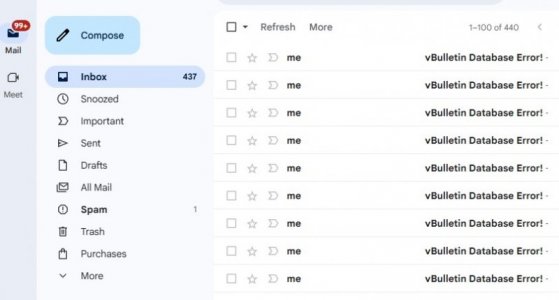

email.jpg
 
Last edited:
Disabling guest access is probably the most effective way to kill a forum. I understand that deeply, but unfortunately it’s my only way to keep the forum up and running.


that is the paradox - forums need new members t o survive but I understand the dilemma.

Hopefully it is possible for lurkers t o see the range of topics but not the actual posts - that could be a compromise?
 
Thanks for all you do, @Matrix . I know this has to be a real pain and inconvenience to deal with.

If the attacks are truly severe enough to threaten uptime, then protecting the existing community surely does come first. A dead public forum attracts fewer newcomers than a functioning semi-private one.

If you do decide to test the waters again in the future, and if the forum software allows it, maybe small steps could help, such as letting guests browse categories and thread titles or perhaps see limited previews while still requiring login for full thread access.

That might still allow search engines to index discussions and let visitors get a feel for the culture of the forum without exposing the entire database to crawlers.

EDIT: I see you responded while I was composing this post and are actually already doing what you can to still facilitate or allow search bot indexing.
 
I stay logged in on this forum. But, I don't think disabling a guest list will do this forum in. Seeing the title to a thread usually is sufficient for me to decide whether I'll read it or not. If a guest is interested enough after seeing several titles, he/she should be able to decide if this forum is for him/her.

It is annoying when a guest posts a catchy title only to realize it's either a bot or a spammer or whatever.

We'll be fine with how you are handling this, Matrix.

By the way, I detest Reddit and only have Facebook as many relatives and friends are there.
 
I may not have known of this change for quite some time, had I not read this thread.

In my Firefox browser, I have protected my Senior Forums site cookie(s) that contain my credentials, from deletion. Even if I close and reopen my browser, the cookie is always there and each time I visit Senior Forums, I am therefore automatically logged in. Without that delete protection of the site cookie, I would of course, have to login each time I initially open my browser and visit SF.

The delete protection feature is available to everyone in Firefox settings:
Settings > Privacy & Security > Cookies and Site Data > Manage exceptions

1) In the popup window entitled Exceptions - Cookies and Site Data, type in seniorforums.com in the "address of website" field.
2) Then click the Allow button. Be sure to then click Save Changes, to close the popup window.

There may be ways of doing the exact same thing in other browsers and devices but Firefox is all I use when visiting Senior Forums and that is what I am familiar with.
 
Last edited:
My browser automatically logs me in when I type in SF's URL so I didn't realize the change until seeing this thread yesterday.

Spam of all kinds is increasingly prevalent on electronic communication sites and devices.

Just as email and cellphone spam detectors sometimes filter out communications that aren't actually spam, SF will undoubtedly lose out on some potential new members.

To me, that loss will be worth the cost. We've all experienced SF being sluggish or inoperable when it's hit with massive bot and spam traffic.

Thanks, @Matrix!
 
On my personal website, the high end service provider visiting statistics now show vastly more bot visits than people that at most, any single day, might be a few dozen. Like thousands of bots everyday that is much worse than just a few years ago. The web is being overrun by those creating bots with AI accelerating that process. Bad malicious bots now make up 37% of traffic. Plenty of information on how websites are trying to combat the issue.

https://www.techbuzz.ai/articles/bots-now-outnumber-humans-on-the-internet-report-shows

...The internet just crossed a historic threshold - and it's not good news for humanity. Bots have officially overtaken human users in total web traffic, according to a new report from HUMAN Security that lays bare how rapidly automated systems are colonizing online spaces. The data reveals automated traffic is growing eight times faster than genuine human activity, marking a fundamental shift in who - or what - actually populates the digital world we navigate daily.

The internet isn't ours anymore. That's the stark takeaway from HUMAN Security's latest State of AI Traffic report, which confirms what many in the industry have suspected but couldn't quite quantify - bots have become the dominant force shaping online traffic patterns.

The numbers tell a story of rapid displacement. While human users continue browsing, shopping, and scrolling, automated systems are doing it all faster and at greater scale. The eight-fold growth rate advantage means that for every new human joining the internet, eight new bots are spinning up to crawl, scrape, post, and interact across the web.

This isn't just about search engine crawlers or legitimate automation. The composition of bot traffic has fundamentally changed in the AI era. Where earlier generations of bots primarily served infrastructure functions - indexing pages, monitoring uptime, archiving content - today's automated agents are increasingly sophisticated mimics of human behavior. They comment on posts, generate reviews, engage in conversations, and navigate websites in patterns that traditional detection methods struggle to flag.

The implications ripple across every corner of the digital economy. For publishers, it means traffic metrics are increasingly unreliable indicators of actual readership. Ad networks face mounting pressure to filter bot impressions from billable views. E-commerce platforms must contend with inventory-hoarding bots and fake review armies. Social networks grapple with the reality that significant portions of their engagement metrics come from non-human actors.
 
Last edited:
Back
Top