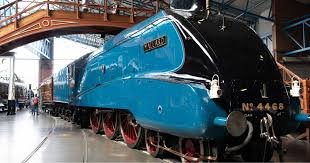
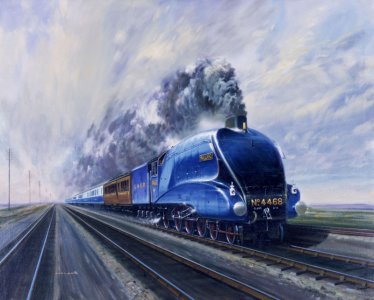
The decision to find out how fast, the locomotive Mallard, could run with the seven-vehicle load seems to have been almost a spur of the moment decision.
Mallard took her carriages through Grantham station at just 24 mph because of track work. The train then accelerated to almost 60 mph over the next two and a half miles, up a rising gradient of 1 in 200, eventually reaching almost 75 mph as it travelled over the next mile-and-a-half to Stoke summit, and again over a further stretch at 1 in 200.
Descending Stoke Bank, the speed rose to 116 mph, and then to 119 mph, and then crossed the 120 mph mark where it stayed for the next three miles, reaching a maximum of 126 mph. The locomotive maintained a speed of between 123 mph and 126 mph for nearly two miles. The record-breaking run was then curtailed as the opportunity was taken to conduct a brake test from such a high speed and the train was approaching the curve at Essendine and it was thought unwise to take the curve at such a high speed.
Mallard went into railway history as the fastest steam hauled train in the world, a unique honour that still stands to this day.





 The "Blue Carpet Python" ...


 Happy Birthday