Pictures From My Smart Bird Feeder

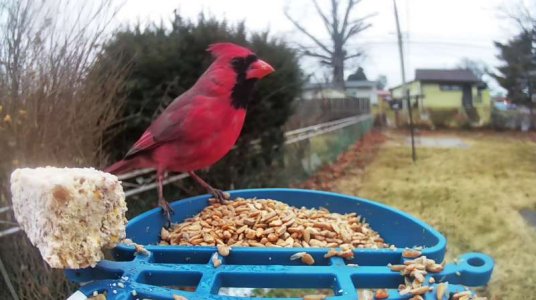
Look who has finally braved the feeder! Nice to see him up close. :)

WhatsApp Image 2026-01-18 at 14.11.50 (1).jpeg


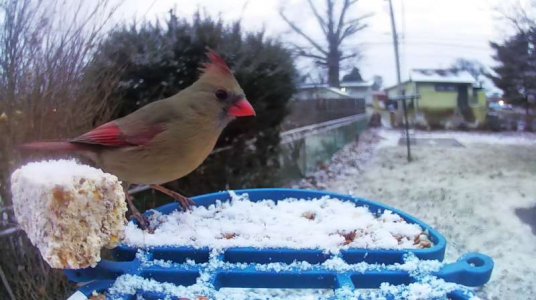
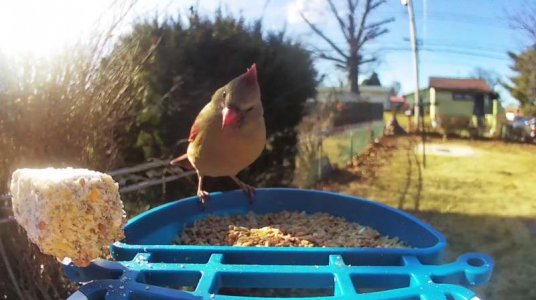
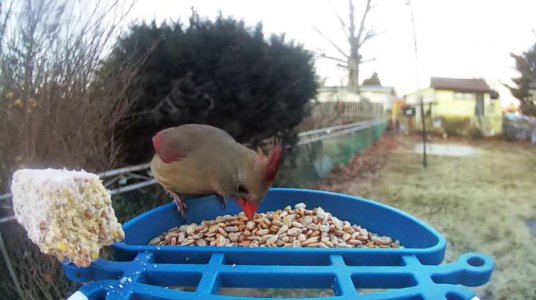
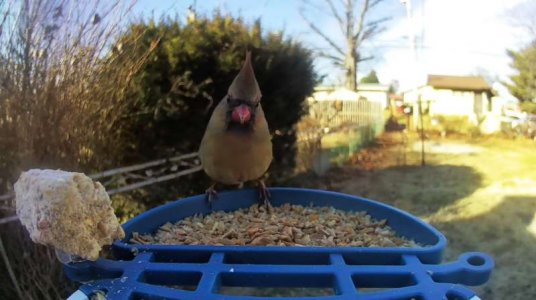
And lady Cardinal was around a bit earlier judging by the snow still on the tray.
WhatsApp Image 2026-01-18 at 14.11.51 (1).jpeg

Also got a nice video of her.

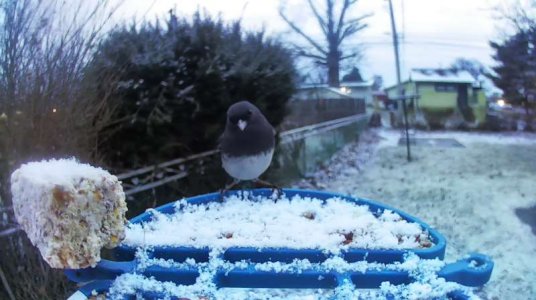
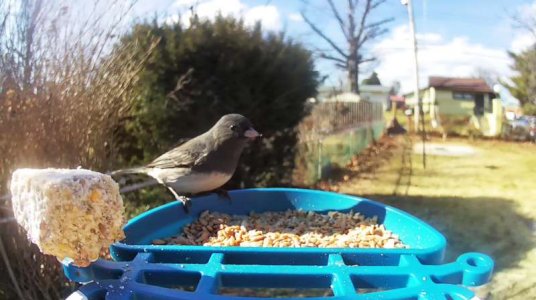
The little Junco. He has such a sweet expression. There are probably a lot of him that I just keep thinking of as one bird.
WhatsApp Image 2026-01-18 at 14.11.51.jpeg

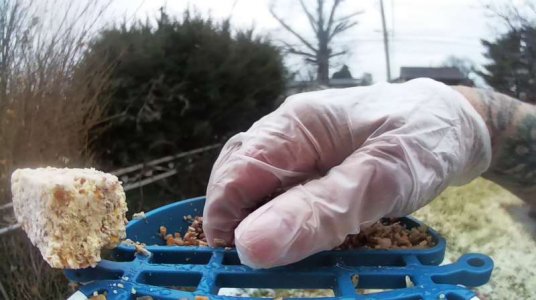
And the elusive and exotic My-Husband's-Hand Bird. 😅
WhatsApp Image 2026-01-18 at 14.11.50 (2).jpeg
 
Last edited:
Oh wow. The male cardinal showed up. How cool is that? He’s beautiful but I now think she’s more attractive. Shes multicoloured.
The little junco is a sweetheart.

Is the food you’re feeding them pure shelled sunflower seeds mixed in cayenne pepper oil?
 

Oh wow. The male cardinal showed up. How cool is that? He’s beautiful but I now think she’s more attractive. Shes multicoloured.
The little junco is a sweetheart.

Is the food you’re feeding them pure shelled sunflower seeds mixed in cayenne pepper oil?
That was my first thought too, that the lady Cardinal is actually more attractive!

He is, isn't he? Always has a sweet look on his little face.

Yes, just shelled sunflower seeds with pepper oil. Husband is thinking of adding some thistle to attract the yellow finches.
 
That was my first thought too, that the lady Cardinal is actually more attractive!

He is, isn't he? Always has a sweet look on his little face.

Yes, just shelled sunflower seeds with pepper oil. Husband is thinking of adding some thistle to attract the yellow finches.
Finches definitely like thistle seed but they do eat sunflower seeds too. I guess their favourite food would be thistle seed though.
You could experiment. Your husband has huge hands. 🙌
 
Last edited:
Your husband has huge hands. 🙌
I don't know why, but I just know noticed this. I read your post earlier so I must have been focused on the bird talk? Or I'm getting old and forgetful! Yes, he does. I went to a Lincoln exhibit in DC once with my son when he was little and there was a cast mold of his hand for everyone to feel, because Lincoln was known for having very large hands.

I put my hand on the mold and thought, I know this hand! ;)
 
I don't know why, but I just know noticed this. I read your post earlier so I must have been focused on the bird talk? Or I'm getting old and forgetful! Yes, he does. I went to a Lincoln exhibit in DC once with my son when he was little and there was a cast mold of his hand for everyone to feel, because Lincoln was known for having very large hands.

I put my hand on the mold and thought, I know this hand! ;)
I added that later on as an edit.
He had a mold taken of his hand.
He’s a hand model then. lol 😂
 
He tried the suet first. Then tried the sunflower seeds. You know, I was thinking about the cayenne pepper. Years ago we were going to try it and decided to buy peanuts instead to feed the squirrels. We’d read that the birds don’t have a sense of smell but apparently that’s not true. According to this article, they do.

*********************************************************

Yes, birds do have a sense of smell
, and it's surprisingly important for many species, used for finding food, navigating, recognizing family, choosing mates, and even finding nesting sites, although its strength varies greatly among different types of birds, with keen smellers like vultures and petrels contrasting with birds where sight is dominant.
How Birds Use Their Sense of Smell:
  • Finding Food: Turkey vultures sniff out decaying flesh from miles away, while storm petrels locate krill by smell.
  • Navigation: Some birds, like homing pigeons, use scents to find their way home.
  • Mating & Communication: Dark-eyed juncos and crested auklets use unique scents (from preen oil) to attract mates or identify each other.
  • Nest Building: Starlings add aromatic plants to nests to deter parasites, identifying the right plants by smell.
  • Identifying Family: Some finches prefer the smell of their own eggs, suggesting family recognition.
Examples of Strong Smellers:
  • Turkey Vultures: Have large olfactory bulbs and can detect ethyl mercaptan(from rotting meat) from great distances.
  • Tubenoses (Petrels, Albatrosses): Use their specialized nasal cavities to smell krill and fish in the ocean.
  • Kiwis: Use their beaks to sniff out insects in the ground.
Why It Was Overlooked:
For a long time, scientists believed birds had a poor sense of smell because their nasal passages seemed small, and vision was considered their dominant sense. However, genetic studies and observations have revealed a far more complex and widespread olfactory ability.
****************************************************
The obviously have a sense of taste or they wouldn’t care what type of food they ate. This article explains how they are somewhat immune to the taste of peppers.

*******************************************************

Yes birds have a sense of taste, though it is generally less developed than that of mammals. While humans have about 9,000 to 10,000 taste buds, most birds have significantly fewer—often ranging from 50 to 500 depending on the species.

Where Are Bird Taste Buds?
Unlike mammals, whose taste buds are concentrated on the tongue, birds have taste buds distributed throughout the oral cavity:
  • Location: They are primarily found on the upper palate (roughly 70%), at the base of the tongue, and in the floor of the mouth.
  • Tongue: The tip of a bird's tongue is often keratinized (hardened) and lacks taste buds.
  • Specialized Placement: In some species like ducks, taste buds are located inside the bill, allowing them to sample food before even swallowing it.

What Tastes Can They Detect?
Birds can perceive several basic tastes, though their sensitivity varies:
  • Sweet: Most birds lack the specific receptor (T1R2) that mammals use for sweet taste. However, hummingbirds and many songbirds have mutated their "savory" (umami) receptors to detect sugar, allowing them to seek out nectar and fruit.
  • Bitter: This is a critical survival sense that helps birds identify toxic plants or insects.
  • Salt: Salt is a necessary nutrient, and birds can detect it to maintain their electrolyte balance.
  • Sour: Recent 2025 research has shown that some birds have evolved a specialized receptor that actually dulls the sour taste of acidic fruits, allowing them to eat foods that might be unpalatable to other animals.
  • Umami (Savory): Many birds use this sense to identify protein-rich foods like meat or insects.

The "Spicy" Exception
Birds are famous for being immune to capsaicin, the chemical that makes chili peppers spicy.
  • Mechanism: Their heat-sensing receptors are structurally different from mammals and do not respond to the "burn" of chili peppers.
  • Evolutionary Advantage: This is a co-evolutionary strategy; peppers "want" birds to eat them because birds spread the seeds far and wide without crushing them, whereas mammals' teeth would destroy the seeds.
  • Note: While they don't feel the "heat," some research suggests that extremely high concentrations of certain compounds in "ghost peppers" may still be detected as aversive.

 
He tried the suet first. Then tried the sunflower seeds. You know, I was thinking about the cayenne pepper. Years ago we were going to try it and decided to buy peanuts instead to feed the squirrels. We’d read that the birds don’t have a sense of smell but apparently that’s not true. According to this article, they do.

*********************************************************

Yes, birds do have a sense of smell
, and it's surprisingly important for many species, used for finding food, navigating, recognizing family, choosing mates, and even finding nesting sites, although its strength varies greatly among different types of birds, with keen smellers like vultures and petrels contrasting with birds where sight is dominant.
How Birds Use Their Sense of Smell:
  • Finding Food: Turkey vultures sniff out decaying flesh from miles away, while storm petrels locate krill by smell.
  • Navigation: Some birds, like homing pigeons, use scents to find their way home.
  • Mating & Communication: Dark-eyed juncos and crested auklets use unique scents (from preen oil) to attract mates or identify each other.
  • Nest Building: Starlings add aromatic plants to nests to deter parasites, identifying the right plants by smell.
  • Identifying Family: Some finches prefer the smell of their own eggs, suggesting family recognition.
Examples of Strong Smellers:
  • Turkey Vultures: Have large olfactory bulbs and can detect ethyl mercaptan(from rotting meat) from great distances.
  • Tubenoses (Petrels, Albatrosses): Use their specialized nasal cavities to smell krill and fish in the ocean.
  • Kiwis: Use their beaks to sniff out insects in the ground.
Why It Was Overlooked:
For a long time, scientists believed birds had a poor sense of smell because their nasal passages seemed small, and vision was considered their dominant sense. However, genetic studies and observations have revealed a far more complex and widespread olfactory ability.
****************************************************
The obviously have a sense of taste or they wouldn’t care what type of food they ate. This article explains how they are somewhat immune to the taste of peppers.

*******************************************************

Yes birds have a sense of taste, though it is generally less developed than that of mammals. While humans have about 9,000 to 10,000 taste buds, most birds have significantly fewer—often ranging from 50 to 500 depending on the species.

Where Are Bird Taste Buds?
Unlike mammals, whose taste buds are concentrated on the tongue, birds have taste buds distributed throughout the oral cavity:
  • Location: They are primarily found on the upper palate (roughly 70%), at the base of the tongue, and in the floor of the mouth.
  • Tongue: The tip of a bird's tongue is often keratinized (hardened) and lacks taste buds.
  • Specialized Placement: In some species like ducks, taste buds are located inside the bill, allowing them to sample food before even swallowing it.

What Tastes Can They Detect?
Birds can perceive several basic tastes, though their sensitivity varies:
  • Sweet: Most birds lack the specific receptor (T1R2) that mammals use for sweet taste. However, hummingbirds and many songbirds have mutated their "savory" (umami) receptors to detect sugar, allowing them to seek out nectar and fruit.
  • Bitter: This is a critical survival sense that helps birds identify toxic plants or insects.
  • Salt: Salt is a necessary nutrient, and birds can detect it to maintain their electrolyte balance.
  • Sour: Recent 2025 research has shown that some birds have evolved a specialized receptor that actually dulls the sour taste of acidic fruits, allowing them to eat foods that might be unpalatable to other animals.
  • Umami (Savory): Many birds use this sense to identify protein-rich foods like meat or insects.

The "Spicy" Exception
Birds are famous for being immune to capsaicin, the chemical that makes chili peppers spicy.
  • Mechanism: Their heat-sensing receptors are structurally different from mammals and do not respond to the "burn" of chili peppers.
  • Evolutionary Advantage: This is a co-evolutionary strategy; peppers "want" birds to eat them because birds spread the seeds far and wide without crushing them, whereas mammals' teeth would destroy the seeds.
  • Note: While they don't feel the "heat," some research suggests that extremely high concentrations of certain compounds in "ghost peppers" may still be detected as aversive.

Well that was interesting, especially the part about what tastes birds can detect and why. But I don't think I knew any of this before reading it now. This is really cool info. Thank you, Patty. 🤗
 
There are some pretty bird sounds in the background of lady Cardinal's videos this morning. (They are about 10 secs. each).

In this one there is a large bird-sounding call near the end of this one and the lady Cardinal looks wary of it.

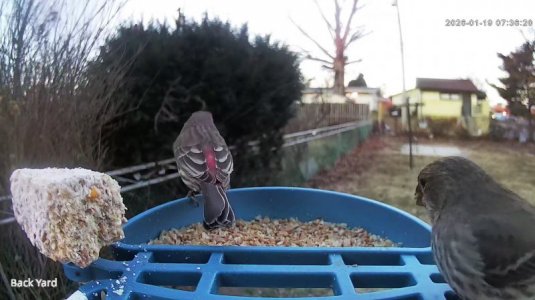
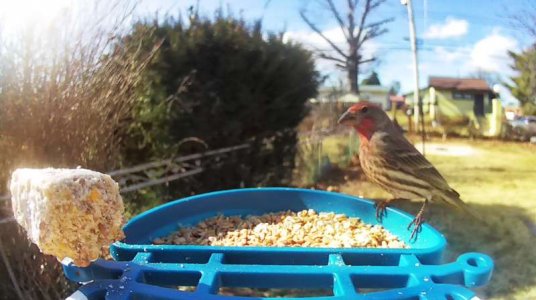
I like this one because of the red visible on the back of this Finch? under the feathers.
WhatsApp Image 2026-01-19 at 07.43.30.jpeg

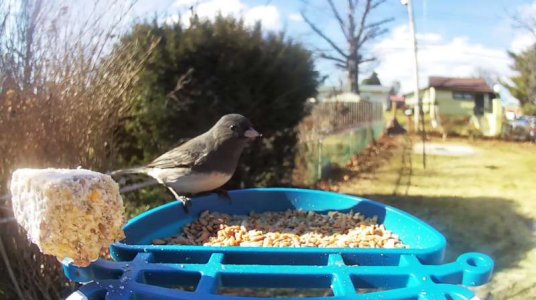
Our little Junco friend this morning.
WhatsApp Image 2026-01-19 at 12.48.52.jpeg


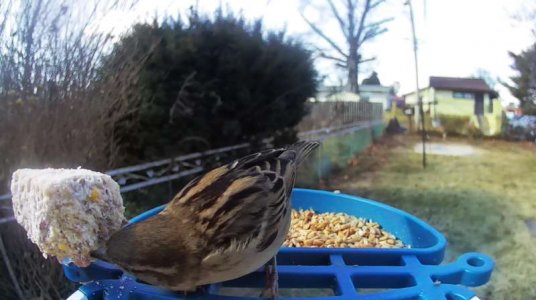
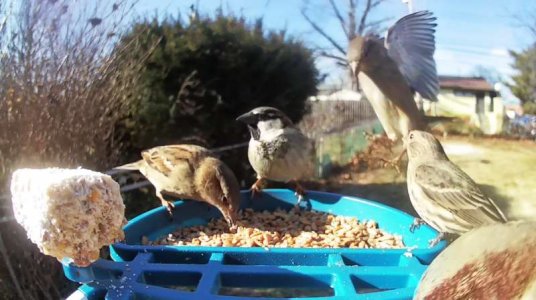
So the sparrows do like the suet as well.
WhatsApp Image 2026-01-19 at 12.48.54.jpeg


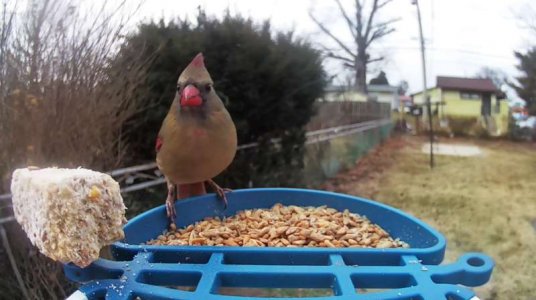
There she is. :) Haven't seen her mate today.
WhatsApp Image 2026-01-19 at 12.48.54 (2).jpeg
 
It’s nice to see them nibbling at the suet.
That sounded like a crow in the background but I’m not sure. The sound and visual recordings are VERY good though.
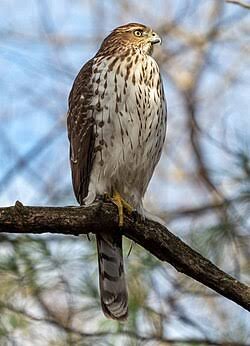
In post #177, in yesterday's video of lady Cardinal, at the end when the video freezes, there is something quite large in the bush and I can't figure out what it could be. It looks big enough to be a hawk, but that bush is too light to support a hawk's weight. It's kind of creepy in a fun way.
 
In post #177, in yesterday's video of lady Cardinal, at the end when the video freezes, there is something quite large in the bush and I can't figure out what it could be. It looks big enough to be a hawk, but that bush is too light to support a hawk's weight. It's kind of creepy in a fun way.
Could it be a crow? Crows are fairly large and intimidating and are omnivorous so are known to prey on little birds and eat other birds eggs.
Hawks defnitely prey on smaller birds. That’s one thing I hated about feeding the bird was the predator birds that would kill the smaller ones. That’s not so fun to see. In fact it’s really upsetting. Luckily you have plenty of bushes for them to hide in.
 
Could it be a crow? Crows are fairly large and intimidating and are omnivorous so are known to prey on little birds and eat other birds eggs.
Hawks defnitely prey on smaller birds. That’s one thing I hated about feeding the bird was the predator birds that would kill the smaller ones. That’s not so fun to see. In fact it’s really upsetting. Luckily you have plenty of bushes for them to hide in.
Yeesh, that would be upsetting! :( I do not want to see that.
A crow is what my husband was speculating also. It just looks so big. Like giant ghost bird.
 
Yeesh, that would be upsetting! :( I do not want to see that.
A crow is what my husband was speculating also. It just looks so big. Like giant ghost bird.
Luckily crows would rather eat tipped over garbage than kill little birds. We had a hawk that came by to catch smaller birds like chickadees or finches. There’s always a down side to everything. I’d forgotten about that until I heard the crow in the video. It’s just nature and that’s what nature does. Try not to worry about it too much.
 
Luckily crows would rather eat tipped over garbage than kill little birds. We had a hawk that came by to catch smaller birds like chickadees or finches. There’s always a down side to everything. I’d forgotten about that until I heard the crow in the video. It’s just nature and that’s what nature does. Try not to worry about it too much.
Thank you, Patty. 🤗 We do have hawks in this neighborhood and I find them beautiful. I'm just going to assume they will not need to bother my little birdies.
 
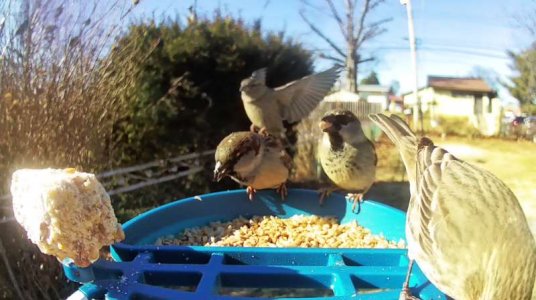
Yesterday, along with our favorites, we had some unexpected and not-so-welcome visitors. :/


WhatsApp Image 2026-01-20 at 13.31.27 (7).jpeg

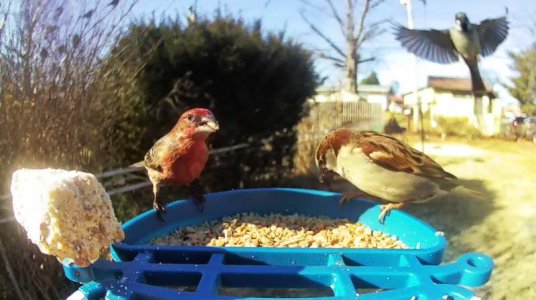
I like this in-flight shot.
WhatsApp Image 2026-01-20 at 13.31.27 (4).jpeg

Birdies in the sun.
WhatsApp Image 2026-01-20 at 13.31.27 (3).jpeg

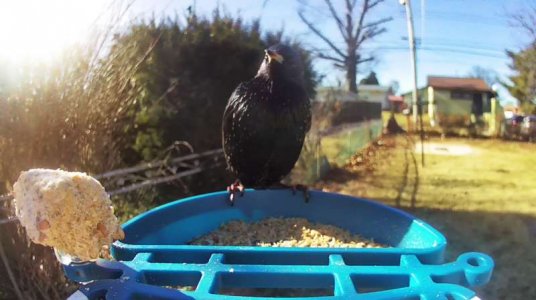
Oh no. It's a Grackle. And I'm sure it's got friends nearby. He is kind of cool-looking, though.
WhatsApp Image 2026-01-20 at 13.31.27 (1).jpeg

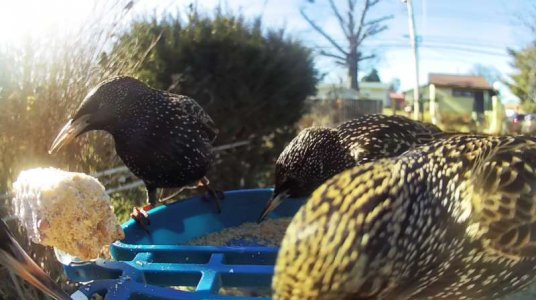
Yep, there they are. Grackles are difficult because they scare away the little birds and tend to eat up all the seed.
WhatsApp Image 2026-01-21 at 14.26.44 (2).jpeg

Thankfully, after I turned the alarm back on, I only saw them a couple more times and when I did, I pressed the alarm button and they flew away. Hopefully that's all we'll need to do to keep them away.
 
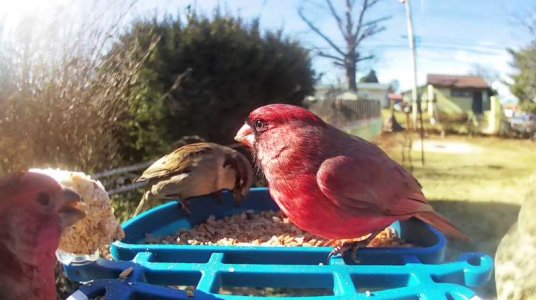
Today, Mr. Cardinal graced us. :)


And lady Cardinal, of course.
WhatsApp Image 2026-01-21 at 14.26.42.jpeg


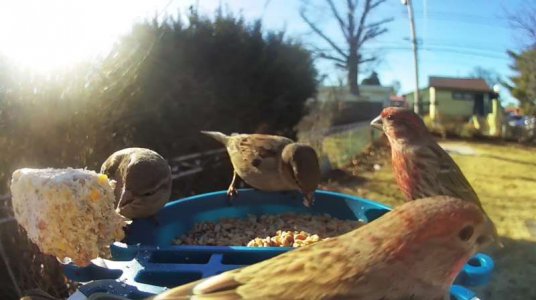
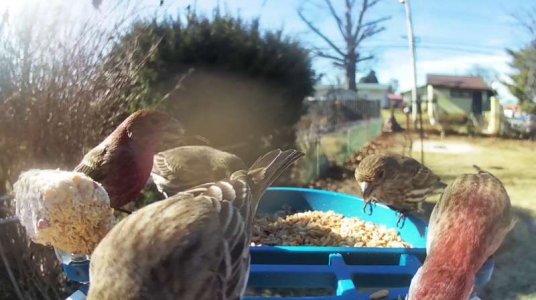
I love when it's crowded at the feeder.
WhatsApp Image 2026-01-21 at 14.26.41 (2).jpeg


I thought the little Red Finch was so pretty, so bright in the sunlight.
WhatsApp Image 2026-01-21 at 14.26.41 (1).jpeg

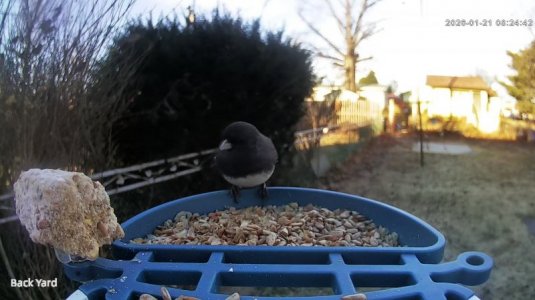
Our Junco friend. He looks sleepy.
WhatsApp Image 2026-01-21 at 14.26.43 (1).jpeg

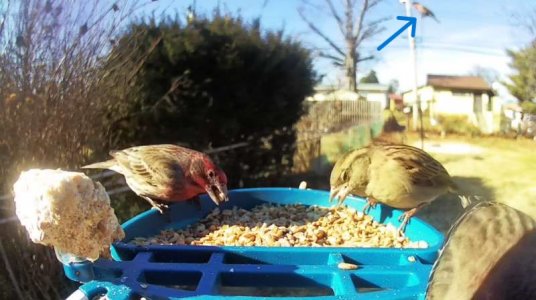
Is that a hawk on the top right?
WhatsApp Image 2026-01-21 at 16.52.01.jpeg
 
Wow. Now you have grackles visiting your feeders. What a large variety of birds you have. Nice pictures. That food looks so good.
It’s no wonder you get such a variety of birds.
I like the fact that you can speak to the birds so if you get too many grackles you can scare them away.

Do you top up the food everyday?
Do you have a safe place to store the seed so the mice doesn’t get them?


Back
Top