Remembrance Day 11/11

Warrigal

SF VIP
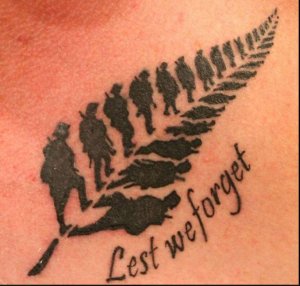
This person is determined never to forget. This is a tattoo.
I suspect it is on a New Zealander.

Lest we forget.JPG

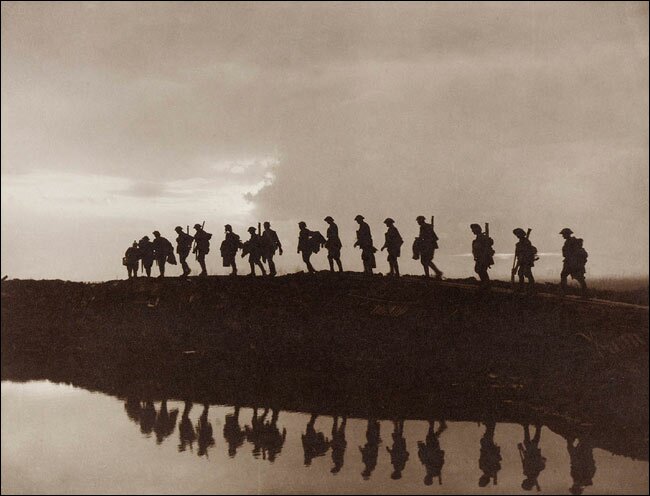
Perhaps this thread could be a chance to publish iconic images of the Great War.

This is a classic image taken by Frank Hurley, an Australian war photographer.
If memory serves it was taken on the western front. The Somme?

forward.jpg
 
Who were the last men to die on 11/11/1918?

60 SECONDS TO CEASEFIRE: THE LAST TO DIE

The very last person to die in the war was an American, shot dead at 10:59am by German soldiers.

00880f1b91e23a54f77091128f2e753a

Seconds to go ... Henry Gunter (centre) died at 10:59am.Source:Supplied

Private Henry Gunter — of German descent — was in a unit ordered to take an enemy machine gun post. Anecdotally the Germans, who knew ceasefire was moments away, at first tried to stop them by shouting and waving — but as the American attack developed, the Germans fired back.
Official records said of Gunter: “Almost as he fell, the gunfire died away and an appalling silence prevailed.”

A Canadian was shot dead one minute earlier — the final Commonwealth soldier to die, shot by a German sniper as his unit cleared houses during confused fighting in a small village.

The last Brit killed was a private shot dead at 9:30am, at Mons — where he had also fought in the British army’s crucial opening engagement of the war in 1914. Private George Edwin Ellison, a 40-year-old father, was among a handful of Britons who died at Mons on the same day.

The French kept on fighting too, losing 75 men. All their graves are marked November 10, allegedly to prevent mass outrage at the waste of life — although it may have been to ensure their families remained eligible for the war pension.

The last French fatality, ten minutes before the ceasefire, was a runner: Augustin Trebuchon, hit by a single bullet as he tried to deliver a message to his comrades that the war was over and hot food was on the way.

It is believed the final German to die was shot just after 11am — by Americans who did not realise the ceasefire was in place. The young officer, called Tomas, had approached them to say they could have the house his men were vacating.

http://www.news.com.au/lifestyle/re...870?from=google_rss&google_editors_picks=true

 
Thanks Bea.

Remembrance Day is a good time to remember ordinary men and women who, when under fire, refuse to be paralysed by their fear and who go one to inspire us by their actions.
 
[h=1]Remembrance Day tradition[/h]
[h=2]Why is this day special to Australians?[/h]At 11 am on 11 November 1918 the guns of the Western Front fell silent after more than four years continuous warfare. The allied armies had driven the German invaders back, having inflicted heavy defeats upon them over the preceding four months. In November the Germans called for an armistice (suspension of fighting) in order to secure a peace settlement. They accepted allied terms that amounted to unconditional surrender.
The 11th hour of the 11th day of the 11th month attained a special significance in the post-war years. The moment when hostilities ceased on the Western Front became universally associated with the remembrance of those who had died in the war. This first modern world conflict had brought about the mobilisation of over 70 million people and left between 9 and 13 million dead, perhaps as many as one-third of them with no known grave. The allied nations chose this day and time for the commemoration of their war dead.
On the first anniversary of the armistice in 1919 two minutes' silence was instituted as part of the main commemorative ceremony at the new Cenotaph in London. The silence was proposed by Australian journalist Edward Honey, who was working in Fleet Street. At about the same time, a South African statesman made a similar proposal to the British Cabinet, which endorsed it. King George V personally requested all the people of the British Empire to suspend normal activities for two minutes on the hour of the armistice "which stayed the worldwide carnage of the four preceding years and marked the victory of Right and Freedom". The two minutes' silence was popularly adopted and it became a central feature of commemorations on Armistice Day.
On the second anniversary of the armistice in 1920 the commemoration was given added significance when it became a funeral, with the return of the remains of an unknown soldier from the battlefields of the Western Front. Unknown soldiers were interred with full military honours in Westminster Abbey in London and at the Arc de Triumph in Paris. The entombment in London attracted over one million people within a week to pay their respects at the unknown soldier's tomb. Most other allied nations adopted the tradition of entombing unknown soldiers over the following decade.
After the end of the Second World War, the Australian and British governments changed the name to Remembrance Day. Armistice Day was no longer an appropriate title for a day which would commemorate all war dead.
In Australia on the 75th anniversary of the armistice in 1993 Remembrance Day ceremonies again became the focus of national attention. The remains of an unknown Australian soldier, exhumed from a First World War military cemetery in France, were ceremonially entombed in the Memorial's Hall of Memory. Remembrance Day ceremonies were conducted simultaneously in towns and cities all over the country, culminating at the moment of burial at 11 am and coinciding with the traditional two minutes' silence. This ceremony, which touched a chord across the Australian nation, re-established Remembrance Day as a significant day of commemoration.
Four years later, in 1997, Governor-General Sir William Deane issued a proclamation formally declaring 11 November to be Remembrance Day, urging all Australians to observe one minute's silence at 11 am on 11 November each year to remember those who died or suffered for Australia's cause in all wars and armed conflicts.
 
We in the U.K. more often than not call it Armistice day and we observe a 2 minute silence.

[h=1]Armistice Day: Nation remembers war dead[/h]

A two-minute silence has been observed across the UK to remember the nation's war dead on Armistice Day.
The silence began at the 11th hour of the 11th day of the 11th month - the time in 1918 when the guns fell silent along the Western Front in Europe.
War memorials, offices, schools, town halls, and churches all hosted events.
The Princess Royal was at the National Memorial Arboretum in Staffordshire, while veterans and serving personnel laid wreaths at the Cenotaph in London.

More here......

http://www.bbc.co.uk/news/uk-34783337
 
  • Like
Reactions: Pam
Thank you again Bea. That article was very informative.

I did not myself take part in any ceremony. I was at home by myself but I always reflect on the terrible losses of the Great War and am sad, not only for those lost and broken lives, but for the fact that the enthusiasm for military adventures continues unabated to this very day. Such waste of resources and blood.
 
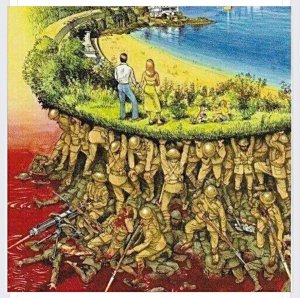
For the last four generations, everyone in my family except for my youngest son and myself have been in one branch of the service or another, and that included the women. This was an image that really struck my husband, a Marine. He always said there was no such thing as an ex-Marine.

image.jpg
 
Thanks Ina. My vets find it so difficult to recall their fallen comrades. How wonderful that your husband was a Marine. Even though I am Canadian, all vets are brothers/sisters in my eyes. I thank him for his service.
 
I always remember Rembrance day and buy a poppy if I see them, and because it as was late young brothers birthday, He passed away at 14 years old exactly one month before his 15 th birthday ..he would be 66 if still living
 
Back
Top