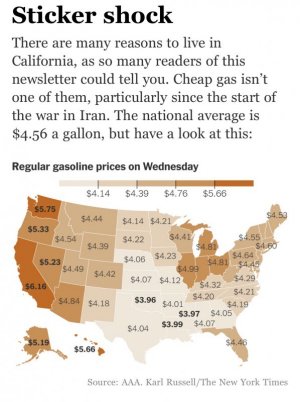
Sticker shock across the Nation.

It's not just gasoline - it's a broad range of food stuffs too.

Prices are rising on essentials, and people are feeling it. Food, housing, insurance, it goes on and on.

Of course, if you follow media reports, wages have actually grown slightly faster than inflation in recent times. But then, that's one of those stats that aren't much relatable to people. We've been battered over the last 5 years or more with rising prices, and any tiny improvements we're seeing now isn't going to compensate for the rises of the past.

Due to the war in Iran, oil prices have risen, and that all ends up coming out of our pockets. The good news is, the oil companies are posting record profits (Shell profits rise as Iran war pushes oil prices higher).
 
I;m sorry but really you'd be in for a shock if you were paying for fuel here.. The average price of petrol is £1.57 per litre ( altho; many places are charging much more ) .. there are 4.5 litres in a UK gallon that makes £7.065 per Gallon.. an approx equiv of $9.50 USD PER Gallon


Diesel is much higher still at.. an average of £1.90 per litre... £8.55 per gallon - approx equiv $11.64.. USD.. per Gallon :(


Super unleaded petrol is at an astonishing £1.78 per litre... that's over £8.00 per gallon... approx equiv.. $10.90 USD per gallon


to put that into perspective the National minimum wage is just over £12.00 per hour...
 
Price of gas per gallon was .53 in 1974. That price adjusted for inflation would be $3.62 today. So even with this temporary spike we are not paying that much more on an inflation-adjusted basis.

Prices of housing, cars, college tuition, and many other things have far outstripped inflation over the past 50 plus years. Doesn't make it any less painful when I fill up my tank, but it provides a little perspective.
 
Price of gas per gallon was .53 in 1974. That price adjusted for inflation would be $3.62 today. So even with this temporary spike we are not paying that much more on an inflation-adjusted basis.

Prices of housing, cars, college tuition, and many other things have far outstripped inflation over the past 50 plus years. Doesn't make it any less painful when I fill up my tank, but it provides a little perspective.
The minimum wage in 1974 was $2.00 an hour, which would be $13.40 in todays dollars. Our current minimum wage is $7.25 an hour, so nearly half of what it was in 1974.
 
Aww Dennis, now you know even if they did open it, there's always another gripe right behind. I am bored with this
gas thing, let's move to the next one. :LOL:

It's quite literally, gas lighting. :D

I see a few people trying to rationalize current prices, but surely we all know why they're suddenly climbing - it's the war in Iran. It's not down to some comparative metric.

In terms of the US, they have huge oil reserves which are refined into gasoline. Therefore, not only would you expect the price to be lower than countries that import their oil, but you really have to question why prices are rising higher in the US. The answer, of course, is the market, nothing to be with scarcity. That oil is now more valuable because foreign oil costs more, the market is up.

The US does import gasoline, but it's usually based on the market value, which is actually in their favor right now.
 
It might surprise some, that while your cost per U.S. gallon of gasoline/petrol is higher, Americans think of the cost of fill-ups and frequency. Example being the U.S. per capita consumes 6 times that of the United Kingdom. So yes that cost of a U.S. gallon of gasoline is important for that reason. Think about that... 6 fillups to one fill-up, really adds up quickly.

Diesel fuel is the opposite, as the United Kingdom per capita, consumes near twice the diesel, as the U.S. When factoring in both diesel and gasoline/petrol, the U.S. consumes about double per capita.

It is important to take into account the entire picture, imho.

 
The minimum wage in 1974 was $2.00 an hour, which would be $13.40 in todays dollars. Our current minimum wage is $7.25 an hour, so nearly half of what it was in 1974.
You know as well as I do that no one (well, less than one percent of hourly workers) makes the Federal minimum wage. In my state the minimum wage is $12.77 per hour. The minimum is higher in many states and cities. In California it's $16.90 per hour,.

Given the broad disparities in costs across the US it makes more sense to set rates locally.

BTW the average hourly wage in the US is about $37.00.
 
Last edited:
It might surprise some, that while your cost per U.S. gallon of gasoline/petrol is higher, Americans think of the cost of fill-ups and frequency. Example being the U.S. per capita consumes 6 times that of the United Kingdom. So yes that cost of a U.S. gallon of gasoline is important for that reason. Think about that... 6 fillups to one fill-up, really adds up quickly.

Diesel fuel is the opposite, as the United Kingdom per capita, consumes near twice the diesel, as the U.S. When factoring in both diesel and gasoline/petrol, the U.S. consumes about double per capita.

It is important to take into account the entire picture, imho.

Why? Our government did something really stupid that caused the price of gas to go up. Why do we need to take anything other than that into account?
 
The price of gas goes up and down, but once prices go up on goods we purchase, due to a higher cost to transport them, they do not follow the same pattern of going down once gas goes down. They have reached a new plateau.
 
Here in Central Calif, gas is still well under $5/gal. My local Chevron is sitting at $4.36 for regular right now, and the Valero is at $4.27. The oddest thing about that is the gap; they're usually only a few pennies apart.

We'll probly see a price-jump when the weather warms up.
 
The minimum wage in 1974 was $2.00 an hour, which would be $13.40 in todays dollars. Our current minimum wage is $7.25 an hour, so nearly half of what it was in 1974.
however that's not all of the USA...

State Variability: As of 2026, many states have increased their minimum wages, often exceeding $15 per hour in areas like California, DC, and New York.
 
$ 4.499/gallon here, a bit less at Costco or for stations offering a cash or membership price.

Gas is no longer a significant budget item for me but prices on other things continue to rise.

I have noticed two things, we no longer hear anything about liberating the good people of Iran and the good people of Iran don’t seem to be doing much of anything to help free themselves from their oppressive regime.
 
Last edited:
$ 4.499/gallon here, a bit less at Costco or for stations offering a cash or membership price.

Gas is no longer a significant budget item for me but prices on other things continue to rise.

I have noticed two things, we longer hear anything about liberating the good people of Iran and the good people of Iran don’t seem to be doing much of anything to help free themselves from their oppressive regime.
Yep, the price of fuel affects the price of everything we buy that needs to be shipped, so even if we don't drive, we still pay the cost. It can also affect local government budgets when their mass transit systems are run on fossil fuels. They won't have money for other things that the people would benefit from, such as parks, street maintenance, rec centers, and other civic projects. They can either cut work on those projects or raise taxes and fees.
 
Back
Top