The cost of living - COL.

Previously I stated the C.O.L.A. to 2.8%. There is now a very slim chance of 2.7%. I'm sure there will be all manner of finger pointing and gnashing of teeth, whichever is the number. My own personal Cost of living exceeds that percent. :(
 
Previously I stated the C.O.L.A. to 2.8%. There is now a very slim chance of 2.7%. I'm sure there will be all manner of finger pointing and gnashing of teeth, whichever is the number. My own personal Cost of living exceeds that percent. :(
As does mine. Utilities and other recurring bills have increased far more than 3% over the past year. Same with nearly everything I purchase on a regular or occasional basis.
 
As does mine. Utilities and other recurring bills have increased far more than 3% over the past year. Same with nearly everything I purchase on a regular or occasional basis.
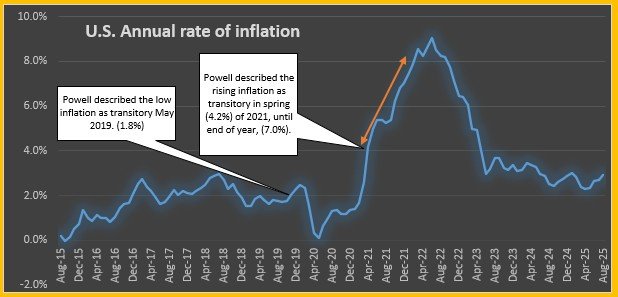
I haven't got all the September bills, but I would estimate my own cost of living has gone up 3.1% over last year. With the Headline CPI projected to be 3.0%~3.1% and CPI-W 2.7%~2.8%, there will be a lot of squabbling and squawking.

To use a phrase from the past... "it's transitory."
annual rate of inflation.jpg
 
Some of this doesn't affect me directly, since my property taxes are frozen, but on several recent news broadcasts, reporters have been speaking with residents about rising property taxes and how those costs will be a deciding factor in whether or not they can afford to buy a home, even if interest rates drop. Many say they cannot afford a home, no matter how low interest goes, since the property taxes and insurance are rising faster than any interest they might save.

I do not understand the need for taxing authorities to increase property tax rates, when they are automatically collecting more taxes as home prices rise every year. Most homes where I live are selling for 3-4 times what they were 15 years ago, yet they always find a way to justify raising taxes for more and more money. [We are not a growing community that requires more law enforcement or city services. Our population has stayed the same for 20 years.]

And we're not seeing improvments from higher taxes. Most of us are dodging potholes, and we have old water lines that constantly break, and just get patched. A city truck stopped some days ago and dumped gravel in a big pothole in front of my house instead of a proper repair. Two red lights downtown have been out over a year and we have stop signs now instead because the city says they can't afford to fix the traffic signals.

The county I live in has no stoplights and only stop signs (to save money of course). When I lived in Indiana, the big trend in towns around Indianapolis was roundabouts. Then again, saves money. Carmel Indiana has the most roundabouts than any other city in the US. They have 155 roundabouts. When I lived in that area, it was a pain. It seemed like every intersection was a roundabout.
 
Previously I stated the C.O.L.A. to 2.8%. There is now a very slim chance of 2.7%. I'm sure there will be all manner of finger pointing and gnashing of teeth, whichever is the number. My own personal Cost of living exceeds that percent. :(

The last piece of data (September's CPI-W) used to determine next years COLA is scheduled to be released on October 15th. However with the government shut down that may be delayed.
 
The county I live in has no stoplights and only stop signs (to save money of course). When I lived in Indiana, the big trend in towns around Indianapolis was roundabouts. Then again, saves money. Carmel Indiana has the most roundabouts than any other city in the US. They have 155 roundabouts. When I lived in that area, it was a pain. It seemed like every intersection was a roundabout.
(Rotaries and roundabouts are the same thing.) To me, what makes driving fun is rotaries (also, hairpin turns). Otherwise, driving is boring and frustrating because I like looking at the stuff beside the road, which is not a safety plan.

Lately, I read that having rotaries is safer than traffic lights. Roundabouts
 
(Rotaries and roundabouts are the same thing.) To me, what makes driving fun is rotaries (also, hairpin turns). Otherwise, driving is boring and frustrating because I like looking at the stuff beside the road, which is not a safety plan.

Lately, I read that having rotaries is safer than traffic lights. Roundabouts
In the long run, they're probably safer as far as injuries go, but they're only as safe as the drivers. Some people don't yield before entering and dart right out there and others just sit there before entering holding up the flow. You almost have to guess what the other drivers are going to do. The four way roundabouts aren't terribly bad but where I live there are a couple that are shaped like an irregular rectangle with five or six entrances and exits. They can be confusing plus I'm not the worlds best driver.
 
In the long run, they're probably safer as far as injuries go, but they're only as safe as the drivers. Some people don't yield before entering and dart right out there and others just sit there before entering holding up the flow. You almost have to guess what the other drivers are going to do. The four way roundabouts aren't terribly bad but where I live there are a couple that are shaped like an irregular rectangle with five or six entrances and exits. They can be confusing plus I'm not the worlds best driver.
That's how they were in Boston - 2 lanes and multiple exits. I took to them like a duck to water, for no reason as I'd never seen one before. The whole thing just made perfect sense to me.

I think that some people were never taught to yield before entering a rotary; they just assume everyone will make way for them. Same with yield signs at expressway entrance ramps.
 
The county I live in has no stoplights and only stop signs (to save money of course). When I lived in Indiana, the big trend in towns around Indianapolis was roundabouts. Then again, saves money. Carmel Indiana has the most roundabouts than any other city in the US. They have 155 roundabouts. When I lived in that area, it was a pain. It seemed like every intersection was a roundabout.
After having drove in England and then coming home and later seeing more roundabouts popping up I am convinced we Americans
are so used to being told by signs and signals what to do that round about safety hopefully will be put on driving tests if not already.
Some people have no idea what to do when they come into one nor how to show patience if someone is driving in one looking
confused. One main road in a town I rarely go to has 4 roundabouts really close together, that is like driving in a bumper car ride
during heavy traffic.
 
Americans are generally poorly acquainted with roundabouts so they tend to be the source of confusion and accidents.

About ten years ago I was in Tenerife, Canary Islands for the better part of a week. Our condo happened to overlook an elementary school with an outdoor area with bicycles, tricycles, scooters, and other human-powered little vehicles. There was a large paved layout that included small sized roundabouts, stop signs, merging lanes, pedestrian crossings, and so forth. The kids used the vehicles to "drive" the patterns (or cross the "streets") during what looked like an adult-supervised PE class.

We asked the owner of the AirBnB who explained that this taught children how to safely navigate various traffic patterns.

My husband and I thought it was an absolutely brilliant concept and regretted the US hadn't done the same. The kids were getting plenty of exercise while learning proper driving and pedestrian skills.
 
America is a tough town when you run out of money.
I am doing financial planing for my life up to 85 years old of age, and I make sure I have the reserved fund for one way travel to Switzerland at the end. Anything left will go to charity. And I prefer the charity with low administrative and marketing expense.
 
The recent tariffs caused many goods to increase in price. Now that those tariffs have been ruled unconstitutional, can people sue to recover the money they lost? I think corporations are already starting to sue to recover the $100s of billions they paid in tariffs.

Here are some of the products that were affected...

The following categories experienced some of the most notable price hikes due to the now-invalidated IEEPA tariffs:
  • Automotive: Motor vehicle parts and specific models saw substantial increases. For example, a 2025 SUV made in Mexico was estimated to cost nearly $8,000 more due to these duties.
  • Home Furnishings: This sector faced some of the largest predicted increases, particularly for furniture, musical instruments, and household necessities.
  • Electronics and Tech: Consumer electronics and various tech products saw prices rise as importers passed on the cost of the duties.
  • Apparel and Footwear: Clothing, such as jeans and toddler sets, and shoes saw price jumps of 10% to 50% depending on the country of origin.
  • Agriculture and Groceries: Prices rose for imported staples like coffee (Brazil), fresh fruit (60% of which is imported), avocados (Peru), and strawberries (Chile). Farmers also saw higher costs for fertilizer and equipment.
  • Restaurant and Hospitality: Over 60% of restaurant operators reported significant challenges due to tariff-related price hikes on food and beverage imports.
I had some work done to my Honda CR-V last year... two wheel bearings replaced and brakes. The parts for those repairs were ridiculously priced due in part to the tariffs. Honda parts have always been expensive, but they were even more expensive due to the tariffs. I wonder if I can recover some of that. Maybe I'll get a notice from the dealer.
 
Back
Top