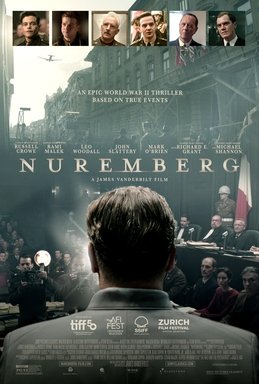
View attachment 477179
Nuremberg (2025)
The film’s title is a bit of a misnomer. The lengthy Nuremberg trials --having taken place between November, 1945 and October, 1946-- served only as an underpinning backdrop to the chief story of the relationship between
Reichsmarschall Hermann Göring and psychiatrist Douglas Kelley, who had been tasked by the U.S. Army to evaluate Göring and other top Nazi defendants about their ability to stand trial.
The chief reason to see this film is the convincing and nuanced portrayal of Göring by
Russell Crowe. Crowe not only has the charisma and the look in his performance, but his expression of the subject’s peculiar appeal dominates every scene he’s in. In contrast, the combination of uneven and incongruous writing for the Kelley character contributes to the confusing performance by
Rami Malek, which makes it seem that Malek was miscast in his role.
Further, the portrayal of the nature of the relationship between the two was possibly made up out of whole cloth. Not having read the book used for inspiration for the screenplay --
The Nazi and the Psychiatrist by Jack El-Hai-- it’s hard to say whether there was any factual basis to the veracity of Göring’s and Kelley’s exchanges. One example: Kelley’s teaching of slight-of-hand to Göring likely serves only as a method to explain how Göring achieved possession of the well known cyanide capsule, which was to save him from hanging.
Of course the film’s purpose was not as a documentary, but rather as an “inspired by” dramatic story of a few particular subjects during the arrest and trial of certain high Nazi officials at the end of WWII.
The supporting actors were effective, such as:
Michael Shannon as lead prosecutor;
John Slattery as the prison commandant;
Mark O’Brien as chief interrogator;
Colin Hanks as an associate psychologist;
Lotte Verbeek as Göring’s wife, Emmy. Most were physically representative of the real life characters they played, however we had to smile at the young and attractive Verbeek in her role as Mrs. Göring who in reality at that time was tall, homely, and rather dowdy at aged 52.
Beyond the focus on the Göring/Kelley relationship, director
James Vanderbilt’s screenplay didn’t get too deep. In fact one could not help noticing the apparent Oscar bait intention-- “camera ready” with quotable lines of dialogue, and certain scene constructions meant for clips. Vanderbilt is not an experienced director, with only one other directing credit,
Truth (2015). It seems to me that more often than not, a writer should not direct his own screenplay. There are many obvious exceptions, but oftentimes a writer does not necessarily know what is going to work on screen.
Nuremberg is certainly watchable, and the story is interesting enough for the subject of a movie, but lackluster direction and a simplistic telling of a complicated subject keeps the picture from being better.
Doc’s rating: 6/10