Women & the gender gap

Fern

Member
Location
New Zealand
The latest survey on countries closing the gender gap, has New Zealand rated 7th, no sign of Australia being closer to the top, but somehow that doesn't surprise me, the Australian male, in my opinion, is quite macho, probably not all, but a fair few of them.
Women have come a long way since the Suffragettes, (New Zealand women the first to get the vote) voiced their strong opposition to a male dominated society, but too many countries
still have this archaic practice.
On 19 September 1893 the governor, Lord Glasgow, signed a new Electoral Act into law. As a result of this landmark legislation, New Zealand became the first self-governing country in the world in which all women had the right to vote in parliamentary elections.
In most other democracies – including Britain and the United States – women did not win the right to the vote until after the First World War.
For five years in a row, Iceland has been rated the country with the world's smallest gender gap by the World Economic Forum (WEF).
The rating means Iceland is the country where women enjoy the most equal access to education and healthcare. It is also where women are most likely to be able to participate fully in the country's political and economic life.
Iceland is joined at the top of the The Global Gender Gap Report, 2013 by its Nordic neighbours Finland, Norway and Sweden.
Overall, the gender gap narrowed slightly across the globe in 2013, as 86 of 133 countries showed improvements. However, "change is definitely slow", says one of the report's authors, Saadia Zahidi.

Europe has seven countries in the top 10. The UK is 18th and the US is 23rd.The Philippines, at fifth, is the highest ranking Asian nation and Nicaragua is the highest-placed country from the Americas, at 10th.
The G20 group of leading industrial nations has no representative in the top 10, nor do the Middle East or Africa.

Top countries

1. Iceland
2. Finland
3. Norway
4. Sweden
5. Philippines

6. Ireland
7. New Zealand
8. Denmark
9. Switzerland
10. Nicaragua
 
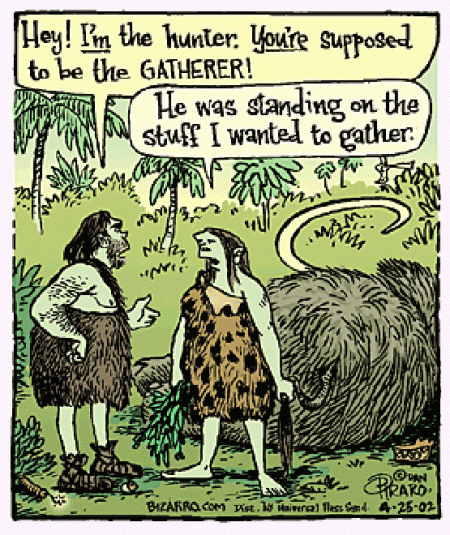
hunter-gatherer-cartoon-by-Bizarro-450x535.gif
 
Saw that earlier Fern....thanks for posting.

Very interesting I thought....surprised you did so badly in healthcare....
 
Yes, there is a gender gap in Australia but it is a lot less than it was in the days of my mother and in my younger days.

Pre-WW II, married women had to resign their public service jobs, even highly trained teachers and nurses. Female workers were paid 80% or less for doing the same work as men but by the time I started teaching in 1963 I was receiving equal pay. However, my mandatory superannuation payments could not benefit my husband after my death although the widow of a public servant would continue to receive payouts from the fund. I could not acquire a credit card or a loan without a male guarantor.

I was once denied service in Hilton hotel bar because I was a female - hubby and I were terribly embarrassed because we were both well behaved and well dressed but "public bar", no matter how up market, only allowed half the public to cross the threshold. The male half.

When my children were a bit older I returned to teaching and had to endure a lot of social stigmatisation from the neighbours for being a working mother. Working mothers, but not working fathers, were the source of all juvenile delinquency in the 1960s.

All of these discriminations have largely been removed and young women today are often oblivious of the battles women have had to fight to get anything like a fair go. First and second wave feminists brought us forward and when modern young women declare that they are not feminists but they believe in gender equality I feel like telling them that they are right on the first point. They are not worthy of the tag feminist unless they are prepared to speak out for that which they claim to believe in.
 
I would agree there's been a lot of changes and some progress. Yet, there is still so much stupidity and resistance. Slowly but ever so surely . . .
 
Yes, there is a gender gap in Australia but it is a lot less than it was in the days of my mother and in my younger days.

Pre-WW II, married women had to resign their public service jobs, even highly trained teachers and nurses. Female workers were paid 80% or less for doing the same work as men but by the time I started teaching in 1963 I was receiving equal pay. However, my mandatory superannuation payments could not benefit my husband after my death although the widow of a public servant would continue to receive payouts from the fund. I could not acquire a credit card or a loan without a male guarantor.

I was once denied service in Hilton hotel bar because I was a female - hubby and I were terribly embarrassed because we were both well behaved and well dressed but "public bar", no matter how up market, only allowed half the public to cross the threshold. The male half.

When my children were a bit older I returned to teaching and had to endure a lot of social stigmatisation from the neighbours for being a working mother. Working mothers, but not working fathers, were the source of all juvenile delinquency in the 1960s.

All of these discriminations have largely been removed and young women today are often oblivious of the battles women have had to fight to get anything like a fair go. First and second wave feminists brought us forward and when modern young women declare that they are not feminists but they believe in gender equality I feel like telling them that they are right on the first point. They are not worthy of the tag feminist unless they are prepared to speak out for that which they claim to believe in.

Yes, the gender gap has closed here also, still lagging in the equal pay department. I think we will see a major turnout of women voters in the next presidential election in the US, also in the governor's race here in Texas as we have a up and coming lady running.
 
Saw that earlier Fern....thanks for posting.

Very interesting I thought....surprised you did so badly in healthcare....
Yes isn't it, but I can remember being in hospital in the 60's, and you got the sense it was male dominated so obviously a way to go yet for anything like equality.

Warrigal, What is your take on why the Aussie male is more macho than his Kiwi counterpart, (that's not to say there are none here) we originated from the same 'stock', ie, mainly British immigration.?
 
I don't know the answer to that one, Fern. The men in my family have never been macho. The majority have always been mild mannered like Clark Kent yet possessed an inner strength that could be relied on by their women. The trend continues to this day in my son and grandsons. I have no time for macho men.
 
More than that. He has a history of aggression towards women whom he sees as rivals.
He is not above using physical intimidation against women.
His body language towards men is also intended to intimidate.
He is a bully and bullies are always gutless, no matter how macho they present.

IMO, of course.
 
Back
Top