world war I

I like to see stories regarding THAT war; especially the air war and the airplanes & machine guns used. OH, and the tanks.

What a difference in the equipment then and now.
 
Both of my Grandfathers served in France in WWI, and both returned in one piece. As one of them used to say, "shot at and missed, s**t at and hit"...

It was ugly. Thanks again Ray & Jim.
 
This is the hundred year anniversary of the end of World War I

and no one cares!
??? The end?
What about Armistice Day - 11-11-1918 ?

Germany had formally surrendered on November 11, 1918, and all nations had agreed to stop fighting while the terms of peace were negotiated. On June 28, 1919, Germany and the Allied Nations (including Britain, France, Italy and Russia) signed the Treaty of Versailles, formally ending the war.

I can assure you that in Australia we have not forgotten. Since 2014 we have been remembering the centenary of every important campaign and battle in which our soldiers served.
 
I know armistice day is in November.

In America I have not seen or heard any mention of it
but perhaps the media people are waiting until 11/11.
Did not know that Australia was involved. We read only about Europe.
Seems like WWII gets all the attention.
 
We were involved from the minute that Britain declared war. Our troops were first engaged on the Gallipoli peninsula from 25 April 1915 and after that we engaged in Egypt and Palestine (my grandfather served in the desert in the Light Horse) and on the Western Front. For a small population we lost a lot of men and as a consequence Australia was a very different place after the war.

On April 25, 1918 at le Hamel, France, Australians and US recruits were side by side under Australian command and this battle was highly successful and was a turning point that halted the German advance.

Australia was very much involved as were other Commonwealth countries such as New Zealand, Canada and India.


Light Horsemen
 
November 11th is recognized in America first as Armistice Day regarding WW1, then as Veteran's Day, to include all veterans for all wars fought by the US.

Remembrance of this, once called The Great War, is taught in our schools. What I have learned was this was a terrible and agonizing war, as they all are, but this one, most especially so.

Armistice - The End of World War I,​

1918​

The final Allied push towards the German border began on October 17, 1918. As the British, French and American armies advanced, the alliance between the Central Powers began to collapse. Turkey signed an armistice at the end of October, Austria-Hungary followed on November 3.


Germany began to crumble from within. Faced with the prospect of returning to sea, the sailors of
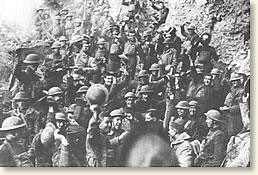
armistice1.jpg
America troops at the front celebrate
the end of the fighting, Nov 11, 1918
the High Seas Fleet stationed at Kiel mutinied on October 29. Within a few days, the entire city was in their control and the revolution spread throughout the country.

On November 9 the Kaiser abdicated; slipping across the border into the Netherlands and exile. A German Republic was declared and peace feelers extended to the Allies. At 5 AM on the morning of November 11 an armistice was signed in a railroad car parked in a French forest near the front lines.

The terms of the agreement called for the cessation of fighting along the entire Western Front to begin at precisely 11 AM that morning. After over four years of bloody conflict, the Great War was at an end.
 
I am a frequent visitor to Belgium, and when I am in Ypres, I make a point of going to the Menin Gate to attend the evening memorial service and the playing of the 'Last post'. For those who don't know about this, I suggest you do a bit of research.
It is quite remarkable the number of regiments (including my grandfather's - the 6th Scottish Rifles (The Cameronians)), and various nationalities who fought and died there. ANZAC day attracts many of our commonwealth allies to the gate.

In recent years this has become very well attended and I almost tend to feel that it has become a 'cog in the WW1 nostalgia machine' - a sort of 'must see' event. This year, it will be particularly busy. When I was there last year, a lot of preparations were already underway.
 
Maternal grandfather served with american forces in France. He never spoke about the time and I only learned from second hand what he experienced. His tin doughboy hat hung from a peg in the garage for years. He was in an area that experienced a mustard gas attack and after returning to the US spent some time in a VA hospital for treatment.
 
My dad served in WWI as a 20 year old. He and his brother were in the same Company. They sailed on the SS President Lincoln and landed in Brest. On it's return voyage to the States, ship was torpedoed and sunk while carrying wounded and officers being rotated home. As I recall, the loss of life was fortunately minimal.

My dad and his brother both returned after the Armistice all in one piece although my dad had contracted a disease similar to malaria that troubled him on and off throughout the rest of his life.

I still have his uniform, minus the leggings and hat.
 
We were involved from the minute that Britain declared war. Our troops were first engaged on the Gallipoli peninsula from 25 April 1915 and after that we engaged in Egypt and Palestine (my grandfather served in the desert in the Light Horse) and on the Western Front. For a small population we lost a lot of men and as a consequence Australia was a very different place after the war.

On April 25, 1918 at le Hamel, France, Australians and US recruits were side by side under Australian command and this battle was highly successful and was a turning point that halted the German advance.

Australia was very much involved as were other Commonwealth countries such as New Zealand, Canada and India.


Light Horsemen

 
Back
Top