Hapiguy
Member
- Location
- North Carolina


Very interesting!


These days, it has become more conversational. What I have heard people say (not to me, fortunately) "Have you had your FY today?".Well who knew .....
.... about pluck yew?


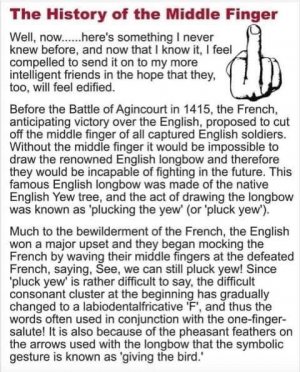
Sorry if this pours cold water on your story, but like all these historical "facts," they get embellished along the way. 5000 English archers and 1000 men at arms faced 20000 French troops at Agincourt. Most historians will say that the archers stuck up two fingers, the middle, like you say, and the index. Who knows for sure, but the reason why the French lost with overwhelming odds in their favour was because the English king, Henry the Fifth, employed a new tactic, what we know today as: Firing (shooting) by rank. Furthermore, he instructed his archers to aim at the horses, the horse's heart is exposed in a cavalry charge. Bringing down the horses left the knights floundering around in full armour, causing yet more mayhem for the French troops at the rear.
Sorry if this pours cold water on your story, but like all these historical "facts," they get embellished along the way. 5000 English archers and 1000 men at arms faced 20000 French troops at Agincourt. Most historians will say that the archers stuck up two fingers, the middle, like you say, and the index. Who knows for sure, but the reason why the French lost with overwhelming odds in their favour was because the English king, Henry the Fifth, employed a new tactic, what we know today as: Firing (shooting) by rank. Furthermore, he instructed his archers to aim at the horses, the horse's heart is exposed in a cavalry charge. Bringing down the horses left the knights floundering around in full armour, causing yet more mayhem for the French troops at the rear.
Not that it matters whether it was one finger or two, but in the UK, the two finger gesture with the palm facing inward, had a similar meaning to that of the middle finger. This was pointed out to Churchill during WW2, which is why you always see Churchill give the famous V for Victory sign with his palm outwards.
Some will also say that the first time gunpowder was used in battle was at Agincourt, it wasn't but it was used at the siege of Harfleur earlier on in the campaign. The mists of time often distort such facts. The French archers were using the crossbow, whilst the English rejected the crossbow in favour of the longbow. Agincourt was the zenith of the bow and arrow, an archer could pierce a four inch thick oak door, such was their strength in drawing back the longbow.

Well, with two fingers held up, it could be that infamous "double bird" (not Under the Double Eagle!Sorry if this pours cold water on your story, but like all these historical "facts," they get embellished along the way. 5000 English archers and 1000 men at arms faced 20000 French troops at Agincourt. Most historians will say that the archers stuck up two fingers, the middle, like you say, and the index. Who knows for sure, but the reason why the French lost with overwhelming odds in their favour was because the English king, Henry the Fifth, employed a new tactic, what we know today as: Firing (shooting) by rank. Furthermore, he instructed his archers to aim at the horses, the horse's heart is exposed in a cavalry charge. Bringing down the horses left the knights floundering around in full armour, causing yet more mayhem for the French troops at the rear.
Not that it matters whether it was one finger or two, but in the UK, the two finger gesture with the palm facing inward, had a similar meaning to that of the middle finger. This was pointed out to Churchill during WW2, which is why you always see Churchill give the famous V for Victory sign with his palm outwards.
Some will also say that the first time gunpowder was used in battle was at Agincourt, it wasn't but it was used at the siege of Harfleur earlier on in the campaign. The mists of time often distort such facts. The French archers were using the crossbow, whilst the English rejected the crossbow in favour of the longbow. Agincourt was the zenith of the bow and arrow, an archer could pierce a four inch thick oak door, such was their strength in drawing back the longbow.
), in which you get two pluck yew's for the price of one!