Electric Vehicles

Yes, this could work.

So, lessee...you swap the capital outlay from multiple individually accessible charging stations to a significant number of batteries that will be charged, ready-to-go when a customer comes in? The surplus batteries would be a sort of "buffer" to smooth the process flow.

An discharged battery would go into a "back room" charger of some kind, optimized for multiple simultaneous batteries. A recharged battery would come out of "storage" and bolted in at a "changing station" (rack?) and the customer would drive away.

So if we assume that the discharged battery can be recharged and undergo diagnostics in the "back room" in about 30 min, we need enough surplus batteries to cover the expected number of customers in any given 30 min period, plus fudge factor.

What do you think?
Yep, that's probably how it will work.

Here's a battery pack from a Nisan Leaf:
photo_battery-64a0b2aa.jpg

It's made up of a dozen or so smaller batteries, so rather than having to replace the entire battery assembly on failure, just the bad ones can be replaced.

China has the advantage in EVs in that the government runs the swap stations, which takes the profit motive out of it. And there's probably a death penalty for anyone who steals batteries from the stations. For it to work in the U.S. would require a great deal of cooperation between several disparate entities, which may not be possible in this day and age.
 
Yep, that's probably how it will work.

Here's a battery pack from a Nisan Leaf:
photo_battery-64a0b2aa.jpg

It's made up of a dozen or so smaller batteries, so rather than having to replace the entire battery assembly on failure, just the bad ones can be replaced.

China has the advantage in EVs in that the government runs the swap stations, which takes the profit motive out of it. And there's probably a death penalty for anyone who steals batteries from the stations. For it to work in the U.S. would require a great deal of cooperation between several disparate entities, which may not be possible in this day and age.
Hah! Yeah!

Funny how the possibility of *serious* accountability focuses the mind.
 
Too funny.
Serious thought.....nuclear power, solar power?

I'm thinking EVs are truly something for the future, but not today, and not tomorrow.
Need to concentrate on and solving power sources
waaaay before pumping out EVs
Look at the links on my posts #5 and #11, and consider the human & ecological damage being wrought, then think of the discarded end products going into land fills and then wonder about future agriculture.

And for what?
 
Look at the links on my posts #5 and #11, and consider the human & ecological damage being wrought, then think of the discarded end products going into land fills and then wonder about future agriculture.

And for what?
Yeah....no solution today, that's for sure
 
Have you thought about getting one?

I saw an article in the newspaper a few days ago about going
on a long trip in one, not recommended at this time of the
year, especially when the trains are on strike, the item wrote
about a 12 hr wait at a service station on the M6 in Cumberland,
the area where they were stuck, is a really bleak place in the
middle of not very much, the item showed a line of Tesla Cars
queueing on the actual motorway to gain access to the services,
I can't find the picture on the net, unfortunately.

They were all heading for Scotland and had reached the North
of England, about 300 miles from London, assuming that was
their starting point, so fully laden car maybe with children on
board, the heater running full blast to keep warm, all will soon
deplete the battery, then you have to wait for a charger, all not
really good adverts for the vehicles.
45 second video of Tesla Queue.

Here is a newspaper article about the problems facing electric
vehicles in the UK, they will also be found in any country that
allows them to be imported or built.

We are all used to filling up with Petrol or diesel, which only
takes about 5 minutes, the quickest charge I believe takes at
least half an hour.

Food for thought.

Mike.

This is the MOST impractical side of EVs in my opinion. :unsure:
 
Bonjour Electrical Engineer since 55 years. Worked in power electronics. A moment please, to inform of a few engineering and technical facts:

1/ Batteries energy density (KWH/Cubic M) is much lower than that of gasoline or oil, thus the weight of batteries is much greater than of petroleum for an equivalent stored energy.

2/ The electro- chemical reactions of charge/discharge in a battery is logarithmic proportional to the temperature in deg K, and doubles or halves with every 10 deg C or K (1.8 deg F) change in temperature, that is a universal rule of chemical reactions,

Arrhenius equation k = Ae^(-Ea/RT) (1889)

Thus batteries are inherently less efficient and slower to charge/discharge as the ambient temperature decreases. ICE engines run at the combustion chamber temps which are so high that the cars ambient has little effect, except during a cold start.

3/ Lithium is the most reactive of the alkali metals, and can burn in water, concrete, sand. The huge amount of Li in a car battery is like a time bomb, if ignites it will not extinguish and will destroy the car (and perhaps occupants). Rare but it happens.

4/ Each charge discharge cycle deteriorates the battery plates and chemicals a bit, thus life is limited to perhaps a few hundred ..a few thousand cycle, so the batteries need replacement with time. A new battery has more capacity than an old one. The manufacturer range will be for a new battery and most favorable conditions, temperature, etc.

5/ Battery Charging rate depends on the charge class, type 1, 2, 3 etc. The lower wattage/class chargers will be much slower.

6/ Have seen info that 50..75 % of charge stations in USA are unusable: Incompatible connector, machine needs maintenance or software/internet issues. After you find (and wait) for a station, it still may not work at all.

All of this can improve over time, but the politicians and government mandarins with sinecures, who promulgate these diktats about what how and where you drive or type of car, will only get worse.

I am sure that electric vehicles are for very short runs and repeated stops: or local use around town eg Post, Amazon Fed Ex, deliveries
As most of the USA area is suburban or rural, the long distances and sparse US population density make EV deployment nationwide madness outside of big cities, from Electrical Engineering view.

Hope that this clears up some confusion here.

Just the rambling of an old retired EE

Jon
 

Attachments

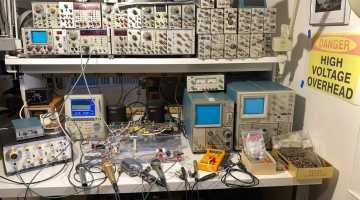
  • bench.jpg
    bench.jpg
    14.5 KB · Views: 6
Last edited:
I used to be an Electrical Engineer, still am I suppose, but retired,
a fairly good one, I like to think!;)

A few months ago, I suggested that if the High Voltage power lines
were buried properly, under the motorways, one phase and earth
under each lane and a receiver in each vehicle, to collect the induction
that would come from the power cables and constantly boost the
batteries, you could get from one end of your journey on the highway,
to the other, without depleting your battery.

The people who I was trying to convince were young and Pooh, poohed,
my idea, they didn't really understand, I fear.

Education here is very poor I think, they are taught to pass an exam, they
never learn the subject properly.

During my technical education, any test had at least 85% pass requirement,
some more, today a friend who went to university in his 40s, told me that the
pass mark was 45%, that tells you something.

Mike.
 
Dear Mike: power supplies and magnetics were my work for decades, design, consulting and manufacturing, I can comment:

Induction coupling you propose is well known and used in some MAG LEV train experiments.

Unfortunately the magnetic coupling of energy falls faster the inverse sq of distance, due to flux fringing, and the H field of a singe conductor is nil at 50.60 Hz. perhaps a few milligauss.

You need many turns of coil, and strong, constant high frequency currents and a very small gap between primary and secondary coils.
MAGLEV works as the tracks are precision.

No practical car or electrified road, will achieve any significat power transfer. That's why electricity trains use overhead catenary wires (1000...1600V) capable of 100....2000 ampère DC to power the train motors and not the methods Mike has proposed.

So, Mike I'm Very sorry to deflate your expectations! Keep thinking!

Amicalment!

Jon
 
Last edited:
Thank you Jean Paul, I am not an expert in this field, just
a thinker, if the primary voltage is anywhere between
15,000 volts and 400,000 volts the effect should in my
mind work for a longer period, sub-stations would be
needed all along the way, these decisions are above my
knowledge, I know that it won't be cheap, but oil wells
are also expensive, never say never.

If you think on a very large scale with your knowledge, do
you think that it will work? I am keen to know.

I know from experience, that if I get too near a high voltage
cable,all the cards in my pocket get wiped clean and are just
bits of plastic afterwards, always happened late on a Friday,
or on a Saturday when the banks were closed>

Mike
 
Mike your mixing électricité and magnetic fields.

HV transmission lines in buried cables are totally Shielded by the earth or a grounded sheath eg a metal conduite. A so called Faraday Shield. High Overhead lines have an electric field, that is by design very weak at the ground level.

To couple automotive power you need a strong magnetic field, as in a transformer, not just a weak electric field.

Finally trend in transmission of EHV lines at 360..500 KV are now DC, not AC.

Amicalement

Jon
 
I appreciate engineer's contributing to the discussion.

There is pretense that the holy people are working to save the planet, and those that don't follow are unholy.

It is all about money and power.

Those that really run the world have had dozens of years to improve life for humans on the planet.

They don't want that.

Nearly everything is throwaway, and the resources required to continue to reproduce the same products, are beyond understanding. Commercial buildings, houses, cars, furniture, clothing ... massive resources including energy.
 
I appreciate engineer's contributing to the discussion.

There is pretense that the holy people are working to save the planet, and those that don't follow are unholy.

It is all about money and power.

Those that really run the world have had dozens of years to improve life for humans on the planet.

They don't want that.

Nearly everything is throwaway, and the resources required to continue to reproduce the same products, are beyond understanding. Commercial buildings, houses, cars, furniture, clothing ... massive resources including energy.
Having been in sales, and having had some slight involvement in the introduction of new products, it has, from time to time, and then only fleetingly, occurred to me that a great way to establish a monopoly would be to convince the 'unwashed masses' that your competition's product was harmful, whereas yours was on the side of the proverbial angels.

This is all idle speculation of course, but if you had shareholders with imaginary titles, such as Special Presidential Envoy for Climate, who could travel the world in luxury while notifying the peons that their minuscule necessities were responsible for pending catastrophes, what wonderful emissaries they would be.
 
I used to be an Electrical Engineer, still am I suppose, but retired,
a fairly good one, I like to think!;)

A few months ago, I suggested that if the High Voltage power lines
were buried properly, under the motorways, one phase and earth
under each lane and a receiver in each vehicle, to collect the induction
that would come from the power cables and constantly boost the
batteries, you could get from one end of your journey on the highway,
to the other, without depleting your battery.

The people who I was trying to convince were young and Pooh, poohed,
my idea, they didn't really understand, I fear.

Education here is very poor I think, they are taught to pass an exam, they
never learn the subject properly.

During my technical education, any test had at least 85% pass requirement,
some more, today a friend who went to university in his 40s, told me that the
pass mark was 45%, that tells you something.

Mike.
I’m no engineer but I’ve installed hundreds of miles of underground power cables. Starting new the cost is minimal, converting to underground can be a nightmare. I was fairly certain the magnetic field was insufficient too but interesting reading from experts. Good on you for a thinking of ideas though.
 
Having been in sales, and having had some slight involvement in the introduction of new products, it has, from time to time, and then only fleetingly, occurred to me that a great way to establish a monopoly would be to convince the 'unwashed masses' that your competition's product was harmful, whereas yours was on the side of the proverbial angels.

This is all idle speculation of course, but if you had shareholders with imaginary titles, such as Special Presidential Envoy for Climate, who could travel the world in luxury while notifying the peons that their minuscule necessities were responsible for pending catastrophes, what wonderful emissaries they would be.

Yep.
 
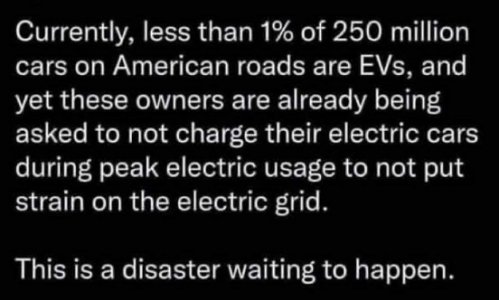
Something to ponder in regards to EV’s. In the 70’s and 80’s underground power was installed all over the country, much of it direct buried. (No conduit) This unjacketed cable was 30 to 35 year cable. How easy do you think replacement is going to be? Transformers were cheapened like most things too. Imagine in your cul-de-sac 10, 15 or 20 EV’s charging at roughly the same time of the evening. Imagine an apartment complex, hundreds of EV’s charging at roughly the same time. That’s a stretch I realize because we already know, EV’s are for the privileged not for apartment dwellers.
 
The push should be less and less driving, not EV nonsense. While we’re at it jet-airplanes and cruise ships ought to mostly go away. I mean if we really care……
 
Back
Top