Interesting facts about 1% of you.

This thread brings back so many memories! The German Army used a shed near the forest to store all kinds of goodies like bags of gun powder, 88 ammo, small arms ammo, revolvers, pistols .. you name it. And left all when they were forced to withdraw in a haste!

We had a blast. I owned a couple of revolvers and a pistol at the time, same with my brother and we had loads of ammo to go with it. Our friends and classmates and us would light a fire between the buttresses of our local church, throw a handful of ammunition into the fire and then lay down flat, waiting for them to go off! It's a wonder no one got killed.

However, our love of bringing live ammo home almost killed the young girl who had been assigned to us by the authorities. This was normal, they were supposed to help women with children whose husbands were fighting in the German Armed Forces. She was young enough to be quite naive and swept up the loose ammo she found and put it into the wood stove for disposal! You can guess what happened, they went off with a great bang, one of the bullets went through a kettle of water, missed her by a few inches and ended up lodged in the kitchen wall! Needless to say, the rod came out that day again!

And we threw our guns into the local river, the day before the French colonial troups entered our town!
 
Last edited:
I'm almost a one-percenter, having been born in 1947.

I knew three of my great-grandparents, all born before 1865. So I've known people born in three centuries.
:) That is very interesting. I have known people from only one century, the twentieth, that is except for one person in the eighteenth. Now I'm feeling sorry for myself.
Edit: Whoops, I forgot a couple of great grandchildren. So I too know people born in three centuries.
 
I have known people born in three centuries too. When you start looking at our lives through these unusual perspectives, we realize how fast times go by. History doesn't seem so distant.

I was born 67 years after General Armstrong died at the Little Bighorn. The army had recently been equipped with a new weapon, Repeating rifles, which often malfunctioned, but were a step above single fire muskets, but the 5 companies he led were wiped out by an enemy using nothing more than bows and arrows.

Then, just 3 years after I was born the atomic bomb was invented. Less than 20 years later we sent men to the moon, and everyone owns their own car. Our government is trillions of dollars in debt and not even sweating about it. People carry telephones in their pockets and fly across the country in a couple of hours when it took people in Custer's time a spring, summer, and part of a fall to travel half that far using horse drawn wagons without roads or bridges.

Granted, when I was 10 years old, the Civil War seemed like a long past part of history. Now I realize I missed it by approximately the length of my own lifetime.
 
I always thought I was alone when looking back on my life and counting my years by history. I was born only 71 years after the end of the American Civil War, that's less than the time I've lived! 38 years after the Spanish-American War! 18 years after the end of WWI! I feel ancient!
 
Last edited:
Wow thank you, that information really has left me with great odds! Scientists say I can live forever soon ?
Of course that means I will have to download the stress factors. Haha ... :coffee: ... Maybe wear a smart phone /
watch to tell me stuff before I do stuff.
 
Thas very humbling, I can give my daughter in law a 1 up in a few years.
100% of the people before me are done once and gone! ... :coffee: ...

-----------
She'll say, "Oh Papa you so funny!"
 
The one percent survival surprises me. 1945/46 saw the start of the generation of the "baby boomers." It was the result of a strong postwar economy, in which couples felt confident they would be able to support a larger family. My parents told me that following the defeat of Hitler and his allies, it produced a confidence that the world would never again be engulfed in such a war.

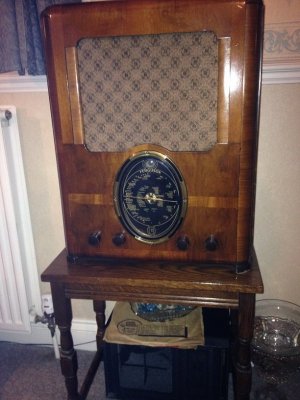
Being one of those one percenters I can certainly recall the days when we never had such expensive things like television or a telephone. The radio was known as a wireless and terms like en suite bathroom would have been laughed at.
This is the wireless:
yesteryear 003.JPGtrolly bus.jpgtaxi.jpg
garbage truck.jpgmilk float.jpg
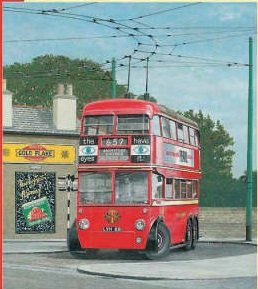
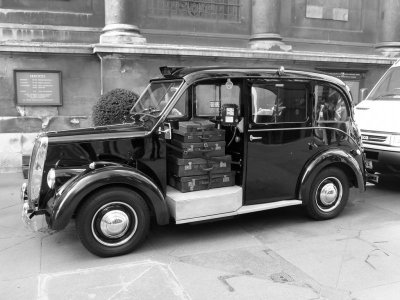
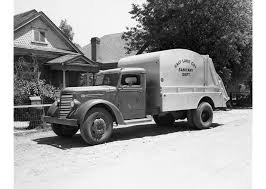
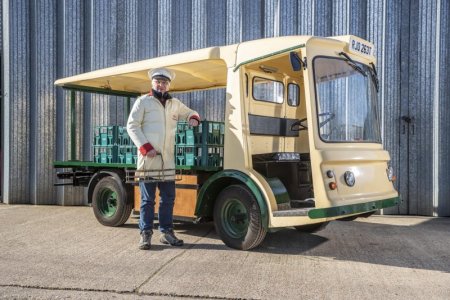
The wireless is followed by an electric bus known as a trolley bus. The taxi was rarely used by working class people but gradually, as wages increased and the economy got stronger, the occasional journey could be afforded. The milkman was a common sight and the vehicle was electric and known as a milk float. Our waste was collected by the dustmen, it was never sorted, nor recycled, it was either burned or buried.
 
The one percent survival surprises me. 1945/46 saw the start of the generation of the "baby boomers." It was the result of a strong postwar economy, in which couples felt confident they would be able to support a larger family. My parents told me that following the defeat of Hitler and his allies, it produced a confidence that the world would never again be engulfed in such a war.

Being one of those one percenters I can certainly recall the days when we never had such expensive things like television or a telephone. The radio was known as a wireless and terms like en suite bathroom would have been laughed at.
This is the wireless:
View attachment 394019View attachment 394016View attachment 394018
View attachment 394020View attachment 394017
The wireless is followed by an electric bus known as a trolley bus. The taxi was rarely used by working class people but gradually, as wages increased and the economy got stronger, the occasional journey could be afforded. The milkman was a common sight and the vehicle was electric and known as a milk float. Our waste was collected by the dustmen, it was never sorted, nor recycled, it was either burned or buried.

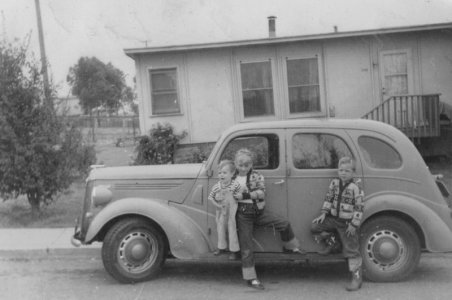
I was born in 1942 and I do remember that we had an English car like that when I was a kid. That's me on the right. The house in the background was a prefab, assembled during World War II to house workers at the Mare Island Naval Shipyard. We moved up to Vallejo from San Francisco in January 1948 and lived there until we returned to the city in 1951.


2023-03-14-007.jpg
 
Last edited:
I recently read that 4.7% of males will reach age 90. I will be 91 next month.
My uncle retired from the U.S.Navy in 1939. That retirement did not last long. He spent WW2 in the south Pacific. We went up into Canada in 1940, my father had business to handle. I was 6 years old and was astounded to see soldiers wearing kilts.
On Dec 7 1941 my big sister came in and told me "the Japs bombed Pearl Harbor. I vaguely knew who the "Japs" were, but I had never heard of Pearl Harbor. I went to Pearl Harbor in 1958. The Arizona memorial had not been built yet, and Hawaii was not yet a state.
 
The one percent survival surprises me. 1945/46 saw the start of the generation of the "baby boomers." It was the result of a strong postwar economy, in which couples felt confident they would be able to support a larger family. My parents told me that following the defeat of Hitler and his allies, it produced a confidence that the world would never again be engulfed in such a war.

Being one of those one percenters I can certainly recall the days when we never had such expensive things like television or a telephone. The radio was known as a wireless and terms like en suite bathroom would have been laughed at.
This is the wireless:
View attachment 394019View attachment 394016View attachment 394018
View attachment 394020View attachment 394017
The wireless is followed by an electric bus known as a trolley bus. The taxi was rarely used by working class people but gradually, as wages increased and the economy got stronger, the occasional journey could be afforded. The milkman was a common sight and the vehicle was electric and known as a milk float. Our waste was collected by the dustmen, it was never sorted, nor recycled, it was either burned or buried.
Trolley buses are still around in a number of places, mostly Asia and the former Soviet Bloc. They have advantages and disadvantages.
 
Thanks kburra for that very interesting post. I was born in 1943 and came to Australia in 1947 ,. I can remember most things mentioned and am so grateful for all the happy times we had.
I'm another war baby, born in 1943, and didn't meet my dad until he was demobbed in early 1946. To grow up in post war Australia was to have a mostly blissful childhood with opportunities that our parents never had.

@oscash, one of my childhood friends was a girl who was a refugee from Europe. Her early years must have been horrendous. Her parents, Ukrainian, had fled to Germany when the Russians marched into Kiev and they were in Berlin in the final days when it was bombed to pieces and the allied armies marched in. I never heard her say whether they were "liberated" by the British or the Russians but I assume it must have been the former.
 
This thread brings back so many memories! The German Army used a shed near the forest to store all kinds of goodies like bags of gun powder, 88 ammo, small arms ammo, revolvers, pistols .. you name it. And left all when they were forced to withdraw in a haste!

We had a blast. I owned a couple of revolvers and a pistol at the time, same with my brother and we had loads of ammo to go with it. Our friends and classmates and us would light a fire between the buttresses of our local church, throw a handful of ammunition into the fire and then lay down flat, waiting for them to go off! It's a wonder no one got killed.

However, our love of bringing live ammo home almost killed the young girl who had been assigned to us by the authorities. This was normal, they were supposed to help women with children whose husbands were fighting in the German Armed Forces. She was young enough to be quite naive and swept up the loose ammo she found and put it into the wood stove for disposal! You can guess what happened, they went off with a great bang, one of the bullets went through a kettle of water, missed her by a few inches and ended up lodged in the kitchen wall! Needless to say, the rod came out that day again!

And we threw our guns into the local river, the day before the French colonial troups entered our town!

Without a chamber and a barrel to build up pressure and velocity cooked off ammo isn't all that dangerous.

 
Back
Top