I am an Atheist and always have been.

Nope... not biting.

I think the primary objection to your earlier post came from the use of the word "immorality" (rather than "unbelief") since being an atheist does not equate to immorality. Atheism is simply the lack of belief in God or gods.

Current court cases document conservative Christian efforts to promote religious presence in schools, such as legislation requiring that public schools allow prayer and display of the 10 commandments.

On the other hand, current court cases also document that many non-theists (a term which includes both atheists and agnostics) oppose religious displays in public spaces and prayers in government buildings. Their actions are expressed through various organizations, including the
Freedom From Religion Foundation, a non-theistic organization that advocates for separation of church and state.

In other words, both sides are indeed engaged in organized, strategic legal, political, and public awareness campaigns.
 
I think the primary objection to your earlier post came from the use of the word "immorality" (rather than "unbelief") since being an atheist does not equate to immorality. Atheism is simply the lack of belief in God or gods.

Current court cases document conservative Christian efforts to promote religious presence in schools, such as legislation requiring that public schools allow prayer and display of the 10 commandments.

On the other hand, current court cases also document that many non-theists (a term which includes both atheists and agnostics) oppose religious displays in public spaces and prayers in government buildings. Their actions are expressed through various organizations, including the
Freedom From Religion Foundation, a non-theistic organization that advocates for separation of church and state.

In other words, both sides are indeed engaged in organized, strategic legal, political, and public awareness campaigns.
It's not so much as "allowing" religious displays as it is mandating them.

Louisiana: In February 2026, the U.S. 5th Circuit Court of Appeals lifted a previous injunction, allowing the state to enforce its law requiring a poster-sized display of the Ten Commandments in every public classroom, from kindergarten to state-funded universities.
Specifics: Displays must be at least 11 by 14 inches with the text in a large, readable font.

Texas: Governor Greg Abbott signed Senate Bill 10 into law in June 2025, requiring displays in all public elementary and secondary school classrooms starting with the 2025–2026 school year.
Specifics: Posters must be at least 16 by 20 inches.
Status: While a federal judge issued a preliminary injunction blocking the law in 11 specific school districts involved in litigation, the state Attorney General has instructed all other districts to comply.

Arkansas: Arkansas Act 573 required the display of the Ten Commandments in all state and local government buildings, including classrooms.

Oklahoma: HB 1006 has been introduced to mandate classroom displays for the 2025–2026 school year.

Legal Context
These laws are frequently challenged under the Establishment Clause of the First Amendment, which prohibits the government from establishing a religion. Proponents often argue these displays reflect American "history and tradition," a newer standard adopted by the U.S. Supreme Court in recent years.
 
It's not so much as "allowing" religious displays as it is mandating them.
I'm already familiar with cases you cited, particularly current cases in the state of Texas.

For the record, I do not personally support mandating display of the 10 commandments in school, just as I do not support all legislation proposed by my constituents, but the voters and the courts ultimately decide the outcome.

I do support advocates of free speech, which includes the right of students in school to pray, distribute literature, and form clubs, arguing that schools should not be"religion-free zones".

Atheists and secular organizations have initiated numerous legal challenges and campaigns to remove or restrict religious Christmas displays (specifically nativity scenes) from public schools and government property. Any court ordered removal of those displays should be considered a mandate.
 
Some people have the personality to be religious, some people have the personality to be anti-religious. That's all. In my extensive family, we all grew up in a Christian teaching staring from my grandmother. But some of my uncles/aunts are Christian some aren't, same with cousins.
 
Yet you feel free to malign by calling others immoral? That’s bigotry. Shame on you.
They do that. Not they, in all the atheists, just like not they, all the christians push their morals on others, but it both happens. I doubt that a christian doctor would have kept pushing my mother on and on and on to just let my dad die, give him euthanasia while he had said no to that and now had Alzheimer.

One Dutch doctor killed a woman with Alzheimer who was difficult and said she wanted to die. Yes I know that normal atheists don't do that, but we have em in the govt pushing for the right for euthanasia and now it's just a cheap way to get rid of people. My sister is a doctor. She said: They ask you to fill in the list if you want to get reanimated, but even if you say yes they won't do that. In my country that is.

Oh and kids have to get sex lessons and I just saw that they now teach em to masturbate. And what irritates me is these adults who think they have a right to see porn. Who cares if kids see it too. I think that's child abuse.
 
Last edited:
Atheists and secular organizations have initiated numerous legal challenges and campaigns to remove or restrict religious Christmas displays (specifically nativity scenes) from public schools and government property. Any court ordered removal of those displays should be considered a mandate.
Yeah, the problem with that is, if schools allow nativity scenes or other displays representing something from Christianity, they need to provide equal rights to all other religions, which is fine, and it's actually good for the students to learn about other cultures. I don't think that's what's happening, though. A lot of people want to designate the U.S. to be a "Christian nation" where only Christians are considered to be true Americans. America isn't a theocracy, although there are some who want it to be.
 
Many of America's Founding Fathers held views that aligned with Unitarian theology—specifically the rejection of the Trinity and the belief in the unity of God, and several definitively identified as Unitarians.

The most prominent Founding Fathers identified as Unitarians include:

John Adams: Often cited as the most "indisputably" Unitarian. Though raised Congregationalist, his home church in Quincy became Unitarian during his lifetime, and he explicitly rejected the Trinity in his private writings, calling it a "fabrication".

Thomas Jefferson: While he never officially joined a Unitarian congregation (as there were none near his Virginia home), he had strong Unitarian sympathies. He famously created the Jefferson Bible by removing miracles and references to Jesus' divinity, and he once predicted that Unitarianism would eventually become the dominant religion in America.

Benjamin Franklin: Frequently categorized alongside Jefferson and Adams as a Unitarian or a "Christian Deist". In his later life, he expressed doubts about the divinity of Jesus, though he praised his system of morals as the best the world had ever seen.

Paul Revere: He is listed by many Unitarian Universalist associations as a notable member of their historical tradition.

Abigail Adams: The wife of John Adams and an influential figure in the founding era, she shared her husband's Unitarian beliefs and is frequently included on lists of famous Unitarians.

John Quincy Adams: Though the son of John Adams, his relationship with the faith was more complex; he was a co-founder of a Unitarian church in D.C. but remained critical of some contemporary Unitarian views, at times leaning toward more traditional interpretations.

James Madison: Occasionally appears on lists as having Unitarian or Universalist leanings, though he is more commonly classified as a liberal Episcopalian.

I've attended a few Unitarian congregations and from what I can tell, their religion is basically: believe whatever you want. :ROFLMAO:
 
Yeah, the problem with that is, if schools allow nativity scenes or other displays representing something from Christianity, they need to provide equal rights to all other religions, which is fine, and it's actually good for the students to learn about other cultures. I don't think that's what's happening, though. A lot of people want to designate the U.S. to be a "Christian nation" where only Christians are considered to be true Americans. America isn't a theocracy, although there are some who want it to be.
Most votes count I guess. Democracy. Amerika has a lot of christians. Holland doesn't. Here a christian school has to also teach about Islam and other religions.
 
This may help sort out terminology. In particular, the assertion that atheism is focused on belief is important.

Atheist: An atheist is a person who does not believe in the existence of God or gods. This lack of belief can be explicit (conscious rejection of a deity) or implicit (absence of belief due to lack of evidence). Atheism is focused on belief—atheists do not affirm the existence of any divine being.

Agnostic: An agnostic is a person who believes that the existence or non-existence of God or gods is unknown or inherently unknowable. Agnosticism is focused on knowledge—an agnostic often maintains that humans cannot have certain knowledge about divine matters, or that such knowledge is currently unavailable.
 
Yeah, the problem with that is, if schools allow nativity scenes or other displays representing something from Christianity, they need to provide equal rights to all other religions, which is fine, and it's actually good for the students to learn about other cultures. I don't think that's what's happening, though. A lot of people want to designate the U.S. to be a "Christian nation" where only Christians are considered to be true Americans.(*see footnote in my reply) America isn't a theocracy, although there are some who want it to be.
:)"A lot of people" [your words] want to do a lot of things. What they can and cannot do legally is a different matter.

The essential point to my post #151, which you apparently took exception to, was this: "both sides [meaning non-theists and theists] are indeed engaged in organized, strategic legal, political, and public awareness campaigns." Christians work for their causes, and atheists are working for theirs as well.

I do not see anything in your new post that changes my position.

As to your opinion regarding the display of a nativity scene:

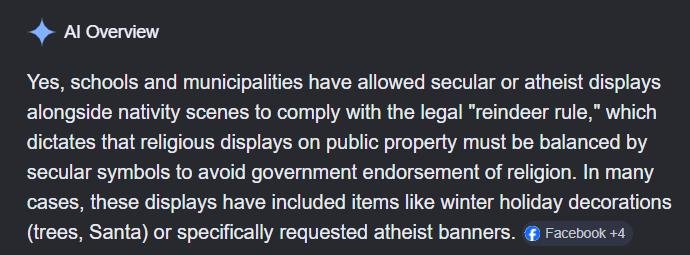
Courts have ruled that if a school allows a private group to display a nativity scene, they cannot legally discriminate against other religions or secular groups wanting to display symbols such as a Menorah, a Festivus pole, a secular sign - or even atheist displays. This is due to the First Amendment's Establishment Clause.

*"only Christians are considered true Americans." :) No, atheists are afforded the same liberties under the law as Christians.
 
Most votes count I guess. Democracy. Amerika has a lot of christians. Holland doesn't. Here a christian school has to also teach about Islam and other religions.
Haven’t seen Amerika spelled that way in a long while. Brings back pleasant memories. Particularly Kafka and Abbie Hoffman.

Fascinating a xian school must teach other religions.

Ive been to holland many times. Always enjoyed myself there.
 
This may help sort out terminology. In particular, the assertion that atheism is focused on belief is important.
Atheist: An atheist is a person who does not believe in the existence of God or gods. This lack of belief can be explicit (conscious rejection of a deity) or implicit (absence of belief due to lack of evidence). Atheism is focused on belief—atheists do not affirm the existence of any divine being.

Agnostic: An agnostic is a person who believes that the existence or non-existence of God or gods is unknown or inherently unknowable. Agnosticism is focused on knowledge—an agnostic often maintains that humans cannot have certain knowledge about divine matters, or that such knowledge is currently unavailable.

While those definitions are no doubt correct, they don't go far enough. The explanation of atheism sounds right (an atheist does not believe in the existence of God because of the lack of evidence) but I get stuck on the "agnostic" definition. "Unknown or inherently unknowable" seems to imply that every word in the Bible describing God could be true, we just don't know. I think that's a cop out. For any other subject (tooth fairy, for instance), no sane person would say maybe there really is such a being, we just don't know for sure because no one has ever actually seen her.

It makes no sense to say that anything at all could be true (Great Pumpkin, Cookie Monster, ghosts, angels, etc.) just because somebody made them up. Either there is evidence or there isn't. That's the way I look at it, anyway.

What I do believe, however, is that the human mind is probably not evolved enough yet to understand or realize what the universe is all about. Sadly, those of us who walk the earth now will never be that evolved. It could happen millenia into the future. It might all be stranger and involve ways of thinking that we are incapable of understanding.

One thing I'm pretty sure about is that if there is a "God," he (she? it?) isn't sitting up there in heaven declaring that he is better than all the other gods, that honoring the Sabbath is more important than not killing other people (look at the order of the Ten Commandments) and boasting, threatening, strutting around like a petty tyrant. God could be a mathematical formula, for all we know. And I doubt that he cares which football team wins the game.

Most of the religions on earth today, and in the past, conceive of one god, or a collection of gods, who sound awfully human to me. And not a particularly admirable kind of human. I'd rather stick with the humorous song by Iris Dement, "I think I'll just let the mystery be."
 
While those definitions are no doubt correct, they don't go far enough. The explanation of atheism sounds right (an atheist does not believe in the existence of God because of the lack of evidence) but I get stuck on the "agnostic" definition. "Unknown or inherently unknowable" seems to imply that every word in the Bible describing God could be true, we just don't know. I think that's a cop out. For any other subject (tooth fairy, for instance), no sane person would say maybe there really is such a being, we just don't know for sure because no one has ever actually seen her.
Thought provoking, but I think the term agnostic focuses solely (OK "mainly") on God the entity, not the the stories and myths that have developed about him over the last 6000 years or so. At least that is how I read the definition of agnostic. The only question I have ever concerned myself with is does God exist or not? All the rest is irrelevant. If he does, maybe Jesus walked on water, or maybe not. It makes little difference.

If anything, the miracles included in the story telling being as contradictory of reality as they are, would weigh heavily against God's existence. The stories can only be true if God exists. They do not support God's existence, unless you already believe he exists. For me it all revolves around the truth of God the entity, which cannot be known.
 
I think the primary objection to your earlier post came from the use of the word "immorality" (rather than "unbelief") since being an atheist does not equate to immorality. Atheism is simply the lack of belief in God or gods.

Current court cases document conservative Christian efforts to promote religious presence in schools, such as legislation requiring that public schools allow prayer and display of the 10 commandments.

On the other hand, current court cases also document that many non-theists (a term which includes both atheists and agnostics) oppose religious displays in public spaces and prayers in government buildings. Their actions are expressed through various organizations, including the
Freedom From Religion Foundation, a non-theistic organization that advocates for separation of church and state.

In other words, both sides are indeed engaged in organized, strategic legal, political, and public awareness campaigns.
I thank you @MACKTEXAS for your attempt at supporting me... it is appreciated.
And while I don't like all the hate, I'm not much concerned because I find it misguided on others' part.
I see a clear double standard as well as, what I suppose the new term "cancel-culture" showing its face.
I've never been accused of be particularly articulate and as for as "gentility"... that's something that I'm working on.
But why is it that "religious" folks (particularly Christians) can be attacked freely, but I use one wrong word-choice...
this ensues? "They" let us believe what we want to... and everyone sees that as okay. I on the other hand, wonder
about others detesting my moral beliefs and in-artfully write it aaannd whatever...

I was not the first to use the term "morality" in this thread... in fact, you should remember that I "replied" to your
post #95 in another poster was talking about him not liking Christian's pushing their "morality" on him.
I didn't intend to use "immorality" as a label toward anybody here so much as a counter to the word-use of morality
used by the other poster... if it was misunderstood, only one person to asked for clarification was @officerripley...
and at that point I had already regretted posting anything at all and others were already attacking/canceling...
there is no talking (imo) when that's been engaged... there's no "discussing".
I am sorry if I hurt anyone's feelings, but I see nothing but hatred from people that I've never even addressed, just all
the nice, kind, peace lovers and however they see themselves, jumping on a bandwagon... grabbing their pitchforks and torches.

Let me ask you (alone) @MACKTEXAS, do I make is a habit of offending folks here... is that my reputation?
There are some here who make it a habit of offending people... regularly. Most of the time nothing ever said.
If nobody is recognizing the palpable duplicity besides myself... then I need to take a break and leave this thread alone.

 
I'm already familiar with cases you cited, particularly current cases in the state of Texas.

For the record, I do not personally support mandating display of the 10 commandments in school, just as I do not support all legislation proposed by my constituents, but the voters and the courts ultimately decide the outcome.

I do support advocates of free speech, which includes the right of students in school to pray, distribute literature, and form clubs, arguing that schools should not be"religion-free zones".

Atheists and secular organizations have initiated numerous legal challenges and campaigns to remove or restrict religious Christmas displays (specifically nativity scenes) from public schools and government property. Any court ordered removal of those displays should be considered a mandate.
Also, people feel that if the 10 Commandments and other Christian symbols are displayed in public schools and out in public, then the same considerations should be given to other religions like Judaism, Muslim or Buddhism, etc. should be displayed. That will never, ever happen.

Best case scenario with a nation of so many different religions, races, etc. is the Separation Of Church and State.....problem solved.
 
I thank you @MACKTEXAS for your attempt at supporting me... it is appreciated.
And while I don't like all the hate, I'm not much concerned because I find it misguided on others' part.
I see a clear double standard . . .

I was not the first to use the term "morality" in this thread... in fact, you should remember that I "replied" to your
post #95
in another poster was talking about him not liking Christian's pushing their "morality" on him.
Post #95 was from another member - it said: "I'd be willing to let religious people believe whatever they want if they wouldn't try to force their versions of morality on me. But most of them do."

My post #104 replied to that (with sarcasm) and said "I'm sure they will be pleased to know they have permission."

I understand your frustration that one person used morality but when you used the word immorality to express your feelings there was objection. I suppose that's because associating immorality with atheism is seen as negative, whereas associating theism (or Christianity) with morality is not perceived as negative - even though the two are not synonymous.

If I remember, you chose not to address the "duplicity" - I did, but shouldn't have because the matter would have received less attention if I had just left it alone.

Let me ask you (alone) @MACKTEXAS, do I make is a habit of offending folks here... is that my reputation?
That is not my perception at all. Actually, you have been rather reserved, but also very considerate and thoughtful with your replies, noticing member's birthdays, wishing those well who are going through bad times, and so on. Thanks.
 
people feel that if the 10 Commandments and other Christian symbols are displayed in public schools and out in public, then the same considerations should be given to other religions like Judaism, Muslim or Buddhism, etc. should be displayed. That will never, ever happen.

reindeer.jpg

Best case scenario with a nation of so many different religions, races, etc. is the Separation Of Church and State.....problem solved.
The solution isn't that simple. Separation of Church and State could "solve" the "problem" by making mandatory prayer and display of the 10 commandments unallowed. But the First Amendment guarantees fundamental rights against government infringement upon freedom of religion, speech, press, assembly, and petition. This is what has made court decisions difficult over the years, and especially in the current climate.
 
I remember one day, when I was informed by my mother that she and my father would no longer force me to go to church, but she hoped I would go sometimes, which was a good compromise that I took seriously.

I was not anti religion and searched for years to find a meaningful relationship with a god, and even came up with new age variations of his being before I had ever heard the term new age. But I could find no evidence for that which has no evidence. I understood the faith based feelings of personal revelation, which I considered possibly the only convincing way to know God, but I had already experienced those psychological reactions in other areas of my life in my young adult years.

I still have them too. They are referred to as peak experiences in psychology, with no religious components necessary. Some people call these spiritual experiences, as best I can gather, but they are just things that cause a release of dopamine and other biochemical reactions. For me it was usually when alone in remote mountainous areas. I have been told that I am spiritual because of that, but that is based on personal semantics. I know what people mean and don't argue the point. It's a wonderful feeling.
The only evidence I have is when events or circumstances changed for unexplanable reasons and I pondered why. For example, early in our lives we bought our first house. Monthly was steep but we knew we could work thru it. At the same time a friend of ours was in a situation due to a divorce and a single child. She didn't know what she was going to do. The church we all went to provided some support but my wife felt we should send her $20 dollars. I looked at her and said that we cannot afford to do this. Things are tight.
I feel we should, my wife replied so.............we did and sent her $20 dollars.
2 weeks later I get a letter from my mortgage company telling me that they were in error and that my correct Mortgage Payment was $20.00 less then the original quote. I have pondered this for many years.
There are other things but suffice to say that this and other events thru are lives convince me that God is there.
It is, in one sense, so vague , yet it isn't.
Faith alone will only get you so far. Sooner or later you're exhausted and without any reason to continue.
I can talk to him. As I said in a previous post. He doesn't answer all the time.
He answers, at times, with questions for me to consider. Sometimes his silence is the answer.

That the question did not require an answer. In other words, I already knew the answer.

He is never wrong, never leads me astray. Never agrees with what I want to hear. Never condones sin or sinful activity and never justifies what I do. He simply replies thru feelings or words that he loves me and I am his. Whatever impulsive thing I did will require correction or the consequences of my mistakes. Never the less he loves me.

No doubt I sound like a complete fool. But there it is. Believe, don't believe, doesn't matter. I know what I know.
I am too old to worry about what people think. If you find some connection in what I am saying then good.
 
View attachment 495523


The solution isn't that simple. Separation of Church and State could "solve" the "problem" by making mandatory prayer and display of the 10 commandments unallowed. But the First Amendment guarantees fundamental rights against government infringement upon freedom of religion, speech, press, assembly, and petition. This is what has made court decisions difficult over the years, and especially in the current climate.
However- First Amendment 'rights' are not absolute..
 
Back
Top