I am an Atheist and always have been.

So, the US government released some previously withheld documents and videos (all very grainy and somewhat vague) regarding UFO's yesterday.

Which got me thinking.

IF it was proven beings from another planet are real, and IF they had either an entirely different creator, or no creator at all in their stories/books - would those with a belief in God as our creator have to question their belief, or would they assume that God must have done some uncredited work?
 
So, the US government released some previously withheld documents and videos (all very grainy and somewhat vague) regarding UFO's yesterday.

Which got me thinking.

IF it was proven beings from another planet are real, and IF they had either an entirely different creator, or no creator at all in their stories/books - would those with a belief in God as our creator have to question their belief, or would they assume that God must have done some uncredited work?
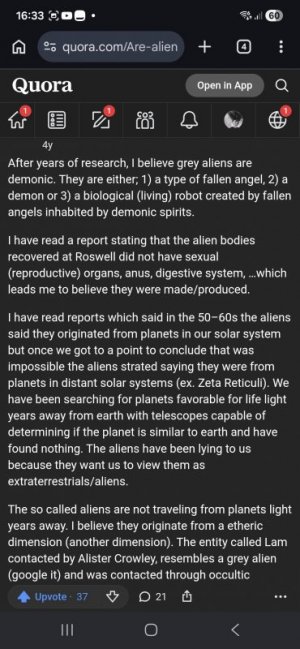
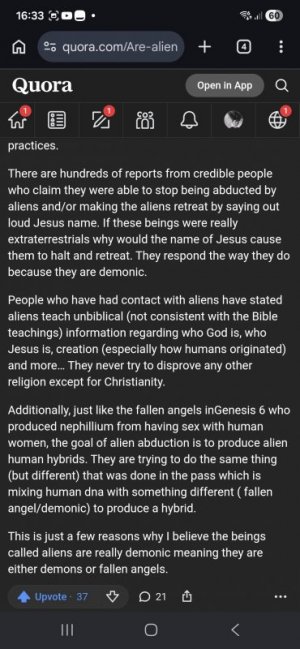
No. I had read that they would release it. Aliens are demons. Demons are the offspring of watchers from the book of Enoch and Genesis 6 (the sons of God) and women, the giants. Most people think that story is insane. I believe it though. Romans, Greek also have stories about Zeus and whoever, giants. I believe that has a base in something.

People who said they had been abducted by aliens, a guy investigated these stories and if someone called on the Name of Jesus the abduction stopped.

 
Last edited:
No. I had read that they would release it. Aliens are demons. Demons are the offspring of watchers from the book of Enoch and Genesis 6 (the sons of God) and women, the giants. Most people think that story is insane. I believe it though. Romans, Greek also have stories about Zeus and whoever, giants. I believe that has a base in something.

People who said they had been abducted by aliens, a guy investigated these stories and if a christian called on the Name of Jesus the abduction stopped.

Right, but you are entitled to your own, earthly beliefs. But I'm saying - what if the aliens had no history of a God belief of any kind, and instead had some other belief outside of a deity.

You seem to be suggesting that you'd ignore their belief, since you already believe they're demons, but I don't want to put words in your mouth.
 
Right, but you are entitled to your own, earthly beliefs. But I'm saying - what if the aliens had no history of a God belief of any kind, and instead had some other belief outside of a deity.

You seem to be suggesting that you'd ignore their belief, since you already believe they're demons, but I don't want to put words in your mouth.
Yes I would. Once on a forum, just for fun an atheist guy asked: What would you do if you met an alien? I said: Kick him out. He said: That's not very hospitable LOL.

A woman asked an alien if he confessed Jesus as Lord. He got mad.
 
In the video I posted he says that non christian guys from the UFO investigation club say: So aliens don't like Jesus. Big deal.

I think that's a big deal. If they came into existance by evolution, then why on earth would they get mad if you talk about Jesus?
 
In the video I posted he says that non christian guys from the UFO investigation club say: So aliens don't like Jesus. Big deal.

I think that's a big deal. If they came into existance by evolution, then why on earth would they get mad if you talk about Jesus?

I'm not talking about anyone getting mad, this is more of a philosophical thing. An alien from another planet would have no reference to this planet and its history. instead, they would have their own, completely different from ours. If the alien arrived and said, "Yes, Jesus is our Lord and Savior", then I think that would be fascinating. How could it be that a completely different race/species, divided by millions of light years, had turned up knowing about Jesus?

But if that is fascinating, then the opposite must also be. Just saying.
 
Historical fiction is a semi fictionalized story based on known facts, events and/or people.
It's a combination of real and imagined senerios, supposition and exaggeration, myth and legend.

Sounds like the bible to me.
There are some interesting nuances used in describing the Bible's 'historic fiction vs mythology discussion', and I've taken an interest in this from the start when the idea of historic fiction was first introduced. I agree with both views. Historical fiction because historic figures are included, some of whom are described using the scant information we have about them from more credible history books.

However, those historic figures and the reasonable "truth" of some of their actions, play a minor role, while the overall message of the Bible is 100% mythological. It is a promise of joys and and abundance beyond reason with no credible evidence to support such things, other than humankind's gullibility to accept the irrational when rational is not appealing. This is the realm of mythology.

Why do Christians whole hardheartedly accept the mythology of the Bible as real when they so eagerly reject the mythology of the ancient Greeks, or the Norse? Or any other mythology, religious or not? As far as I can see, the joy in the ridiculous descriptions in Greek mythology are no more or less plausible than the ridiculous claims of the Bible. Although the Greek presentation is a lot more fun.

But the Norse; Now there's a mythology I can feel in my bones, maybe because I have a Norse ancestry. Had I existed in that part of the world at the time of that mythology, I may have been a true believer... Or not. I suppose there were a few skeptics alive back then in that area too; You know skeptics, the bottom tier of society, constantly throwing wet rags on what is meant to be a party of escape from reality. Eat, drink, and be merry... Because then you die.

But in Christianity, you don't die. You live forever, even as the last flames of the universe die out and time ceases to exist. Hurray! Yeah, I guess that's worth sinking one's teeth in, at least for many.
 
I'm not talking about anyone getting mad, this is more of a philosophical thing. An alien from another planet would have no reference to this planet and its history. instead, they would have their own, completely different from ours. If the alien arrived and said, "Yes, Jesus is our Lord and Savior", then I think that would be fascinating. How could it be that a completely different race/species, divided by millions of light years, had turned up knowing about Jesus?

But if that is fascinating, then the opposite must also be. Just saying.
I get what you mean. If they were like: huh? Jesus? What's that? That would be what I expect from an alien who is just a normal being.

But if they flee and get mad , that shows me they're demonic and people have said that this is what they did.

Screenshot_20260509_163335_Chrome.jpgScreenshot_20260509_163327_Chrome.jpg
 
There are some interesting nuances used in describing the Bible's 'historic fiction vs mythology discussion', and I've taken an interest in this from the start when the idea of historic fiction was first introduced. I agree with both views. Historical fiction because historic figures are included, some of whom are described using the scant information we have about them from more credible history books.

See, this another thing for me. Sure, some emphasize the HISTORICAL content and discount the fictional bits. But it kind of falls apart for me when it comes to miracles. I doubt anything could convince me that a snake "spoke" without some fictional liberties being taken. And how about Moses having a chat with a burning bush (yes, I know it was God using the Bush as a cosmic telephone)?

I mean parting the Red Sea - really? I suppose blind faith allows such things to pass, but my addled brain simply says - nah, the specifics there are made up. :D
 
There is no God, therefore using the word "God" is incorrect (I am using the dictionary definition of the word "God"). ;)

Critical thinking is always needed, but as soon as it makes a lot of people feel uncomfortable, they run back to what they know.
You better put or your boxing gloves. 😄 We have a fight. Exactly what is God? Who says? Critically speaking, does the author of a dictionary have the authority to define God, or do the authors of dictionaries define a word and possibly where it originated and how we use the word? Our argument is not if there is or is not a god, but how we are using a word to mean a concept named in the word.

There are different concepts of God, and I am quite sure no English dictionary presents the concept of God as universal consciousness, which is very different from religious concepts of god and gods. In our culture, this new understanding of god has not been around long enough for authors of dictionaries to give us the new concept of god. If you were Hindu, you would have a different understanding of god and the Native American understanding of truth is different.

And I love ❤️this argument. It is these differences we should argue about and I am so frustrated with atheists proving Christian mythology right when they totally reject the word "god". As though both people are talking about the same god. It would be far more productive to force an argument about the concept of "god". What is god? How do we know that is the correct understanding of god?

If we could get past a total refusal to accept any possible understanding of god, then we can start having more productive discussions of how believable Bible stories are and if there are any problems with what the Bible says. Reducing every discussion of God to whether it exists or not is an exercise in futility. Every time you make that argument, you prove the Christian right. The Bible tells us people who do not know any better will reject god. Please, please, stop doing that.
 
This comes close:
Pantheism is the belief system that equates the universe with divinity, viewing the universe itself as a manifestation of God. This belief is not confined to a single religion and can be found in various spiritual and philosophical traditions.

Edit (My correction based on what The President of the Universal Pantheist Society told me): "Pantheism, IS God, not the manifestation of the "other" God, and of course, parts thereof are knowable."
Thank you, that is something that continues the discussion, rather than preventing discussion.

I believe the universe is the manifestation of three-dimensional reality. I think it is possible to have other dimensions, but that is incomprehensible to me. I think the god thing gets really messed up as soon as we make it a personal being who cares about us as a good father cares about his children. Now you have to depend on it as a child depends on his/her parent and that just is not right.

On the other hand, logos is reason, the controlling force of the universe. Science is a better way to learn about this controlling force than reading a holy book that plagiarizes Sumerian mythology.
 
I have also read your posts.
No, thank you.
You are replying to a post I directed to Bretrick.
If that means only Bretrick should respond, maybe you want to handle those discussions in pm's. Posting in a public forum invites everyone to respond. I am not sure I can remember not to respond to you when you don't want me to. My memory isn't that good. So if it is a private message, please use pms.
 
The Bible says that too.

“A quart of wheat for a denarius, and three quarts of barley for a denarius
Revelation 6:6

A denarius was a standard day’s wage, while a quart of wheat was only enough food for one person per day, meaning basic staples become extremely expensive, demanding a full day's work just to survive
When I first became interested in such matters, it seemed to me the last days were predicted not only in the Bible, but also in the construction of the Great Pyramid in Giza and Tarot cards.

My next thought was that anyone familiar with this planet and humans could predict earthquakes and other such disasters, famine, and war. The Mayans thought the good years and the bad years were cyclical. Today I like the geological explanations most.
 
If that means only Bretrick should respond, maybe you want to handle those discussions in pm's. Posting in a public forum invites everyone to respond. I am not sure I can remember not to respond to you when you don't want me to. My memory isn't that good. So if it is a private message, please use pms.
My post # 694, posted in a public forum, but clearly to Bretrick says this: "I gave a "like" reaction to your post, even though the two of us have different beliefs, because I appreciate how you have stayed with your thread all this time and have been respectful of all the viewpoints expressed. So - thanks for that."

In his post #696, @rbtvgo, wrote replied, to me the following:
thank you. I believe what I write. Don't know if I express myself in the best way possible. I try. I have noticed you in previous post. You have questions for me?
Since my post 694 had nothing whatsover to do with anything @rbtvgo had previously written, there was no need for him to "thank" me for my post which was a comment to Bretrick, or say "I believe what I write," (I had never questioned what he wrote) or for him to ask me, "you have questions for me?" Therefore, it should be simple enough for anyone to see why I responded to @rbtvgo in my post #700 with the following:
"No, thank you.
You are replying to a post I directed to Bretrick."

When and if I decide to utilize pms, that will be my own decision. In the meanwhile, when I am quoted in a forum, it is acceptable that I reply in the forum. But, if you feel only pms are acceptable, then perhaps you should have addressed this with me via a pm instead of a forum post.
 
If that means only Bretrick should respond, maybe you want to handle those discussions in pm's. Posting in a public forum invites everyone to respond. I am not sure I can remember not to respond to you when you don't want me to. My memory isn't that good. So if it is a private message, please use pms.
No-one has forbidden anyone to respond to anything.
You misunderstand MACKTEXAS, who merely informed rbtvgo of an error.
 
She doesn't need to explain. I was responding as a friend. She is angry, frustrated and upset. I Wass merely trying to be a friend. I have no agenda. I was trying to provide some comfort.
Want you claim your intentions were, are not what others see.

I do not know why you think I was angry. Would you please copy and paste what I said?
 
Thank you, that is something that continues the discussion, rather than preventing discussion.

I believe the universe is the manifestation of three-dimensional reality. I think it is possible to have other dimensions, but that is incomprehensible to me.
Actually, I believe the consensus is currently four dimensions, with the fourth dimension currently referred to as "space-time." I can sense that myself in that our dimensional reality could not exist with out space-time as it could not exist without any one of the other three. I'm not sure if there is a difference between "time" and "space-time," but theorists seem to want to label it that way.

While I'm drifting off your topic thrust, which I will return to, this understanding of our universe just interests me. I think the description of four dimensional space is well grounded, much more than that of alternate realities, which is mostly known through current science fiction, but has been offered by theoretical physicists, which makes it interesting for science fiction to develop. But in my own limited reasoning abilities, it holds an interest to me. I can say why not? It may be of spiritual interest, but I really don't know.

I think the god thing gets really messed up as soon as we make it a personal being who cares about us as a good father cares about his children. Now you have to depend on it as a child depends on his/her parent and that just is not right.
This is what is so appealing about Pantheism. It requires no human qualities or supernatural sentience or leaps of logic to be deeply revered. It is certainly greater than all of us, who are mere infinitesimal parts of it's sum, and we would not be here without it, even if it takes no interest in our personal lives or requires nothing from us or for us.

But according to the Pantheist I mentioned earlier, there are pantheists who do attribute sentience and some vague human qualities to it also. The only requirement is that it be deified. To that, I had to ask why deify it if it has no god like qualities (god like as defined according to Christianity, of course). For that question he pointed me to the dictionary: "Deity; That which is deified." OK, he had me there, so I asked why would you worship the universe as a god, to which he offered, "Because I have a god shaped hole in my heart," at which point I mostly dismissed him.

But I did still respect him, even as off center (according to the Christian society I had been brought up under), he still made more rational sense to me than most other's spiritual claims, and I had already given serious thought to such a god in my own spiritual quest, even though I eventually threw the whole quest out as a wild goose chase. But who am I do say what people should be allowed to deify, if they need such a thing.
On the other hand, logos is reason, the controlling force of the universe. Science is a better way to learn about this controlling force than reading a holy book that plagiarizes Sumerian mythology.
The universe does have control over one overriding human experience, but I don't think it uses logic or even needs such a thing to exert that force, but I agree about exploring these controlling forces through science. And science does it far more elegantly than any mythology as it goes about understanding a universe that creates awe and wonder beyond our current grasp. It also leaves the door open for human made religions, which seem little more that minor quirks in a much greater quest to understand.

 
Last edited:
Back
Top