Playing with Mercury

jnos

Member
From another thread, The Body's "Hiding Places:

Heavy metals like mercury are also absorbed by the body tissues and remain there almost indefinitely. We absorb it by eating larger fish species. Forget about shark and swordfish.

Did anyone else ever play with loose mercury? As a kid I remember my mom breaking several thermometers over the years. She'd put what she could salvage into a small bowl for us to play with. It was such fun. Little did we know! :nightmare:

About 20 years ago I visited a daughter teaching in a very small town high school. In their supplies cupboard there was this a 1/2 gallon jar labeled, "Mercury." It had apparently been there for years waiting for proper disposal.
 

Last edited:
:p:p
From another thread, The Body's "Hiding Places:


Did anyone else ever play with loose mercury? As a kid I remember my mom breaking several thermometers over the years. She'd put what she could salvage into a small bowl for us to play with. It was such fun. Little did we know! :nightmare:

You bet I did! Even "made" some by releasing it from combination in Mercury compounds, Sulfide, I think. Cook it in a test tube, and little globules of liquid mercury condense out on the upper, cooler wall of the tube. Of course, some escaped as vapor, to be assimilated into the surrounding air.

Late in the "game", it was revealed by special diffraction photography that the puddle of mercury in the bottom of every mercury barometer in virtually every high school chemistry classroom had a "cloud" of mercury vapor above the surface of the liquid, as the metal very slowly evaporated! Yep, metals evaporate, too. Everything does. Has to do with the law that states molecules move FROM the location of high concentration TO the location of lower concentration.

Ms Warrigal just might expand this more fully than I can, she being a chemistry whiz! imp

About 20 years ago I visited a daughter teaching in a very small town high school. In their supplies cupboard there was this a 1/2 gallon jar labeled, "Mercury." It had apparently been there for years waiting for proper disposal.
 
We used to play with it back in the 40's. We would make pennies mercury coated. They were fun but we had no idea of the dangers.
 

I remember very well and it was fun. Probably broke a few thermometers intentionally to play. But we had no idea at the time. I went to donate blood recently and now they don't even use a digital stick anymore. It's more like a twist tie you put under your tongue.
 
Having been a chemistry student for several years, then working in a few labs, I've had more than my share of contact with mercury.

We also used to wash our hands with benzene, and pipette everything by mouth - they hadn't invented those nifty auto-pipettes yet. So you used a glass tube (that often you had blown yourself) which may or may not have been in contact with other chemicals to do your work. :cower:

Don't ask about the experiments in my basement lab as a kid with sulfur, chlorine, etc - there lies a tale that mankind is not ready for.
 
chemistry_set.jpg

GilbertAtomicOpentrimmed.jpg
th

th
This boy's just having a bit too much fun there
 
Last edited:
.....Don't ask about the experiments in my basement lab as a kid with sulfur, chlorine, etc - there lies a tale that mankind is not ready for.

I've already mentioned my own such experience, including the 2nd. degree burns to my face and hand, which helped form me into the 14 year-old monster I became then, and remained ever since! imp
 
.... as the metal very slowly evaporated! Yep, metals evaporate, too. Everything does. Has to do with the law that states molecules move FROM the location of high concentration TO the location of lower concentration.

Now that is good to know, Imp. I had a little blob of mercury, maybe a half inch across, that I kept in a loose capped plastic bottle for years. I thought it was my imagination that it kept getting smaller. Seems like it got so small I discarded it. This was over a 40 year period.
 

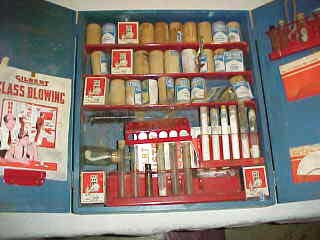
"Glass Blowing At Home", or "How To Permanently Scorch Your Tongue".


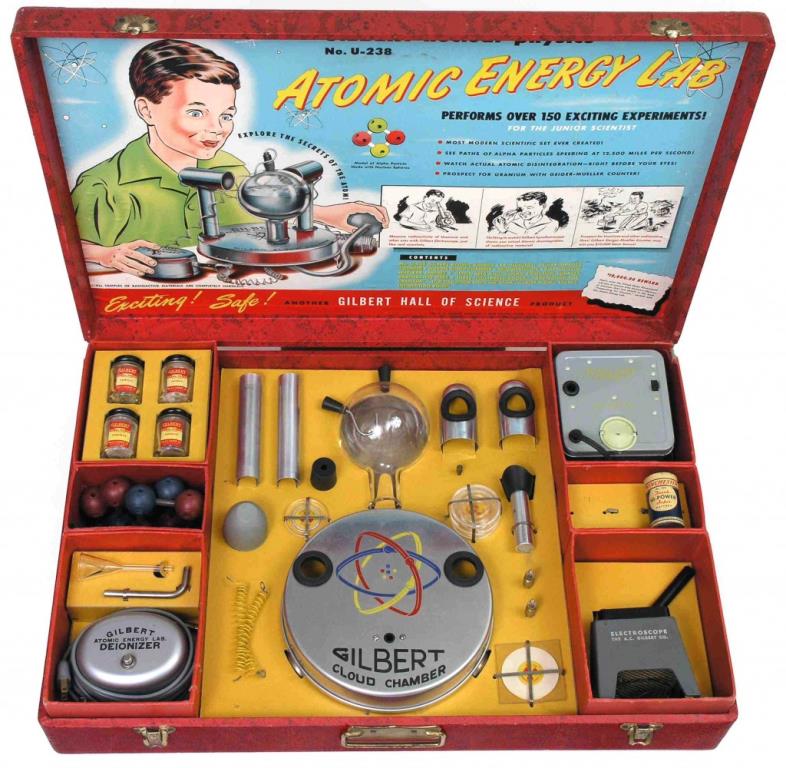
Oh, where to start ... first off, poor kid has a permanent Bikini Island scar on his face ... his cheeks are distended from breathing in too many excited particles ... that "deionizer" looks suspiciously like a cheap '50's doorbell ... and note all the creams, salves and braces included in the kit!

th

th
This boy's just having a bit too much fun there

LMAO! But it's tested and approved!
 
As a science teacher I would regularly demonstrate the mercury barometer by filling a metre long glass tube in water and inverting it over an open bowl of mercury.

We would also demonstrate surface tension using the downward meniscus of mercury and I vaguely remember heating mercury to show the purple vapour. However, I was under the impression that elemental mercury could not be absorbed via the skin and was not as dangerous as compounds of mercury. Of course, today all contact with mercury is advised.

This excerpt from Wiki talks about the various ways it enters our bodies

The consumption of fish is by far the most significant source of ingestion-related mercury exposure in humans and animals, although plants and livestock also contain mercury due to bioconcentration of mercury from seawater, freshwater, marine and lacustrine sediments, soils, and atmosphere, and due to biomagnification by ingesting other mercury-containing organisms.[SUP][6][/SUP] Exposure to mercury can occur from breathing contaminated air,[SUP][7][/SUP] from eating foods that have acquired mercury residues during processing,[SUP][8][/SUP] from exposure to mercury vapor in mercury amalgam dental restorations,[SUP][9][/SUP] and from improper use or disposal of mercury and mercury-containing objects, for example, after spills of elemental mercury or improper disposal of fluorescent lamps.[SUP][10]
[/SUP]
Consumption of whale and dolphin meat, as is the practice in Japan, is a source of high levels of mercury poisoning. Tetsuya Endo, a professor at the Health Sciences University of Hokkaido, has tested whale meat purchased in the whaling town of Taiji and found mercury levels more than 20 times the acceptable Japanese standard.[SUP][11]
[/SUP]
Human-generated sources, such as coal-burning power plants [SUP][12][/SUP] emit about half of atmospheric mercury, with natural sources such as volcanoes responsible for the remainder. An estimated two-thirds of human-generated mercury comes from stationary combustion, mostly of coal. Other important human-generated sources include gold production, nonferrous metal production, cement production, waste disposal, human crematoria, caustic soda production, pig iron and steel production, mercury production (mostly for batteries), and biomass burning.[SUP][13]
[/SUP]
Small independent gold-mining operation workers are at higher risk of mercury poisoning because of crude processing methods. Such is the danger for the galamsey in Ghana and similar workers known as orpailleurs in neighboring francophone countries. While no official government estimates of the labor force have been made, observers believe 20,000-50,000 work as galamseys in Ghana, a figure including many women, who work as porters. Similar problems have been reported amongst the gold miners of Indonesia.[SUP][14]
[/SUP]
Mercury and many of its chemical compounds, especially organomercury compounds, can also be readily absorbed through direct contact with bare, or in some cases (such as methylmercury) insufficiently protected, skin. Mercury and its compounds are commonly used in chemical laboratories, hospitals, dental clinics, and facilities involved in the production of items such as fluorescent light bulbs, batteries, and explosives.[SUP][15][/SUP]

Coal which we used in our home heaters and which is still used in the generation of electricity is something I didn't know about but I did know that gold used to be extracted by using mercury to form an amalgam which was later heated to reclaim the mercury vapour and the pure gold metal. This method might still be used today (?)
 
Our sixth-grade science teacher handed out dollops of mercury to play with. We coated dimes, and smashed the bead of mercury on the desk and marveled at how it came back together again, etc. Of course, a couple of the guys swallowed some of theirs. That might explain how they turned out.....? I wonder if it's too late to sue the school district for mercury poisoning.
 
Now that is good to know, Imp. I had a little blob of mercury, maybe a half inch across, that I kept in a loose capped plastic bottle for years. I thought it was my imagination that it kept getting smaller. Seems like it got so small I discarded it. This was over a 40 year period.

Nan, that is astounding! If the container of any evaporating liquid is tightly capped, and capable of withstanding the material's "vapor pressure", the volume of liquid will never change. Your container may have not been sealed, allowing the vapor to escape. Vapor pressure is a little-understood concept for many non-technical folks. If you have ever opened a gasoline-containing can in hot weather, you may have heard the "poof" sound of the vapor pressure being relieved. Gasoline and other very volatile materials, have a higher vapor pressure than the common materials we deal with: water, milk, finger nail polish remover (acetone), etc.
 
Nan, that is astounding! If the container of any evaporating liquid is tightly capped, and capable of withstanding the material's "vapor pressure", the volume of liquid will never change. Your container may have not been sealed, allowing the vapor to escape.

Imp, I noted it was in a loose-capped bottle. But who knows, I may still find it one day.:)
 
Yes.. both my husband and I played with mercury as kids.. However, hubby went one better. He had a toy soldier set where he melted lead and poured it into molds to make the soldiers.. I believe they were called "casting sets" How dangerous!!
 
We used to play with it back in the 40's. We would make pennies mercury coated. They were fun but we had no idea of the dangers.

Yes. We did that too. My brother worked across the street in the Edison Movie studio and brought home all kinds of good stuff that they used for special effects. I think we all escaped harm because our exposures were brief and not a matter of long term acquisition by the body.
 
Yes.. both my husband and I played with mercury as kids.. However, hubby went one better. He had a toy soldier set where he melted lead and poured it into molds to make the soldiers.. I believe they were called "casting sets" How dangerous!!

Yes. I did that too. I was into military miniatures for many years. Spent a lot of time breathing in the fumes of lead paint while painting them as well.
You know, with all of the very real dangers, I am reading the posts here and looking at all of the intelligent, inquisitive, scientifically literate people these sets produced. We had a whole generation of kids who were given the tools to inquire with.
....if they didn't blow themselves up of course.:eek:mg1:
 
Rock, they still do the lead casting these days, don't they?

Its been a long time, but I just researched it. People are still doing it. In order to get lead they have to go to fishing supplies, plumbing supplies and even tire shops. Never having a fortune, I switched to buying the 1/72 plastics long ago. The details are far superior to anything metal, but its hard to keep paint on the soft plastics.
 
Yes. I did that too. I was into military miniatures for many years. Spent a lot of time breathing in the fumes of lead paint while painting them as well.
You know, with all of the very real dangers, I am reading the posts here and looking at all of the intelligent, inquisitive, scientifically literate people these sets produced. We had a whole generation of kids who were given the tools to inquire with.
....if they didn't blow themselves up of course.:eek:mg1:

This actually is a pretty truthful and profound statement. I know for certain that the chemistry set, as well as the erector set and Lionel trains set the wheels of "needing to know" in motion for me. At 10 I got a toy bazooka which propelled a "rocket" by spring force. Harmless enough device. My 6th. grade Science teacher stopped at our house one day and had a little talk with my mother. He recognized my interest in Science deeply, and being a committed teacher, urged her to encourage my interests, aiming at college in a few years. He explained to me how he had actually fired a real bazooka in the Army, when I showed him mine! He told of how and why the bazooka produced no felt recoil such as results with a typical firearm.

Compare that with today's generation. Something has drastically changed between then and now. imp
 
Compare that with today's generation. Something has drastically changed between then and now. imp

Well, now they have computers and electronic gizmos all over the place - maybe that's the new generation's equivalent of our chemistry and Erector sets?


Back
Top