Facemasks in the COVID-19 era: A health hypothesis

JonDouglas

Senior Member
Location
New England
There appears to be a peer-reviewed study done by Stanford University that allegedly demonstrates beyond a reasonable doubt that face masks have absolutely zero chance of preventing the spread of Covid-19? No? It was posted on the the National Center for Biological Information government website. The NCBI is a branch of the National Institute for Health. You might want to read it while it's still online, given the possibility it will be taken down since it doesn't fit the narrative.

Edit Note: I copied and saved the study in case govt. or internet censors decide to nuke it.
 

Last edited:
This part is interesting, too...

"Among asymptomatic individuals, there was no droplet or aerosol coronavirus detected from any participant with or without the mask, suggesting that asymptomatic individuals do not transmit or infect other people. This was further supported by a study on infectivity where 445 asymptomatic individuals were exposed to asymptomatic SARS-CoV-2 carrier (been positive for SARS-CoV-2) using close contact (shared quarantine space) for a median of 4 to 5 days. The study found that none of the 445 individuals was infected with SARS-CoV-2 confirmed by real-time reverse transcription polymerase."
 
This part is interesting, too...

"Among asymptomatic individuals, there was no droplet or aerosol coronavirus detected from any participant with or without the mask, suggesting that asymptomatic individuals do not transmit or infect other people. This was further supported by a study on infectivity where 445 asymptomatic individuals were exposed to asymptomatic SARS-CoV-2 carrier (been positive for SARS-CoV-2) using close contact (shared quarantine space) for a median of 4 to 5 days. The study found that none of the 445 individuals was infected with SARS-CoV-2 confirmed by real-time reverse transcription polymerase."
If the science and research is solid, you could get the idea that we've been "had". It would be interesting if the media would question Fauci and other NIH officials about this, but that's not likely to happen. Anyway, the more information, the better and this may be another data point. This study would help explain why there's not much covid mortality/illness differences between states with no masking requirement and states where masking is mandated.
 

Last edited:
If the science and research is solid, you could get the idea that we've been "had". It would be interesting if the media would question Fauci and other NIH officials about this, but that's not likely to happen. Anyway, the more information, the better and this may be another data point. This study would help explain why there's not much covid mortality/illness differences between states with no masking requirement and states where masking is mandated.
A congressional hearing was held and Fauci and a CDC rep (I think) had to answer some pretty tough questions. I found it on youtube. Interesting to say the least.
 
That goes against every single thing I've read or heard about the efficacy of masks. They are saying that the virus probably doesn't pose too much of a problem on hard surfaces, but it does spread through the air. How else would all these (maskless) people be getting it?

Is Fauci some kind of evil villain making up false facts to fool us all? Perhaps he bought a lot of stock in a mask company? And if anything this big was the truth, wouldn't it be in every major headline in the world? Why is this the only place I have seen this idea?

Sorry, it just doesn't ring true.
 
I knew that after researching it 16 months ago. Viruses are microscopic & if you magnified your mask, it would look like a chain-link fence. Expecting a mask to prevent viruses from entering is like expecting a chain-link fence to prevent mosquitoes from entering.
That's why I wasn't surprised when my sister & both I caught colds 3 months ago. She was surprised, because she bought into what we were being told. If our masks couldn't prevent cold viruses (which are also in the Coronavirus family), it can't prevent Covid.
And, if masks prevented Covid, how would we have cases spiking ever since masks were required?
 
That goes against every single thing I've read or heard about the efficacy of masks. They are saying that the virus probably doesn't pose too much of a problem on hard surfaces, but it does spread through the air. How else would all these (maskless) people be getting it?

Is Fauci some kind of evil villain making up false facts to fool us all? Perhaps he bought a lot of stock in a mask company? And if anything this big was the truth, wouldn't it be in every major headline in the world? Why is this the only place I have seen this idea?

Sorry, it just doesn't ring true.
I posted the link to the research article. I trust you read it and, like I said, it's another data point you can believe or not. As for Fauci, he's just a government mouthpiece bureaucrat who says what he's told. This study, BTW, is not the first that's said masks are ineffective. There was a similar article in another medical journal. That said, we're just presenting information and not trying to convince you of anything.
 
Last edited:
I posted the link to the research article. I trust you read it and, like I said, it's another data point you can believe or not. As for Fauci, he's just a government mouthpiece bureaucrat who says what he's told. This study, BTW, is not the first that's said masks are ineffective. There was a similar article in another medical journal. That said, we're just presenting information and not trying to convince you of anything.
I'm sure you'll find this interesting, JD.

https://articles.mercola.com/sites/...t1HL&cid=20210417&mid=DM860177&rid=1134943967
 
I posted the link to the research article. I trust you read it and, like I said, it's another data point you can believe or not. As for Fauci, he's just a government mouthpiece bureaucrat who says what he's told. This study, BTW, is not the first that's said masks are ineffective. There was a similar article in another medical journal. That said, we're just presenting information and not trying to convince you of anything.
And, at the beginning of this, Fauci said masks are useless & don't bother. Later, when they were required........they suddenly became a good idea.
 
Thank you for the article. I found several words misspelled and they called the CDC the "Central for Disease Control" which made me suspicious of this article. I did a search and found several articles in FAVOR of mask wearing on the same NCBI website. Is this just a database for medical articles?
 
Thank you for the article. I found several words misspelled and they called the CDC the "Central for Disease Control" which made me suspicious of this article. I did a search and found several articles in FAVOR of mask wearing on the same NCBI website. Is this just a database for medical articles?
If you found several articles favoring mask wearing, please post the links/sources. Thanks.
 
I don't care!
old-woman-wearing-a-face-mask-400-207415010.jpg
 
Some more references: At issue is the physics of particle size and contradictory, randomized controlled trial (RCT) studies, and meta-analysis reviews of RCT studies, as to the extent that masks and respirators work or don't work to prevent respiratory influenza-like illnesses, or respiratory illnesses believed to be transmitted by droplets and aerosol particles.
Jacobs, J. L. et al. (2009) “Use of surgical face masks to reduce the incidence of the common cold among health care workers in Japan: A randomized controlled trial,” American Journal of Infection Control, Volume 37, Issue 5, 417 – 419. https://www.ncbi.nlm.nih.gov/pubmed/19216002
N95-masked health-care workers (HCW) were significantly more likely to experience headaches. Face mask use in HCW was not demonstrated to provide benefit in terms of cold symptoms or getting colds.​
Cowling, B. et al. (2010) “Face masks to prevent transmission of influenza virus: A systematic review,” Epidemiology and Infection, 138(4), 449-456. https://www.cambridge.org/core/jour...atic- review/64D368496EBDE0AFCC6639CCC9D8BC05
None of the studies reviewed showed a benefit from wearing a mask, in either HCW or community members in households (H). See summary Tables 1 and 2 therein.​
bin-Reza et al. (2012) “The use of masks and respirators to prevent transmission of influenza: a systematic review of the scientific evidence,” Influenza and Other Respiratory Viruses 6(4), 257–267. https://onlinelibrary.wiley.com/doi/epdf/10.1111/j.1750-2659.2011.00307.x
“There were 17 eligible studies. … None of the studies established a conclusive relationship between mask/respirator use and protection against influenza infection.”​
Smith, J.D. et al. (2016) “Effectiveness of N95 respirators versus surgical masks in protecting health care workers from acute respiratory infection: a systematic review and meta-analysis,” CMAJ Mar 2016 https://www.cmaj.ca/content/188/8/567
“We identified six clinical studies … . In the meta-analysis of the clinical studies, we found no significant difference between N95 respirators and surgical masks in associated risk of (a) laboratory-confirmed respiratory infection, (b) influenza-like illness, or (c) reported work-place absenteeism.”​
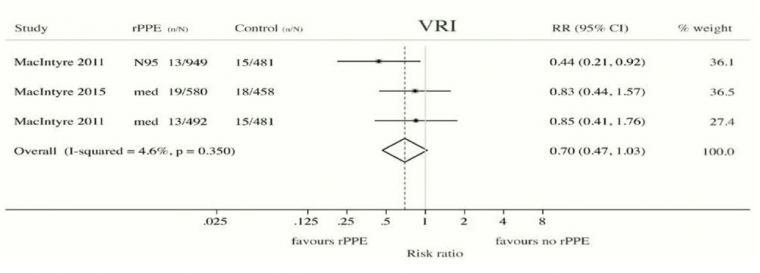
Offeddu, V. et al. (2017) “Effectiveness of Masks and Respirators Against Respiratory Infections in Healthcare Workers: A Systematic Review and Meta-Analysis,” Clinical Infectious Diseases, Volume 65, Issue 11, 1 December 2017, Pages 1934–1942, https://academic.oup.com/cid/article/65/11/1934/4068747
“Self-reported assessment of clinical outcomes was prone to bias. Evidence of a protective effect of masks or respirators against verified respiratory infection (VRI) was not statistically significant”; as per Fig. 2c therein:​
offeddu-chart-verified-respitory-infections.png
Radonovich, L.J. et al. (2019) “N95 Respirators vs Medical Masks for Preventing Influenza Among Health Care Personnel: A Randomized Clinical Trial,” JAMA. 2019; 322(9): 824–833. https://jamanetwork.com/journals/jama/fullarticle/2749214
“Among 2862 randomized participants, 2371 completed the study and accounted for 5180 HCW-seasons. ... Among outpatient health care personnel, N95 respirators vs medical masks as worn by participants in this trial resulted in no significant difference in the incidence of laboratory-confirmed influenza.”​
Long, Y. et al. (2020) “Effectiveness of N95 respirators versus surgical masks against influenza: A systematic review and meta-analysis,” J Evid Based Med. 2020; 1- 9. https://onlinelibrary.wiley.com/doi/epdf/10.1111/jebm.12381
“A total of six RCTs involving 9,171 participants were included. There were no statistically significant differences in preventing laboratory-confirmed influenza, laboratory-confirmed respiratory viral infections, laboratory-confirmed respiratory infection, and influenza-like illness using N95 respirators and surgical masks. Meta-analysis indicated a protective effect of N95 respirators against laboratory-confirmed bacterial colonization (RR = 0.58, 95% CI 0.43-0.78). The use of N95 respirators compared with surgical masks is not associated with a lower risk of laboratory-confirmed influenza.”​

Too many hypotheses with too little hard science and agreement.

 
The CDC and others never claimed mask wearing would offer perfect protection against Covid, thus all the other guidance and restrictions.

Nevertheless, when it comes to the value of masks it's important to remember that we don't exhale virus particles all by themselves. They ride along on the larger water vapor and spittle droplets that carry them from our lungs.

When infected people wear masks, their water vapor exhalations get caught in their mask, thus the "my mask protects you and your mask protects me" drumbeat that has been sounded for months.

Most of us wear masks as a protection to others, but also as final, though admittedly imperfect, personal barriers.

Masks obviously don't offer complete protection from Covid. However, when combined with avoiding crowds, social distancing, limiting unnecessary contacts outside our families, good hygiene, and vaccines, until this virus is defanged they appear to be a useful tool.

Regarding the OP's orginal Stanford paper link, most of us, particularly those on this forum, aren't wearing masks long enough to suffer any long or short term problems from them. In the past 13 months I've probably only worn a mask longer than an hour about 15 times.
Over two hours? Maybe three times.

A close friend is a retired trauma surgeon who's married to a retired surgical nurse. They wore masks for 8-12 hours at a time, with short breaks for food, a little rest, and bathroom visits. They're in their late 60s and have no lung issues.

Come to think of it, I can't recall ever hearing of retired surgeons (other than smokers) having compromised lungs. I've certainly never seen anything that attributes their mask wearing to poor health.
 
I think some people feel better wearing a mask and seeing others masked because it makes them believe they are doing something to protect themselves and others.

For myself, I've survived 13 months going everywhere maskless so I think the whole mask thing is a crock. No mask mandate, Texas and Mississippi, are doing better than many Northern mandate states.
 
The CDC and others never claimed mask wearing would offer perfect protection against Covid, thus all the other guidance and restrictions.

Nevertheless, when it comes to the value of masks it's important to remember that we don't exhale virus particles all by themselves. They ride along on the larger water vapor and spittle droplets that carry them from our lungs.

When infected people wear masks, their water vapor exhalations get caught in their mask, thus the "my mask protects you and your mask protects me" drumbeat that has been sounded for months.

Most of us wear masks as a protection to others, but also as final, though admittedly imperfect, personal barriers.

Masks obviously don't offer complete protection from Covid. However, when combined with avoiding crowds, social distancing, limiting unnecessary contacts outside our families, good hygiene, and vaccines, until this virus is defanged they appear to be a useful tool.

Regarding the OP's orginal Stanford paper link, most of us, particularly those on this forum, aren't wearing masks long enough to suffer any long or short term problems from them. In the past 13 months I've probably only worn a mask longer than an hour about 15 times.
Over two hours? Maybe three times.

A close friend is a retired trauma surgeon who's married to a retired surgical nurse. They wore masks for 8-12 hours at a time, with short breaks for food, a little rest, and bathroom visits. They're in their late 60s and have no lung issues.

Come to think of it, I can't recall ever hearing of retired surgeons (other than smokers) having compromised lungs. I've certainly never seen anything that attributes their mask wearing to poor health.
I remember early on that specialists discovered COVID-19 starts replicating (weaponizing itself) as soon as it gets in your nose. Previous coronaviruses didn't replicate until they got in your throat, bronchials, or lungs. Soon after that discovery, those specialists and others said that, because of the nasal replication, wearing a mask was ineffective, arguing that, mask or no mask, you have to exhale, and all masks allow you to do that. But you're exhaling a live, possibly already weaponized virus. That's why coming to what is a safe distance became so important.

Also, that's why they talked about respirators and people having to wear tanks on their backs, and about the cost and practicalities of that being prohibitive.

I clearly remember this whole argument. It was pretty short-lived.


Back
Top