

This should clear it up for you, it's not a simple one line answer.In the Christian religion God is the Father, Son, and the Holy Ghost. Therefore shouldn't God's pronound be "They"?
What does the Bible teach about the Trinity? | GotQuestions.org

This should clear it up for you, it's not a simple one line answer.In the Christian religion God is the Father, Son, and the Holy Ghost. Therefore shouldn't God's pronound be "They"?

Yes it really does matter.This forum and it's members are also in my daily gratitude prayer. Whether you like it or not,
the differences we all share in so many things helps me to understand people better. To know
each of us are seeking answers in our very own way.
Only time will tell and who of us we be able to say "I was right!" In the end, does it really matter?
If we all end up in a different place or the same, or no place at all, we all got to live and believe as
we wanted.
For some of us it really does matter for some it never will, it doesn't need to be something to divide us or for some to try and trickYes it really does matter.
I just demand from God that everyone gets saved here. Last minute or whatever. If you call on Jesus just before you die you will be saved. I say it, so people know and for the rest I only have to pray and God will show them. Just call on Jesus. Everyone who calls upon the Name of the Lord will be saved.

You know. I don't think it does. Not one bit, but here we are on page 33.Only time will tell and who of us we be able to say "I was right!" In the end, does it really matter?
It can be a great discussion to be able to be part of here, in the world around us, it's a very touchy subject with manyYou know. I don't think it does. Not one bit, but here we are on page 33.

It's a form of positive thinking. Almost any kind of positive thinking is good because it results in positive emotions and promotes more positive thinking due to the brain's neuroplasticity. The parts of our brains we use grow larger like a muscle and the parts we don't use, atrophy. Positive thinking becomes habitual when we do it enough."The practice of gratitude" It's one of those things where the benefit becomes clear when you do it. I've never come across the psychological dynamics of why it works, although I'm sure there is something out there. I understand it from experience, but I've never sat down and figured out the cause/effect connection. As you say, it doesn't make any difference why or how you do it. It's still the same cat, just skinned in different ways.

2:28It's a form of positive thinking. Almost any kind of positive thinking is good because it results in positive emotions and promotes more positive thinking due to the brain's neuroplasticity. The parts of our brains we use grow larger like a muscle and the parts we don't use, atrophy. Positive thinking becomes habitual when we do it enough.
Martin Seligman's formula for happiness is Positive Emotions + Engagement + Relationships + Meaning + Accomplishments or PERMA. So "positive emotions" is one element that leads to happiness.
It seems like the positive psychology movement has kind of waned in popularity, but it's still useful. There have been entire books written about the practice of gratitude by researchers and Buddhists, too, from what I remember.

You, I believe, agree with what I am trying to convey. He is there to talk to. He hears us. He doesn't agree with us most times but he makes that clear. I do not look for for him to supply the answers I want. I suspect you are the same.I should add here too, I don't just pray when I am in need. I give a prayer every morning
of gratitude for another day, for the beauty of the world around me, for the simple things that
give me peace, happiness for His glory that is in each day. My health and those that love me.
I have more prayers of gratitude than of needing help over the last few decades and I think
that is a big help in being heard and shown the way and it's a commitment I made when I was
baptized right after I gave him my guilts, sins and bad feelings toward certain people in my life
and left them in that water never to look back.
I've noticed that forced practice develops it, just like forced practice develops skills. And then it becomes habitual. A refresher course once in a while would probably be useful too. Although, I don't refresh very often.It's a form of positive thinking. Almost any kind of positive thinking is good because it results in positive emotions and promotes more positive thinking due to the brain's neuroplasticity. The parts of our brains we use grow larger like a muscle and the parts we don't use, atrophy. Positive thinking becomes habitual when we do it enough
I didn't realize a movement had been underway, but I do remember reading books that included directions for positive thinking, usually never using the term, "positive thinking." Consequently, I didn't know a movement had faltered.It seems like the positive psychology movement has kind of waned in popularity, but it's still useful. There have been entire books written about the practice of gratitude by researchers and Buddhists, too, from what I remember.

This should clear it up for you, it's not a simple one line answer.
What does the Bible teach about the Trinity? | GotQuestions.org
Nothing is Bible made simple, if there is I wouldn't trust it.Clear as mud.
Nothing is Bible made simple, if there is I wouldn't trust it.
No but He does say: Let Us make man in Our Image.In the Christian religion God is the Father, Son, and the Holy Ghost. Therefore shouldn't God's pronound be "They"?
It is hard to understand. I had a very hard time for a long time sitting and understanding it. I still don't understand it all and probablyThat's one of the reasons why I don't trust it.
It is hard to understand. I had a very hard time for a long time sitting and understanding it. I still don't understand it all and probably
never will totally. But I do understand the underlying meaning in regards to my life. It is riddled with complex thinking and words maybe
for a reason because if your desire to seek knowledge from it is truly from the heart in love, then you will keep returning to it to learn
and then apply what you have read. Then one day that "AhHa!" moment arrives and the flood gates open.
I used to say that too and get so frustrated, but here I am today!It's hard to understand because it makes no sense.
On a purely physical level, the merging of cosmic forces and the Earth are interwoven, although not happening everywhere at the same time. But the Earth, let alone life on Earth, would not be possible without the cosmic forces to begin with. I equate "Heaven" with "The Heavens," or cosmos, but I don't give it a spiritual spin. It doesn't seem necessary.
Transcendent Connection:
We describe similarities in the ontology of quantum physics and of Carl Gustav Jung’s psychology. In spite of the fact that physics and psychology are usually considered as unrelated, in the last century, both of these disciplines have led at the same time to revolutionary changes in the Western understanding of the cosmic order, discovering a non-empirical realm of the universe that doesn’t consist of material things but of forms.
These forms are real, even though they are invisible, because they have the potential to appear in the empirical world and act in it. We present arguments that force us to believe, that the empirical world is an emanation out of a cosmic realm of potentiality, whose forms can appear as physical structures in the external world and as archetypal concepts in our mind. Accordingly, the evolution of life now appears no longer as a process of the adaptation of species to their environment, but as the adaptation of minds to increasingly complex forms that exist in the cosmic potentiality. The cosmic connection means that the human mind is a mystical mind.
Keywords: Archetypes, Cosmic Consciousness, Mysticism, Non-empirical reality, Potentiality, Quantum physics, Spirituality, Unus Mundus, Virtual states Carl Gustav Jung, Quantum Physics and the Spiritual Mind: A Mystical Vision of the Twenty-First Century - PMC
I am totally good with what you said. I like eastern philosophy and understanding how we become better people by intentionally thinking or behaving as we want to think and behave until it becomes a habit.It's a form of positive thinking. Almost any kind of positive thinking is good because it results in positive emotions and promotes more positive thinking due to the brain's neuroplasticity. The parts of our brains we use grow larger like a muscle and the parts we don't use, atrophy. Positive thinking becomes habitual when we do it enough.
Martin Seligman's formula for happiness is Positive Emotions + Engagement + Relationships + Meaning + Accomplishments or PERMA. So "positive emotions" is one element that leads to happiness.
It seems like the positive psychology movement has kind of waned in popularity, but it's still useful. There have been entire books written about the practice of gratitude by researchers and Buddhists, too, from what I remember.
Vida May
We describe similarities in the ontology of quantum physics and of Carl Gustav Jung’s psychology. In spite of the fact that physics and psychology are usually considered as unrelated, in the last century, both of these disciplines have led at the same time to revolutionary changes in the Western understanding of the cosmic order, discovering a non-empirical realm of the universe that doesn’t consist of material things but of forms.
These forms are real, even though they are invisible, because they have the potential to appear in the empirical world and act in it. We present arguments that force us to believe, that the empirical world is an emanation out of a cosmic realm of potentiality, whose forms can appear as physical structures in the external world and as archetypal concepts in our mind. Accordingly, the evolution of life now appears no longer as a process of the adaptation of species to their environment, but as the adaptation of minds to increasingly complex forms that exist in the cosmic potentiality. The cosmic connection means that the human mind is a mystical mind.
Keywords: Archetypes, Cosmic Consciousness, Mysticism, Non-empirical reality, Potentiality, Quantum physics, Spirituality, Unus Mundus, Virtual states Carl Gustav Jung, Quantum Physics and the Spiritual Mind: A Mystical Vision of the Twenty-First Century - PMC
I don't think I've ever heard that expression before. Did you get it from Nietzsche's writings? (AI told me that's the most common source of the expression.)However, I have also walked through Hades. That is where we determine our meanings and purpose, and people who don't go to Hades remain frivolous. However, we should never go there without the help of the gods because it is easy to get lost in Hades. That means suffering depression and may be even psychosis.
Nothing is Bible made simple, if there is I wouldn't trust it.
not sure what that all means. ?????????????Gratitude. To one's self, or to whom? Is that truly gratitude, or just appreciating the good things happening to you right now?
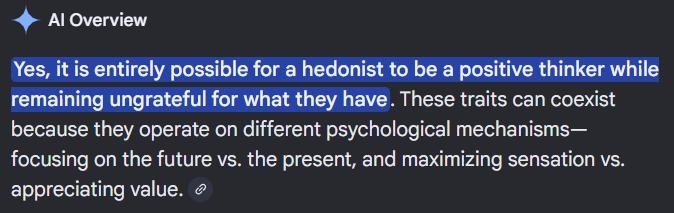
Ancient self-reliant philospohers like Aristippus (founder of the Cyrenaics) argued that hedonistic, immediate, sensory pleasures are all that really matter in life.
Since the Cyrenaics were skeptics who doubted they could truly know the ultimate cause of their sensations, they saw little value in directing thanks (gratitude) especially toward abstract concepts, including evolution or the cosmos.
View attachment 503761

"Gratitude is the memory of the heart" - Sr Mary MacKillop RSJ, Australian's first and only SaintGratitude. To one's self, or to whom? Is that truly gratitude, or just appreciating the good things happening to you right now?

