

You are using an out of date browser. It may not display this or other websites correctly.
You should upgrade or use an alternative browser.
You should upgrade or use an alternative browser.
Have we forgotten WWII?
- Thread starter Grumpy Ol' Man
- Start date


AZ Jim
R.I.P. With Us In Spirit Only
- Location
- SURPRISE, ARIZONA
As I have said before you are my hero. As kids my brother collected for the war effort. While we were doing that you were in Europe keeping us safe. Bravo and cheers.Nice post GOM....Thanks.
Time flies and people forget or lose interest.
But the participants NEVER forget !
I am one of them.
AZ Jim
R.I.P. With Us In Spirit Only
- Location
- SURPRISE, ARIZONA
School children in Los Angeles had dog tags too. Me included.Kids in New York were issued dog tags, but it was soon found that the older teens were trading them boyfriend to girlfriend.
There are still a few WW2 vets here in our senior community and they are honored every year. Those of us who were kids then but veterans later are recognized as well.

No, I have not forgotten WWII. Since I was born in late '38, some of my earliest memories are from uncles and cousins who served. My oldest uncle Charlie was on his way to Europe after advanced basic training, but didn't make it. (Read about the torpedo hitting the USS Dorchester --> http://www.americanveteranscenter.o...-chaplains-and-the-sinking-of-the-dorchester/
He was one of those lost at sea.) that is a wonderful account of real courage!
My oldest first cousin whose nickname was "Shady", landed on Omaha Beach as the boatswain and had to make sure all men got off. He survived, and I talked to him about 2 years before he passed on about the landing there. It was about a couple of months after the movie "Saving Private Ryan" was made. I'll never forget what he said: "If you multiplied the first 5 minutes of the movie by a factor of 5, it was pretty close to what happened to us on that beach".
I also talked to some of my cousins and another uncle (mom's side) who had been in the Battle of the Bulge. We called him "Uncle Champ" and he was a very interesting fellow. I didn't know until later in life of some of the things he experienced and he lived to be 100, and he was my last uncle. I really hated to see him pass.
I have a friend at church, Abe, who is still kicking and he was a gunner on a battleship in the Pacific. He was a different man when the war was over and he made a promise to God that he would repent of his sins and go to bible school and become a missionary if he survived. He did survive and finished school at Bob Jones, then went to Japan as a missionary. He has been influential in my life and we have had many interesting talks, as I've heard him give his testimony several times, but now at age 95 he has slowed down a little. But he still plays par-3 golf and is on a bowling team.
He was one of those lost at sea.) that is a wonderful account of real courage!
My oldest first cousin whose nickname was "Shady", landed on Omaha Beach as the boatswain and had to make sure all men got off. He survived, and I talked to him about 2 years before he passed on about the landing there. It was about a couple of months after the movie "Saving Private Ryan" was made. I'll never forget what he said: "If you multiplied the first 5 minutes of the movie by a factor of 5, it was pretty close to what happened to us on that beach".
I also talked to some of my cousins and another uncle (mom's side) who had been in the Battle of the Bulge. We called him "Uncle Champ" and he was a very interesting fellow. I didn't know until later in life of some of the things he experienced and he lived to be 100, and he was my last uncle. I really hated to see him pass.
I have a friend at church, Abe, who is still kicking and he was a gunner on a battleship in the Pacific. He was a different man when the war was over and he made a promise to God that he would repent of his sins and go to bible school and become a missionary if he survived. He did survive and finished school at Bob Jones, then went to Japan as a missionary. He has been influential in my life and we have had many interesting talks, as I've heard him give his testimony several times, but now at age 95 he has slowed down a little. But he still plays par-3 golf and is on a bowling team.

hollydolly
SF VIP
- Location
- London England
In the UK WW2 is never forgotten, and it should never be forgotten lest we repeat the same mistakes all over again.... however it does make you think about just how long ago it was. My father would have been 92 years old now... yet he was only 13 years old when the 2nd world war started... and just 19 years old when it finished.
My mother was just 5 years old when it started ....it really was a very long time ago..
Next year will be the 100th anniversary of the beginning of the Great war (WW1)
My mother was just 5 years old when it started ....it really was a very long time ago..
Next year will be the 100th anniversary of the beginning of the Great war (WW1)
Camper6
Well-known Member
- Location
- Northwestern Ontario Canada
How does the United States remember November 11.
In Canada it's called Remembrance Day. There are parades and indoor ceremonies and laying of wreaths at soldiers monuments. Veterans take part whenever and however they can.
We also wear red poppies. World Wars definitely are not forgotten.
In Canada it's called Remembrance Day. There are parades and indoor ceremonies and laying of wreaths at soldiers monuments. Veterans take part whenever and however they can.
We also wear red poppies. World Wars definitely are not forgotten.
hollydolly
SF VIP
- Location
- London England
Equally..in the UK it's called Remembrance day, but celebrated on a Sunday... we also wear poppies.. and the parades and ceremonies are the same here as you describe, with the exception that the Queen and the royal family always lay a wreath at the cenotaph as wel...

While in Paris a few years back, my wife and I took a day trip (13 hours escorted) out to the Normandy Beaches and then we visited the American Cemetery where over 9000 American soldiers are buried. I have also visited the cemetery in Arlington, VA. I went to those cemeteries not to just take a few pictures, but to thank, pray and cry for the heroes that gave their life, so that the rest of us could live and enjoy the freedoms that we have now.
My Dad was a career military man in the U.S. Army and was in three wars, WWII, Korean War and Vietnam, but was not a combat soldier in Vietnam. Over the years, he shared some very interesting facts about WWII, although he never spoke much about his involvement in any of the wars. Before I went off to Vietnam, I asked him how he felt when he killed his first man. He told me that if I wanted to keep my sanity that I shouldn't look at the enemy as men, but look at them as targets. He told me that you will be taught to destroy the "target" and he was right.
Come next May, we are planning a trip to Hawaii, which will be my fourth trip over there. This time, my wife and I are taking two of our five Grandchildren along with us. I plan on making sure that both of them spend several hours at Pearl Harbor. It has been surprising to me of how little today's students know about U.S. History.
My Dad was a career military man in the U.S. Army and was in three wars, WWII, Korean War and Vietnam, but was not a combat soldier in Vietnam. Over the years, he shared some very interesting facts about WWII, although he never spoke much about his involvement in any of the wars. Before I went off to Vietnam, I asked him how he felt when he killed his first man. He told me that if I wanted to keep my sanity that I shouldn't look at the enemy as men, but look at them as targets. He told me that you will be taught to destroy the "target" and he was right.
Come next May, we are planning a trip to Hawaii, which will be my fourth trip over there. This time, my wife and I are taking two of our five Grandchildren along with us. I plan on making sure that both of them spend several hours at Pearl Harbor. It has been surprising to me of how little today's students know about U.S. History.

Warrigal
SF VIP
- Location
- Sydney, Australia
Australians do not forget.
Buckets of money are being spent this year commemorating hundred year old events of the Great War and 75 year old events from WW II.
This photo is typical of the memorials that can be found in just about every small rural town, often in the centre of the main street. The names of the local fallen in the first war are inscribed with the names from the second added later.

They are usually small, less than life size and flowers and wreaths are placed there at intervals throughout the year.
In Canberra we have the magnificent Australian War Museum which is well visited by school children, tourists and Australian families.
We do not forget.
Buckets of money are being spent this year commemorating hundred year old events of the Great War and 75 year old events from WW II.
This photo is typical of the memorials that can be found in just about every small rural town, often in the centre of the main street. The names of the local fallen in the first war are inscribed with the names from the second added later.
They are usually small, less than life size and flowers and wreaths are placed there at intervals throughout the year.
In Canberra we have the magnificent Australian War Museum which is well visited by school children, tourists and Australian families.
We do not forget.
Last edited:
Warrigal
SF VIP
- Location
- Sydney, Australia
Today Australia remembers the fighting on the Kokoda Trail where the Japanese overland southward sweep was halted by relatively raw Australian militia until more seasoned troops could arrive. This was hard and bloody fighting in mountainous tropical jungle of Papua. This was the first time the Japanese were forced back after the defeat of Singapore.
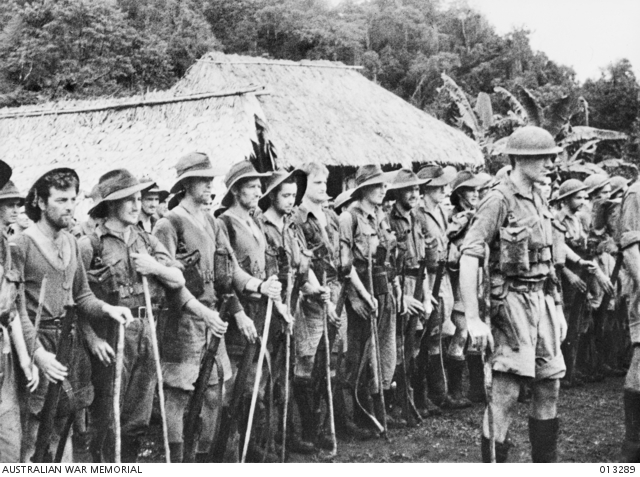
We do not forget.
The Kokoda Track campaign or Kokoda Trail campaign was part of the Pacific War of World War II. The campaign consisted of a series of battles fought between July and November 1942 in what was then the Australian Territory of Papua. It was primarily a land battle, between the Japanese South Seas Detachment under Major General Tomitarō Horii and Australian and Papuan land forces. The Japanese objective was to seize Port Moresby by an overland advance from the north coast, following the Kokoda Track over the mountains of the Owen Stanley Range, as part of a strategy to isolate Australia from the United States.
Japanese forces landed and established beachheads near Gona and Buna on 21 July 1942. Opposed by Maroubra Force, then consisting of four platoons of the 39th Battalion and elements of the Papuan Infantry Battalion, they quickly advanced and captured Kokoda and its strategically vital airfield on 29 July. Despite reinforcement, the Australian forces were continually pushed back.
The veteran Second Australian Imperial Force (AIF) 21st Brigade narrowly avoided capture in the Battle of Mission Ridge – Brigade Hill from 6 to 8 September. In the Battle of Ioribaiwa from 13 to 16 September, the 25th Brigade under Brigadier Kenneth Eather fought the Japanese to a halt but ceded the field to the Japanese, withdrawing back to Imita Ridge.
The Japanese advanced to within sight of Port Moresby but withdrew on 26 September. They had outrun their supply line and had been ordered to withdraw in consequence of reverses suffered at Guadalcanal. The Australian pursuit encountered strong opposition from well prepared positions around Templeton's Crossing and Eora Village from 11 to 28 October. Following the unopposed recapture of Kokoda, a major battle was fought around Oivi and Gorari from 4 to 11 November, resulting in a victory for the Australians. By 16 November, two brigades of the Australian 7th Division had crossed the Kumusi River at Wairopi, and advanced on the Japanese beachheads in a joint Australian and United States operation. The Japanese forces at Buna–Gona held out until 22 January 1943.
Australian reinforcement was hampered by the logistical problems of supporting a force in isolated, mountainous, jungle terrain. There were few planes available for aerial resupply, and techniques for it were still primitive. Australian command considered that the Vickers machine gun and medium mortars were too heavy to carry and would be ineffective in the jungle terrain. Without artillery, mortars or medium machine guns, the Australians faced an opponent equipped with mountain guns and light howitzers that had been carried into the mountains and proved to be a decisive advantage. Australian forces were unprepared to conduct a campaign in the jungle environment of New Guinea. The lessons learned during the course of this campaign and the subsequent battle of Buna–Gona led to widespread changes in doctrine, training, equipment and structure, with a legacy that remains until the present day.
In consequence of the rapid Japanese advance and the perceived failure to quickly counterattack, a "crisis of command" resulted, in which manoeuvring by General Douglas MacArthur, Supreme Commander of Allied Forces in the Southwest Pacific Area, and General Sir Thomas Blamey, commander of Allied Land Forces, resulted in the sackings of three high-ranking Australian officers.
The generalship of MacArthur and Blamey has been criticised for unreasonable and unrealistic perceptions of the terrain and conditions under which the campaign was fought – to the detriment of the troops committed to the fighting. The Kokoda Track campaign has been mythologised as Australia's Thermopylae and incorporated into the Anzac legend
https://en.wikipedia.org/wiki/Kokoda_Track_campaign
We do not forget.
Warrigal
SF VIP
- Location
- Sydney, Australia
Hubby and I will be travelling to Canberra in early November to see special events and displays commemorating Armistice Day (11/11/1918) when the guns fell silent ending World War I. Australia does remember and commemorates this war and every war since.
While in Canberra I will place poppies on the wall next to the names of two of my uncles who died in WW II. One lies in Singapore, the other in Central Nigeria. I have been to the Singapore grave twice but I will never be able to visit the other uncle. Both died the year before my birth but they are still remembered, as is my father who served in New Guinea but lived to return home.
The Shrine of Remembrance in Hyde Park Sydney has been up graded with a new reflective pool and easier access for all to the lower levels. We plan to see that soon too.
http://www.anzacmemorial.nsw.gov.au/
My mother attended a country high school that was build as a war memorial to the First World War. Because it serves a community need it is well maintained to this day. The school motto is Pro tanto quid retribuemus which translates as For so much, what shall we repay?
https://haywarmem-h.schools.nsw.gov.au/
While in Canberra I will place poppies on the wall next to the names of two of my uncles who died in WW II. One lies in Singapore, the other in Central Nigeria. I have been to the Singapore grave twice but I will never be able to visit the other uncle. Both died the year before my birth but they are still remembered, as is my father who served in New Guinea but lived to return home.
The Shrine of Remembrance in Hyde Park Sydney has been up graded with a new reflective pool and easier access for all to the lower levels. We plan to see that soon too.
http://www.anzacmemorial.nsw.gov.au/
My mother attended a country high school that was build as a war memorial to the First World War. Because it serves a community need it is well maintained to this day. The school motto is Pro tanto quid retribuemus which translates as For so much, what shall we repay?
https://haywarmem-h.schools.nsw.gov.au/

C'est Moi
Dishin' it out.
- Location
- Houston Y'all
How does the United States remember November 11.
In Canada it's called Remembrance Day. There are parades and indoor ceremonies and laying of wreaths at soldiers monuments. Veterans take part whenever and however they can.
We also wear red poppies. World Wars definitely are not forgotten.
It's Veteran's Day in the US. Before WWII it was Armistice Day, then renamed by Congress after WWII to honor all Veterans.
C'est Moi
Dishin' it out.
- Location
- Houston Y'all
Australians do not forget.
Buckets of money are being spent this year commemorating hundred year old events of the Great War and 75 year old events from WW II.
This photo is typical of the memorials that can be found in just about every small rural town, often in the centre of the main street. The names of the local fallen in the first war are inscribed with the names from the second added later.
They are usually small, less than life size and flowers and wreaths are placed there at intervals throughout the year.
In Canberra we have the magnificent Australian War Museum which is well visited by school children, tourists and Australian families.
We do not forget.
That statue looks like Paul Newman.
Warrigal
SF VIP
- Location
- Sydney, Australia
The men who answered the call to enlist for service in WW I were the flower of Australian manhood.
They were tall and very fit.
The resemblance to Paul Newman is uncanny, isn't it?
Perhaps Paul Newman looks like an Aussie digger ?
(Digger is a military slang term for soldiers from Australia.)
They were tall and very fit.
The resemblance to Paul Newman is uncanny, isn't it?
Perhaps Paul Newman looks like an Aussie digger ?
(Digger is a military slang term for soldiers from Australia.)

DaveA
Well-known Member
- Location
- Coastal Massachusetts, USA
I still think of it as Armistice Day. My dad served in France during WWI (1917 'til the Armistice in 1918) and fortunately came home without injuries. He and his brother enlisted together and served in the same unit overseas.

RadishRose
Forever in Our Hearts
- Location
- Connecticut, USA
I wasn't here yet, but from all the accounts of my father and his friends, also my mother who explained a lot to me... I could never forget. I have talked about what I know to my son and to his sons.
Anyone remember the old TV show called "The Big Picture"? Not knowing what is actually was, I would sit with my father and look at it.
Anyone remember the old TV show called "The Big Picture"? Not knowing what is actually was, I would sit with my father and look at it.
peppermint
Senior Member
- Location
- East Coast Yes
Hangover....My sister in law's Dad is still alive at 94 yrs old....He was in WW11....
He lied about his age at 16 yrs old....He was in the Battle of the Bulge...Saw many die.
He made it by someone dragging him out....Woke up in a Military make shift hospital....
He lost his wife from Cancer and a daughter died this year of Cancer....He lives alone,
my sister in law looks after him and he also has a girlfriend....Geez!!!! I know of some
that are almost 100 years old and fought for our country....God Bless them, all....
He lied about his age at 16 yrs old....He was in the Battle of the Bulge...Saw many die.
He made it by someone dragging him out....Woke up in a Military make shift hospital....
He lost his wife from Cancer and a daughter died this year of Cancer....He lives alone,
my sister in law looks after him and he also has a girlfriend....Geez!!!! I know of some
that are almost 100 years old and fought for our country....God Bless them, all....
I have the photo album of my Uncle Bob who was killed in Germany during WW2. It contains the telegram notifying my grandparents of his death, it contains photos, an old postcard, some V-mails. I have the flag that draped his casket. I had never seen any of these items until shortly before my mother died seven years ago. She told me a very detailed story about him being on leave when Japan bombed Pearl Harbor, how he was told to report back to his base immediately, how that was the last time they ever saw him and they took a family picture together before he left. It's almost as if grandma sensed he would never return. I don't know if it's not remembering so much as the constant reminder of pain and suffering we are experiencing in our very troubled world. Remembrances for too many wars, for 9/11, for the Oklahoma bombing, for every school schooting. It's not that a lot of people don't want to remember but we seem to be so overwhelmed with rembrance and memorials that we appear to be in a constant state of grief. Some who would prefer to try move on from the past by trying to salvage whatever joy and sanity they can take hold of in their lives. They are grateful to our military. I think a day to honor military is sufficient and a day to remember those we loved who are gone is sufficient. I'm not so sure about all of this constant need to remember every single event throughout the year.


fmdog44
Well-known Member
- Location
- Houston, Texas
Dreams are what scare me knowing how I dream. I never went to Viet Nam but I am guessing had I seen action there I may have had trouble in life because of dreams. It is disturbing to watch WWII vets in their very late years in their lives still weeping when they discuss their experiences.
rgp
Well-known Member
- Location
- Milford,OH
I live close to the War Birds museum. They have a B-25 Mitchell there and on one visit, I noticed a change in 'mood' by the hosts/guides. An older gentleman was near the Mitchell. The Mitchell was his plane from WWII . He was 92 [then] used a cane, and guided by his daughter, but Hey!...looked pretty good for his age IMO.
The host that i was talking with said that he [the Vet] liked to come out & visit "his girl" ......The folks at the museum always gave him a little 'alone' time with her.
The host that i was talking with said that he [the Vet] liked to come out & visit "his girl"
......The folks at the museum always gave him a little 'alone' time with her.
Leann
Traveler
My Dad was a Purple Heart veteran of WWII. His life after the war was difficult because he went into the military healthy at the age of 18 and was honorably discharged at 23 with a life-altering handicap. He died at the age of 51. I have the flag that draped his coffin in a display case folded in the military triangle in my house. It's in my living room so any one who enters will see it. I'll always remember WWI and I'll never forget my Dad. #lovehim
rgp
Well-known Member
- Location
- Milford,OH
My Dad was a Purple Heart veteran of WWII. His life after the war was difficult because he went into the military healthy at the age of 18 and was honorably discharged at 23 with a life-altering handicap. He died at the age of 51. I have the flag that draped his coffin in a display case folded in the military triangle in my house. It's in my living room so any one who enters will see it. I'll always remember WWI and I'll never forget my Dad. #lovehim
Is it displayed in one of those glass triangle cases? I have my dads flag as well, been meaning to get one of those. I'm sure I can find one on-line . I'll look around.

john19485
Member
My display case is in this videoIs it displayed in one of those glass triangle cases? I have my dads flag as well, been meaning to get one of those. I'm sure I can find one on-line . I'll look around.
[video]https://www.facebook.com/john.mizell.9/videos/vb.531233100/10156139687058101/?type=3[/video]